
If you’re running a newsletter, you probably live and die by your open and click rates. But what if that is only a tiny piece of the puzzle? Newsletter fulfillment tracking software is the tool that shows you the whole picture.
It bridges the gap between your email platform and your payment processor. This lets you see exactly how readers discover you, engage with your content, and ultimately decide to become paying supporters. Think of it as the deep-dive analytics you need to stop guessing and start truly understanding your audience.
What Is Newsletter Fulfillment Tracking
Imagine you’re a baker. You would not just track how many people walk by your shop (opens) or peek in the window (clicks). You would want to know who actually comes in, buys a pastry, and comes back the next week.
Running a newsletter without fulfillment tracking is like running that bakery blindfolded. You’re just hoping for the best. This software removes the blindfold. It shows you precisely which subscribers are your most loyal customers and which ones are just window shopping.
For a creator or a small publisher, every single subscriber matters. This kind of software helps you manage those relationships with hard data, not just hunches. It maps out the entire journey for you.
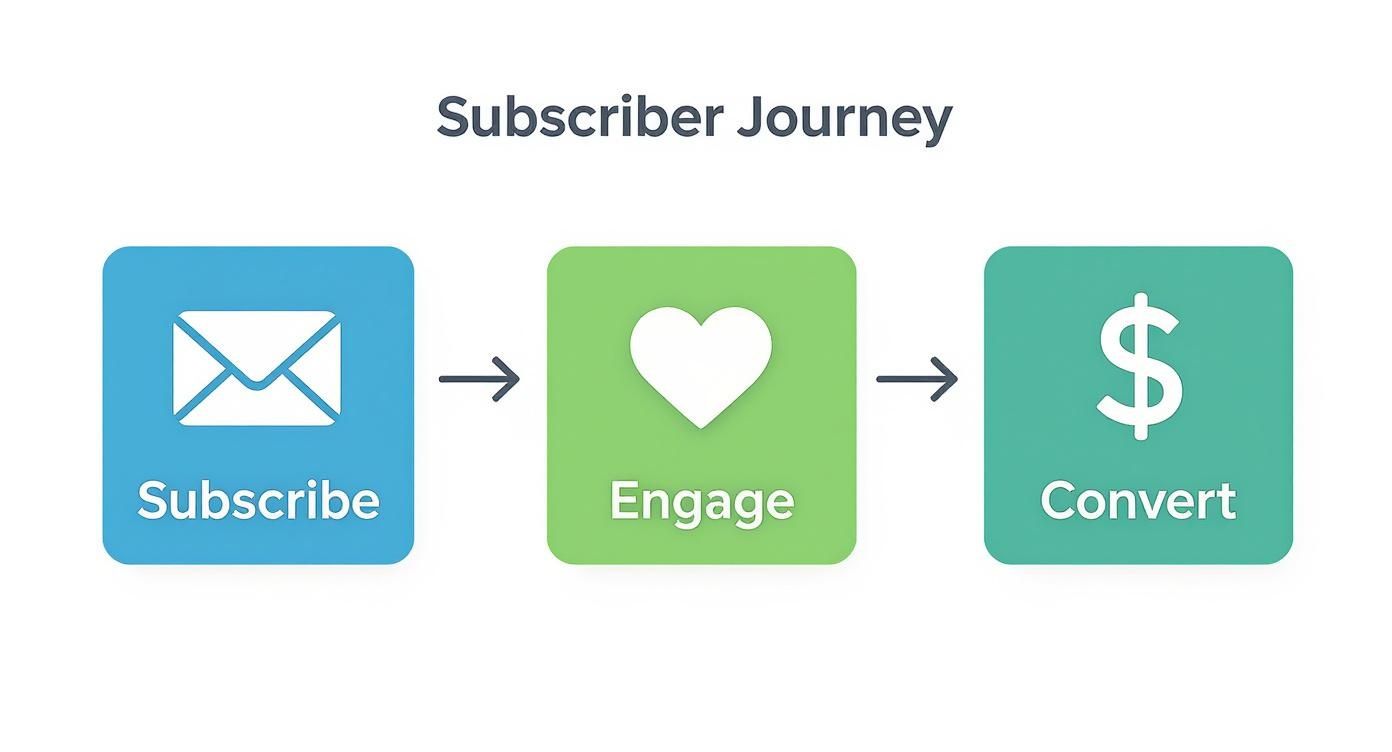
This simple flow shows you how the software follows a reader from the moment they find you to the moment they pull out their credit card, giving you clarity every step of the way.
Beyond Basic Email Analytics
Your email service provider gives you the basics. Those are often vanity metrics. But fulfillment tracking tells you the business story. It answers the questions that actually move the needle:
- Which articles are actually convincing people to pay?
- What’s the real lifetime value (LTV) of a subscriber who came from Twitter versus one who came from a guest post?
- Which of my loyal readers are showing signs they might cancel soon?
To really get why this is so important, it helps to understand the core idea of marketing attribution. If you’re not familiar, checking out a comprehensive guide to marketing attribution is a great starting point. It’s all about connecting your efforts to real-world results, which is exactly what these tools do for your newsletter.
The demand for this level of detail is exploding. The global market for email newsletter software hit USD 1.5 billion in 2024 and is expected to more than double to USD 3.2 billion by 2033. Why the huge jump? Because creators are finally realizing they need smarter tools to personalize their content and grow their business effectively.
Core Features That Drive Creator Growth

Let’s be honest, not all tracking tools are built the same. The best newsletter fulfillment tracking software goes way beyond just counting opens and clicks. It gives you the tools to turn your publication from a passion project into a real, sustainable business.
Think of it like this: your standard email analytics show you the size of the crowd, but these features introduce you to the individuals within it. You get to understand who your most loyal fans are, what they actually care about, and why some people eventually decide to leave.
Advanced Subscriber Segmentation
Segmentation is just a fancy word for grouping your audience based on what they do. Instead of seeing your list as one giant, anonymous blob, you can create super-specific groups like “Readers who clicked my affiliate links” or “Paid subscribers who’ve ignored the last three emails.”
Here’s a practical example. A food blogger could create a segment of free subscribers who have clicked on every single dessert recipe they’ve sent in the last two months. That is not just a random list; it’s a hot lead. The blogger can then send this group a targeted offer for a paid “Dessert Masters” recipe book and watch the conversion rate soar compared to a generic blast to their entire list.
Segmentation is what lets you stop broadcasting a message and start having a conversation. You’re tailoring your content and offers based on what specific groups have already told you they want through their actions.
Full Conversion and Payment Tracking
This is where the rubber meets the road. This feature connects the dots between your content, your email platform (like Substack or Beehiiv), and your payment processor, like Stripe. It paints the complete financial picture of your newsletter business, all in one place.
Effective software should answer these questions at a glance:
- Successful Payments: Who paid you this month, and exactly how much?
- Payment Failures: Which credit cards failed, and can you recover that revenue?
- Cancellations and Churn: Who canceled their subscription, and when did they do it?
Having this data in one dashboard is a total game-changer. Instead of just reacting to a dip in revenue at the end of the month, you can proactively see a payment failure, reach out to that subscriber, and save the subscription. To dig deeper, our guide on automated payment tracking for newsletters shows just how much time this process can save.
Churn and Retention Analysis
Getting a new subscriber feels great, but keeping the ones you have is how you build a stable business. Churn analysis features help you pinpoint why subscribers are leaving. The software can spot patterns you’d never see on your own, like a higher churn rate among subscribers who came from a specific marketing campaign.
Armed with this knowledge, you can build a real retention strategy. You might notice engagement tends to drop off after three months. That’s your cue to create an automated email that checks in with subscribers at the 90-day mark, maybe with a special piece of content or a quick survey. This is how you stop guessing and start making smart, data-backed decisions to keep your readers around for the long haul.
How Creators Use Tracking Software to Grow
Theory is one thing, but seeing how this software works in the real world is where it all clicks. The true power of newsletter fulfillment tracking comes alive when you see how creators use it to stop guessing and start making smart, data-backed decisions that actually grow their business.
It is all about finding the hidden opportunities buried within your subscriber list. Let’s look at a couple of real-world scenarios. This is not about staring at confusing dashboards; it’s about having a clear roadmap to sustainable growth.
Turning Engagement into Revenue
Imagine a food blogger with a popular weekly newsletter full of free recipes. She has a great open rate, consistently around 45%, but her digital product sales are completely flat. She’s thinking about launching a paid recipe club but has no idea who would actually sign up.
Using her tracking software, she creates a special segment of her most engaged free subscribers. These are the die-hards, the readers who have opened at least 8 of her last 10 emails and clicked on links to her more advanced recipe guides. Just like that, she has a list of 500 dedicated fans.
Instead of blasting her entire list with a generic launch announcement, she sends this specific group a targeted email campaign. The message feels personal, acknowledging their loyalty and offering them an exclusive early-bird discount for the new paid club. The result? A 15% conversion rate from that segment, which means 75 new paying members in the very first week. The data showed her exactly who was ready for more.
Preventing Churn Before It Happens
Now, let’s switch gears to a B2B publisher who runs a newsletter for marketing professionals. The paid tier is $20 a month for deep-dive industry analysis, so losing even a few subscribers each month hits the bottom line hard.
Their tracking software includes a “subscriber health” score, which quickly flags readers whose engagement is starting to drop. The tool spots a subscriber who hasn’t opened an email in three weeks, even though their payment is still active. This person is now officially “at risk” of churning.
The software allows the publisher to be proactive, not reactive. Instead of waiting for the cancellation email, they can step in and re-engage a reader who is clearly losing interest.
The publisher sets up a simple, automated workflow. The at-risk subscriber gets a personal-sounding email: “Hey, we’ve missed you! Here’s a link to our most popular report from last month.” That small, human touch is often all it takes to bring them back into the fold and save the account. This is a game-changer, especially since payment systems are usually the last point of contact. Having reliable insights from a tool with a solid Stripe integration for newsletter ads helps you get ahead of these problems before they happen.
By pinpointing churn risks and converting their most loyal free readers, creators are using newsletter fulfillment tracking software to build much stronger, more profitable publications. It is about making smarter decisions, one subscriber at a time.
How to Choose the Right Tracking Tool
Picking the right tracking software can feel overwhelming. There are a ton of options out there, all promising the world, and it’s easy to get bogged down in feature comparisons and buzzwords.
The secret is to tune out the noise. Do not get distracted by shiny objects. Instead, focus on a simple question: “Will this tool give me the answers I need to actually grow my newsletter?” You’re not looking for another dashboard to check; you’re looking for a partner that clarifies your path forward.
Start with Essential Integrations
Before you even glance at a pricing page, check the integrations. If a tool does not connect cleanly with the platforms you already rely on, it’s a non-starter. Manually exporting and importing spreadsheets is exactly the kind of time-wasting work you’re trying to eliminate.
Make a simple checklist. Does the software play nicely with your core setup?
- Your Newsletter Platform: Whether you’re on Substack, Beehiiv, ConvertKit, or something else, the connection needs to be seamless.
- Your Payment Processor: A rock-solid integration with Stripe is essential. This is how you’ll get accurate data on revenue, failed payments, and subscriber value without pulling your hair out.
- Your Sponsorship Tools: If you run ads, can it connect to your ad management system? For Substack writers, finding compatible Substack sponsor tracking tools is a particularly crucial step.
Evaluate Pricing and Scalability
Pricing for these tools is all over the map. You will see flat monthly fees, per-subscriber costs, and everything in between. The sticker price today is not the whole story.
The real question to ask is, “What will this cost me when my list grows from 1,000 to 50,000 subscribers?” A cheap plan might look great now, but if the price jumps dramatically as you succeed, you will be stuck migrating to a new tool down the road. Look for predictable pricing that scales fairly with your business.
Think of it this way: The right tool is an investment, not an expense. It should pay for itself by helping you reduce churn, convert more paid subscribers, and save you hours of manual work each week.
The market for these tools is exploding. It was valued at USD 3.25 billion in 2024 and is expected to reach USD 9.65 billion by 2035. This boom means more innovation and better options for us, but it also means you have to choose carefully. You can read the full research about this market growth to get a better sense of the landscape.
Prioritize Actionable Data and Support
At the end of the day, a pretty dashboard is worthless if the data does not lead to action. The software should make it painfully obvious what you need to do next.
Can you easily spot subscribers who are at risk of churning? Can you, in just a few clicks, create a segment of your most dedicated free readers to send a special offer to? If you cannot immediately see a clear action to take from the data, it’s just noise.
And do not forget about support. When you’re staring at a number that does not make sense, you need a quick, helpful answer from a real person. Check reviews and ask other creators about their experiences. Great support turns a piece of software into a true partner in your growth.
Measuring the ROI of Your Tracking Software
So, how do you know if your new software is actually paying for itself? The right tool should not just be another line item on your expense sheet. It should deliver a clear return on investment (ROI). To see that return, you have to look past vanity metrics like open rates and focus on the numbers that directly impact your bottom line.
To really measure what’s working, you need a solid grasp of the key email marketing performance metrics that signal growth. This is how you connect the dots between the software’s features and real financial gains.
Focusing on Business-Critical KPIs
The true value of your software shines through when you track specific Key Performance Indicators (KPIs). These are the metrics that tell the real story of your newsletter’s financial health.
Here are the big ones to watch:
- Subscriber Lifetime Value (LTV): This is the total revenue you can realistically expect from one subscriber over their entire time with you. Your software should help you see which acquisition channels are bringing in the most valuable readers.
- Churn Rate Reduction: This is simply the percentage of subscribers who leave. Even a small drop in churn can have a massive impact on your monthly recurring revenue.
- Free-to-Paid Conversion Rate: This shows how well you’re convincing free readers to become paying subscribers.
Let’s break it down. Say your software costs $50 per month. If it helps you reduce churn by just 2%, you might keep three paid subscribers who were about to leave, each paying $10 a month. That is $30 in saved revenue, meaning the tool has already paid for more than half its cost from that one improvement alone.
A Simple Formula for Calculating ROI
Figuring out your return does not require a complicated financial model. It just comes down to a basic understanding of what you’ve gained versus what you’ve spent.
Here is a simple way to think about it:
ROI = (Financial Gain from Software – Cost of Software) / Cost of Software
“Financial gain” can come from multiple places. Think retained subscriptions, new paid sign-ups, or even the time you save on manual, administrative work. For ad-based revenue, you can get a quick estimate using a free newsletter ad ROI calculator.
While the average email open rate hovered around 37.67% in 2024, what truly matters is monetization. Platforms like beehiiv prove this point perfectly. Their Ad Network has generated over $3.7 million for creators, and paid subscriptions have pulled in another $8.6 million. It’s a powerful reminder that the right setup turns engagement into real income.
Frequently Asked Questions
Getting into the weeds of new software can feel like a detour when your real job is creating content. Let’s clear up a few common questions that pop up for creators when they first look into fulfillment tracking.
Does This Software Work with Platforms Like Substack or Beehiiv?
Yes, absolutely. The best fulfillment tracking tools are built from the ground up to plug right into the popular newsletter platforms you’re already using. Think of this software as the missing link between your content platform (like Substack, Beehiiv, or ConvertKit) and your payment processor (Stripe).
This connection happens behind the scenes using something called an API, which just lets the two systems talk to each other automatically. This is how the tracking tool can pull in all your subscriber data and perfectly match it with payment info, giving you one central dashboard to see the whole picture. Before you choose a tool, just give its integrations page a quick look to make sure your setup is supported. The goal is a seamless connection that finally lets you say goodbye to exporting and importing spreadsheets for good.
Is This Software Only For Newsletters With Paid Subscriptions?
While it is a total game-changer for paid subscriptions, it delivers a ton of value for free newsletters, too. You do not need a single paying subscriber to benefit from smarter analytics.
For free publications, this software helps you understand reader engagement on a much deeper level than just opens and clicks. You get to see who your most dedicated readers are, which topics truly resonate, and how long they stick around. This kind of information is pure gold.
You can use these insights to:
- Pinpoint Your “Super Fans”: Easily identify and segment your most active readers. These are the people most likely to support you in other ways down the road.
- Cross-Promote with Confidence: Guide your most engaged free subscribers toward a digital product, a course, or a webinar you’re offering.
- Get Better Feedback: When you need input on a new idea, you can ask your most loyal readers. These are the ones who you know actually care about the direction you’re headed.
It helps you understand the true health and potential of your entire audience, not just the people who pay you.
The real shift here is moving from a broadcast mentality to a strategic one. You start to understand the unique behaviors and value of different reader segments, whether they pay you directly or not.
How Is This Different From My Regular Email Analytics?
This is a really important distinction. Your Email Service Provider (ESP), like Mailchimp or ConvertKit, gives you campaign-level data. It tells you how one specific email performed: its open rate, click-through rate, and who unsubscribed. It’s useful, but it’s just a snapshot in time.
Newsletter fulfillment tracking software provides subscriber-level and business-level data. It zooms out to look at the entire subscriber journey and connects their behavior directly to the financial health of your publication. It’s built to answer the bigger, more strategic questions your ESP just cannot touch.
For example, your ESP can tell you that Email A had a 42% open rate. Great. But your fulfillment software can tell you that subscribers who found you through a guest post have a Subscriber Lifetime Value (LTV) of $150, while those who came from a Twitter ad only have an LTV of $45. Now that is an insight you can act on, telling you exactly where to focus your growth efforts for the best results.
Put simply: your ESP tracks your emails. Fulfillment software tracks your business.
Ready to stop the spreadsheet chaos and automate your newsletter’s ad operations? Ad Slots handles sponsor tracking, invoicing, and scheduling, so you can focus on writing great content. Learn more and get started with Ad Slots today.