
Are you still manually copy-pasting ad creative into every single newsletter? It’s a tedious process. The entire routine of finding sponsors, hammering out deals, and slotting in the ads is slow, full of potential mistakes, and just plain exhausting.
There’s a much better way. Think of automated newsletter ad insertion as a self-stocking vending machine for your ad slots. It handles all the placement for you, so you can stop refilling the shelves by hand.
The End of Manual Ad Placement in Newsletters
For way too many creators, making money from their newsletter feels like a second full-time job. All those hours spent on ad operations are hours you cannot spend creating the amazing content that got you subscribers in the first place. This manual process is a massive roadblock to growth.
Just think about the typical workflow. You start by hunting for sponsors, then get stuck in endless email chains negotiating rates. Once you finally land a deal, you have to keep track of their creative, schedule the placement in some spreadsheet, and hope you remember to drop the right ad into the right issue. After all that? You still have to handle invoicing and chase down payments. It is a fragile system held together by sheer effort.
The True Cost of Manual Ad Management
The problem is not just about wasted time. Managing ads by hand creates real risks and lost opportunities that can seriously stunt your newsletter’s potential. Every minute you spend on admin is a minute you could have spent on things that actually grow your business, like writing better content or engaging with your audience.
Here is what that manual headache usually involves:
- Scattered Communication: Trying to manage ad creative, sponsor instructions, and insertion orders buried in dozens of different email threads and documents.
- Error-Prone Scheduling: Relying on spreadsheets and calendar reminders, where one simple mistake can mean a missed ad and an unhappy sponsor.
- Inconsistent Revenue: Manual sales cycles often lead to unsold inventory and an unpredictable income stream, making it impossible to plan for the future.
- Limited Scalability: Juggling three sponsors by hand might be doable. But ten? Or twenty? That is a logistical nightmare waiting to happen.
This is exactly why switching to automated ad insertion is so important. It is not just about being more efficient. It is about building a professional, scalable, and reliable way to make money from your work.
By automating the tedious parts of ad management, you turn your operations from a source of stress into a streamlined system. This frees you up to focus on creating value for your readers and growing your audience which, in turn, makes your ad slots even more valuable.
How Automated Ad Insertion Actually Works
So, what is really going on behind the scenes with automated ad insertion? It is not some kind of dark magic. Think of it as a super-efficient ad traffic controller for your newsletter. Instead of you manually hunting down advertisers and plugging in their creative, the system does all the heavy lifting for you, connecting your available ad slots with the right campaigns at the right time.
This technology completely does away with the old, clunky process that used to eat up so much of a creator’s time. No more endless email chains, negotiating rates, or manually pasting ad copy.
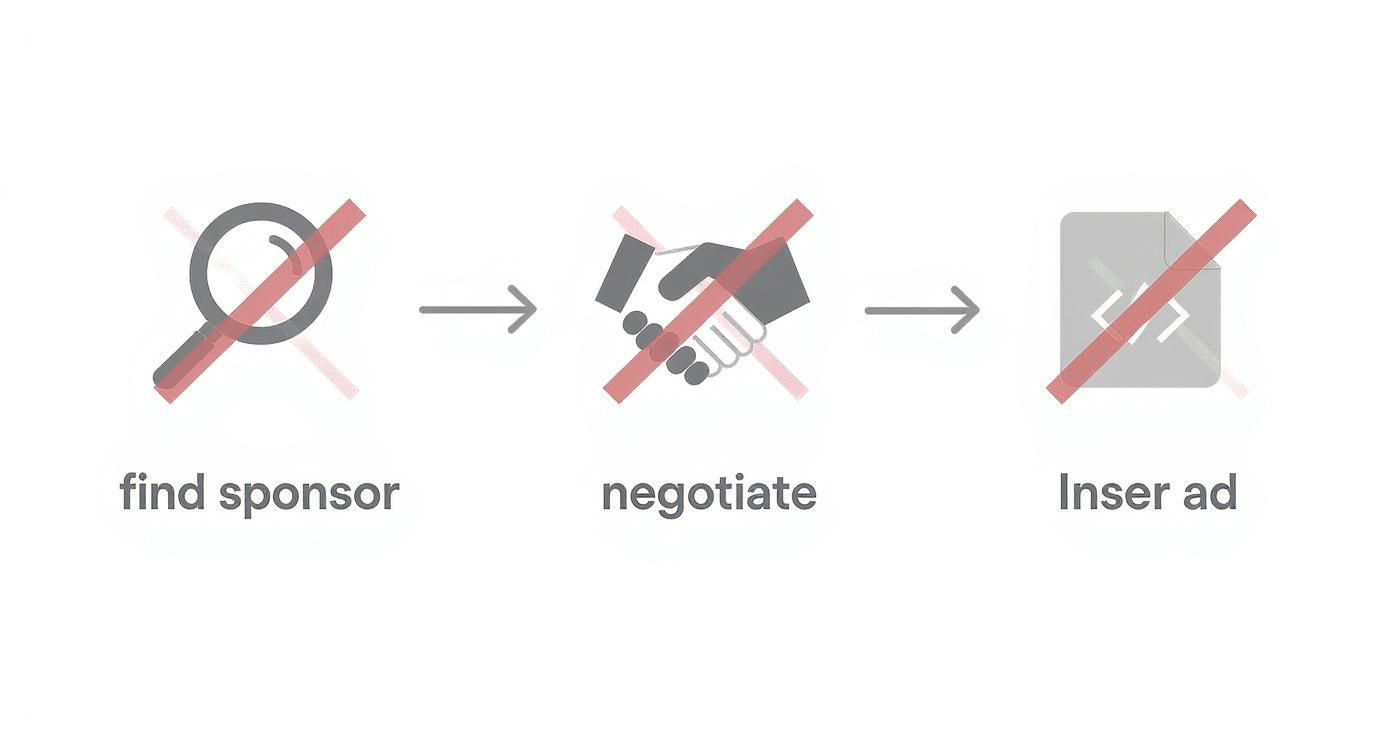
That old workflow was a serious bottleneck. It forced you to spend more time playing ad manager than creating the content your audience loves. An automated system simply removes those hurdles, giving you a straight shot to monetization.
The Core Technology Explained
At its core, automated ad insertion works using a simple piece of code, often called an ad tag or a snippet. You pop this little snippet into your newsletter template right where you want an ad to show up. It is a one-time setup.
From that point on, whenever a subscriber opens your email, that ad tag springs into action. It sends a request to an ad server, which instantly acts like a high-speed auctioneer, considering several factors you have already set up:
- Inventory Rules: What ad slots are actually open in this specific newsletter?
- Campaign Schedules: Which advertisers are supposed to be running their ads today?
- Targeting Criteria: Does this particular subscriber fit the profile an advertiser is trying to reach?
- Frequency Caps: Has this subscriber seen this specific ad enough times already?
Based on these rules, the server picks the perfect ad and beams it directly into the newsletter. This entire decision-making process happens in the blink of an eye, literally in the milliseconds it takes for the email to load on a subscriber’s screen.
From Ad Request to Ad Display
Let’s break down what this looks like in the real world, step-by-step.
- You Define Ad Slots: First, you go into a platform like AdSlots and mark the specific spots in your template where ads can run. This could be a top banner, a spot in the middle of your content, or even a small classifieds section at the bottom.
- Advertisers Book Slots: An advertiser comes along and books a campaign. They will set their budget, choose the dates they want their ad to run, and maybe specify the type of audience they are targeting.
- A Subscriber Opens Your Email: The moment a reader opens your newsletter, the ad tag sends out its signal to the ad server.
- The System Makes a Match: The server quickly looks at all the active campaigns, checks them against your placement rules, and picks a winner for that specific open.
- The Ad Appears: The winning ad’s creative is dynamically inserted right into the ad slot. Your reader sees a relevant, timely ad, and you did not have to lift a finger.
This dynamic insertion is what makes automated newsletter ad insertion such a game-changer. You can run dozens of campaigns from different advertisers in the very same ad slot, all without ever having to touch your newsletter template again.
This hands-off approach ensures your ad inventory is always working for you. It guarantees that every ad placement is optimized, scheduled correctly, and fulfilled without any manual oversight, turning your newsletter into a consistent revenue engine.
The financial results speak for themselves. The Beehiiv Ad Network, for example, has generated over $3.7 million for its publishers. That kind of success is built on the back of dynamically placing ads based on subscriber data, a task that would be simply impossible to manage by hand. You can dive deeper into these newsletter monetization trends to see just how powerful this can be.
Manual vs Automated Ad Insertion Workflow
To really appreciate the difference, let’s compare the old way of doing things with the new automated workflow. The table below breaks down the tasks involved, and it quickly becomes clear how much time and effort you save.
| Task | Manual Process | Automated Process |
|---|---|---|
| Finding Sponsors | Hours of cold outreach, networking, and prospecting | Sponsors find you and book through a self-serve portal |
| Negotiating | Back-and-forth emails on rates, dates, and terms | Pre-set rates and availability; automated booking |
| Invoicing | Manually creating and sending invoices, then chasing payments | System handles invoicing and payment processing automatically |
| Ad Creative | Manually collecting and approving ad copy and images | Advertisers upload creative directly to the platform |
| Implementation | Copying and pasting HTML/text into the email template | A single ad tag is placed in the template one time |
| Scheduling | Using spreadsheets to track who runs on what date | The platform manages all campaign scheduling automatically |
| Reporting | Manually tracking clicks/views and compiling reports | Real-time dashboards provide performance data for you and the advertiser |
As you can see, automation does not just save a little time here and there. It completely removes entire categories of tedious, administrative work from your plate. This frees you up to focus on what you do best: creating great content.
Unlocking Real Revenue Growth for Your Newsletter
Switching to automated ad insertion is not just about winning back a few hours each week. Think of it as a strategic upgrade for your newsletter’s financial engine. The benefits go way beyond simple efficiency. They create a direct path to real, sustainable revenue growth.
One of the biggest headaches for creators is unsold inventory. Hunting for sponsors manually almost always leaves empty ad slots, which is basically leaving money on the table with every email you send. Automation completely flips that script. It connects you to a much wider pool of advertisers, which can dramatically increase your ad fill rates.
When every ad slot is consistently sold, your income becomes more reliable and robust. More advertisers competing for your audience’s attention also means you can finally start charging what your inventory is actually worth.
Better Ads and a Happier Audience
You might worry that more ads will annoy your subscribers. But when done right, the opposite is often true. Automated systems are fantastic at targeting, making sure the ads your readers see are actually relevant to their interests. Instead of a generic, one-size-fits-all ad, your audience gets promotions that feel more like helpful recommendations.
This relevance leads to incredible engagement. For example, research from Mailchimp shows that personalized and segmented email campaigns can boost click-through rates by as much as 100%. Good advertising, when targeted properly, can enhance the reader experience, not detract from it.
A better ad experience creates a powerful feedback loop: your subscribers are more engaged, which makes your ad slots more valuable to sponsors. Higher value attracts better advertisers, leading to even more relevant content for your audience.
This boost in quality is a key driver for long-term growth. To really maximize your newsletter’s potential, you should also explore other proven strategies to make money with a newsletter that can complement your automated ad efforts.
The ROI of Automation in Action
Let’s run some numbers for a real-world example. Imagine your newsletter has 25,000 subscribers and a solid 40% open rate, giving you about 10,000 opens per issue.
Manual Scenario: You spend hours finding one primary sponsor a month who pays a flat $1,000. You also manage to sell two smaller classified ads for $250 each. Your total monthly revenue is $1,500, but it costs you a ton of time in outreach, negotiation, and manual placement.
Automated Scenario: With automated ad insertion, you can fill your primary ad slot dynamically in every single issue. Let’s use a common CPM (cost per 1,000 opens) of $25. If you send weekly, that’s $250 per issue from just your primary slot.
Here is how that stacks up over a month.
| Metric | Manual Sponsorship | Automated Ad Insertion |
|---|---|---|
| Subscribers | 25,000 | 25,000 |
| Opens per Issue | 10,000 | 10,000 |
| Primary Ad Revenue | $1,000 (flat monthly fee) | $1,000 (from 4 weekly issues @ $250/issue) |
| Classified Ad Revenue | $500 (flat monthly fee) | $400 (from 4 weekly issues @ $100/issue) |
| Total Monthly Revenue | $1,500 | $1,400 |
At first glance, it might seem like the manual approach wins. But this simple calculation misses two huge factors: the massive reduction in your workload and the ability to scale. The automated system also handles all the invoicing and payouts, which is another huge time-suck eliminated. We have got a whole guide on how to streamline your invoicing with Stripe integration for newsletter ads if you want to dive deeper.
The real ROI is not just about the dollar amount. It is about transforming your ad operations from a frustrating bottleneck into a scalable, hands-off system. With automation, you are not just earning from each send. You are building a proper business model that can grow with your audience without burning you out.
Setting Up Your Automated Ad System Step by Step
Alright, let’s get practical. You have seen what automation can do, but how do you actually build it? This section is your playbook for getting an automated newsletter ad insertion system up and running. It might sound a bit technical, but it is really just a series of logical steps.
We will walk through picking the right platform, mapping out your ad inventory, setting the rules, and getting paid. The whole point is to make this process feel less like a chore and more like an exciting upgrade for your business.
Choosing Your Platform
First things first: you need the right tool for the job. This is probably the most important decision you will make. Your choice really boils down to your email service provider (ESP), how comfortable you are with new tech, and what you need the system to do.
You have a few main options here:
- All-in-One ESPs: Some platforms, like beehiiv, have their own ad networks built right in. This is often the simplest route because everything is already integrated, meaning less setup for you. If you are already on one of these, it is a no-brainer to check it out first.
- Third-Party Ad Management Tools: This is where a dedicated tool like AdSlots comes in. It is designed to plug into pretty much any ESP you use. This gives you one central dashboard to manage direct-sold sponsorships, automate scheduling, and handle invoicing. It is a lifesaver if you are drowning in spreadsheets.
- Ad Networks: Services like Paved connect you to a huge marketplace of advertisers. This is a great way to fill any unsold ad slots without having to do the sales outreach yourself.
A lot of successful creators actually use a hybrid model. They manage their premium, direct-sold ads with a tool like AdSlots and then let an ad network fill in any leftover inventory. To see how these can work together, it is worth exploring a dedicated beehiiv ad management integration to see how it can add more power than the native tools alone.
Defining Your Ad Inventory
Once you have your platform picked out, you need to decide what you are actually selling. This just means mapping out the specific ad slots, your ad inventory, available in your newsletter. Think of it like creating a menu for potential advertisers.
Start by looking at your newsletter template and identifying the prime real estate. Common ad slots include:
- Primary Sponsorship: This is your marquee spot, usually placed right at the top “above the fold.” It is what everyone sees first and fetches the highest price, with CPMs typically landing between $15 to $30 per 1,000 opens.
- Mid-Article Slot: An ad placed somewhere in the middle of your content. This is a fantastic spot for advertisers who want to catch readers when they are most engaged with what you have to say.
- Classifieds Section: Usually a simple text-link ad tucked away at the bottom. It is a budget-friendly option, perfect for smaller advertisers or even your own affiliate promotions.
Inside your chosen ad platform, you will create these slots, giving each a name, a description, and a price tag. This becomes the digital inventory that advertisers can browse and book.
This diagram shows how a platform takes those ad slots you just defined and handles the entire process automatically.
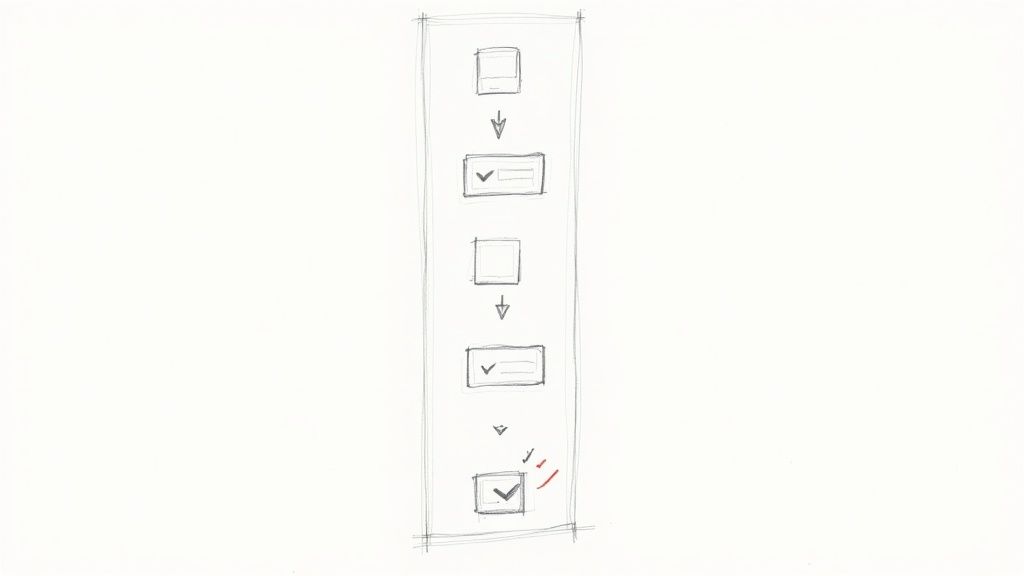
The system is the connective tissue between your ad inventory, your calendar, and your bank account, creating a smooth journey from booking to payout.
Setting Up Placement Rules and Targeting
This is where you take back control. You get to tell the system how and when to run ads. You are the editor-in-chief, setting the ground rules to make sure the automation works for you, not the other way around.
Your rules are what protect the reader experience. By controlling what ads appear and who sees them, you maintain the trust you have built with your audience, and that is your most valuable asset.
Here are a few of the key settings you will be in charge of:
- Scheduling: You define the calendar. Block out dates you do not want ads to run, or set specific start and end times for every sponsorship.
- Frequency Capping: Nobody likes being spammed. This lets you limit how many times a single subscriber sees the same ad, keeping your readers happy.
- Approval Workflows: This is your quality control. Set up a quick review process to approve all ad creative before it goes live. It is a simple step to make sure every ad feels right for your brand.
The last piece of the puzzle is connecting your payment provider, like Stripe, to the platform. This automates the best part of the whole process: getting paid. When an advertiser books a slot, the system can fire off an invoice and process the payment automatically. The money just shows up in your account. No more chasing down payments or sending awkward “just following up” emails.
Getting the Most Out of Your Ad Revenue
Flipping the switch on an automated ad system is a great first step. But to really make it work for you, you need to be smart about it. Think of it less as a tool and more as a strategy.
These tips will help you do just that. It is all about finding that sweet spot where you are making good money without annoying the readers who make it all possible.
Put Your Ads Where People Will Actually See Them
This might sound obvious, but ad placement can make or break a campaign. It is tempting to just squeeze ads in wherever they will fit, but a little bit of strategy goes a long way. The idea is to get maximum visibility without wrecking the reading experience.
Here are the three placements that consistently perform the best:
- Primary Sponsorship: This is your prime real estate. It sits right at the top, often just below your intro. It is the first thing people see and, because of that, it is your most valuable ad slot.
- Mid-Article Slot: Tucking an ad into the main body of your content is a clever move. Your reader is already hooked and engaged, so the ad feels less like an interruption and more like a natural part of the flow.
- Classifieds Section: Think of this as a simple, text-based section at the end of your newsletter. It is perfect for smaller advertisers who want to get their feet wet, and it is an easy way for you to sell leftover space and boost your overall revenue.
By offering a mix of these options, you open the door to advertisers with different budgets and goals. That means you are more likely to sell out your inventory every single time.
Price Your Ad Slots Like a Pro
Pricing is a delicate dance. Price too high, and you will scare off sponsors. Price too low, and you are leaving cash on the table. So, where do you start? A good first step is to check out what others are charging.
A common benchmark for a primary sponsorship slot is a CPM (cost per 1,000 opens) between $15 and $30. So, if your newsletter gets around 5,000 opens, you could reasonably charge between $75 and $150 for that top spot.
Of course, this is not a hard-and-fast rule. If you have a super-niche B2B audience, you can likely charge a lot more. The key is to start with a benchmark, gather performance data, and adjust your rates to reflect the real value you are providing. For a much deeper look at this, our guide on newsletter advertising best practices breaks down pricing models in detail.
Test Everything, Then Test Again
The biggest mistake you can make is to “set it and forget it.” The most successful creators are always tinkering. Your ad platform’s analytics dashboard is your best friend here. It tells you exactly what is working and what is falling flat.
You do not need to run complicated experiments. Start with simple A/B tests:
- Format: Does a simple text link get more clicks than a flashy banner in your classifieds?
- Placement: What happens if you move that mid-article ad from after the first paragraph to after the third?
- Call to Action: Try testing “Learn More” against “Get Your Discount.” You might be surprised by what resonates with your audience.
These small, data-driven tweaks really add up over time, leading to serious growth in your ad revenue. And remember, none of this matters if your emails do not land in the inbox. Following essential email deliverability best practices ensures your subscribers (and your ads) actually get seen.
How to Know If Your Ads Are Actually Working
You have set up an automated ad system, which is a huge win. But the real question is, is it actually making you more money and saving you time? To figure that out, you need to track the right numbers. Staring at a dashboard full of data without knowing what it all means is like trying to navigate a ship without a compass.
This is where Key Performance Indicators (KPIs) come in. Let’s break down the essential metrics that tell you the true story of your newsletter’s ad performance, helping you make smarter decisions that directly impact your revenue.
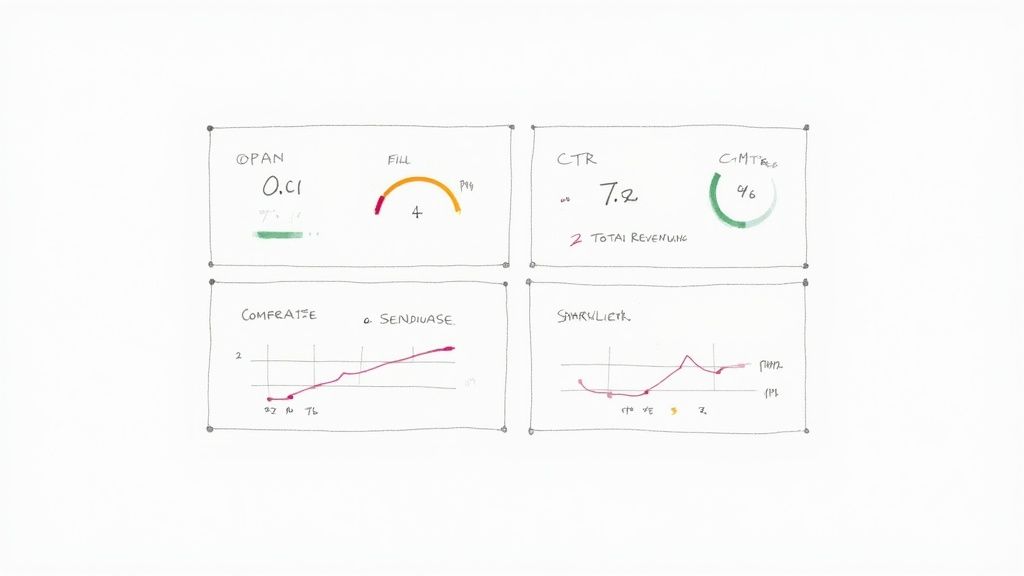
The Core Metrics You Can’t Ignore
Your analytics dashboard is packed with data, but you do not need to track everything. Focusing on a handful of core metrics will give you a crystal-clear picture of what is working without getting lost in the weeds.
These are the numbers that really move the needle:
Fill Rate: This is simply the percentage of ad slots you had available that you successfully sold. A 100% fill rate is the goal. It means you did not leave any money on the table and monetized every opportunity.
CPM (Cost Per Mille): This classic advertising metric stands for “cost per thousand impressions.” In the newsletter world, that usually means opens. It shows you what sponsors are willing to pay for every 1,000 subscribers who see their ad. A higher CPM signals your audience is highly valued.
CTR (Click-Through Rate): CTR tells you what percentage of your readers clicked on an ad. A strong CTR is a powerful signal to sponsors that your audience is engaged and the ads are relevant. It is proof that their message is landing.
Total Ad Revenue: This is the big one, the total income you have generated from ads over a set time. It is your ultimate measure of success and helps you spot growth trends and forecast what is ahead. Keeping this clear is much easier with tools that provide automated payment tracking for newsletters.
To help you keep these straight, here is a quick-reference guide to the essential metrics for tracking the success of your automated ad insertion strategy.
Key Performance Indicators for Ad Monetization
| KPI | What It Measures | Why It’s Important |
|---|---|---|
| Fill Rate | The percentage of available ad slots filled with paid ads. | Shows how effectively you are selling your inventory. A low rate means missed revenue opportunities. |
| CPM | The average cost an advertiser pays for one thousand views or impressions of an ad. | Indicates the value of your ad inventory. A higher CPM means you can charge more. |
| CTR | The percentage of subscribers who clicked on an ad after seeing it. | Measures ad relevance and audience engagement. High CTR attracts and retains sponsors. |
| Total Ad Revenue | The total income generated from all ad placements over a period. | The ultimate bottom-line metric for tracking growth and the financial health of your newsletter. |
Tracking these KPIs consistently will give you the insights needed to fine-tune your ad strategy and maximize your earnings.
How Do Your Numbers Stack Up?
Knowing your own stats is great, but the real magic happens when you see how they compare to others in the industry. Context is everything.
While rates vary wildly depending on your niche, a typical CPM for a main sponsorship slot often falls between $15 and $30. If your CPM is way below that, it could be a sign you need to adjust your pricing or work on boosting reader engagement.
A good CTR proves to advertisers they are getting real value for their money. If your click rates are consistently in the basement, it might be time to rethink your ad placements or even the kind of sponsors you partner with. Think of these benchmarks as a guide, not a rulebook, to help you spot opportunities for growth.
Got Questions About Automating Your Ads?
Making a change to how you run your business always brings up questions. And when it comes to your newsletter’s revenue, you want to be sure you are making the right call. Let’s walk through some of the most common worries creators have about automated newsletter ad insertion.
My goal here is to give you straight, clear answers so you can figure out if this is the right move for you.
Will I Lose Control Over the Ads in My Newsletter?
This is the big one, is it not? The short answer is a hard no. Any good ad platform is built to put you in the driver’s seat, not the other way around. The automation is there to handle the tedious logistics, not to make creative or brand decisions for you.
You are still the boss, and here is how:
- Approval Queues: Most systems let you see and approve every single ad creative before it ever gets near your newsletter. This is your chance to make sure every sponsorship fits your brand’s voice and what your readers expect.
- Blocklists: You can easily create lists of competitors, brands, or entire ad categories you want nothing to do with. This gives you complete control over brand safety.
Think of it like this: the system is your new operations manager, handling all the scheduling and placement grunt work. You, however, remain the editor-in-chief with final say.
How Much Can I Realistically Earn?
Okay, let’s talk money. What you can earn really boils down to a few key things: the size of your audience, how engaged they are, and the niche you are in. A highly engaged newsletter for a specific, profitable audience (think finance, B2B tech, or health) is naturally going to fetch a higher price per ad.
To give you a ballpark, a primary sponsorship slot often pulls a CPM (cost per thousand impressions) between $15 and $30. So, if your newsletter gets 5,000 opens each issue, you could be looking at $75 to $150 for that one top ad spot. The real magic happens when you start consistently filling that spot, which is exactly what an automated system helps you do.
Is It a Pain to Set Up an Automated Ad System?
Thankfully, no. Modern ad platforms are designed for creators, not developers. The whole process is usually surprisingly simple.
You will typically get a small snippet of HTML code, often called an ad tag, that you paste into your email template one time. That is it. This little piece of code does all the heavy lifting, fetching the correct ad from the server the moment a subscriber opens your email.
If you are using a platform with its own ad network, like beehiiv, it is often even easier. As long as your email service lets you pop in a bit of custom HTML, you will be up and running in no time.
Ready to ditch the spreadsheets and build an ad system that actually scales with you? Ad Slots automates everything from booking and scheduling to invoicing and payments, freeing you up to focus on what you’re best at: creating amazing content. See how AdSlots can streamline your ad operations today.