
So, what exactly is a newsletter sponsor CRM?
Simply put, it’s a dedicated system built to manage your entire sponsorship business from start to finish. It takes you from tracking potential leads and managing your ad calendar all the way to getting paid. It’s the difference between running your ad sales out of a messy garage and operating a clean, organized, professional warehouse.
Why Your Spreadsheet Is Costing You Sponsorships
If you’re using a spreadsheet to manage sponsorships, you’re in good company. It’s where most of us start. But as your newsletter gains traction, that once-helpful spreadsheet starts to work against you, silently becoming the biggest bottleneck in your business.
A disorganized sales process is a surefire way to lose money. A forgotten follow-up email, a missed invoice, an accidental double-booking of a prime ad slot, each little slip-up chips away at your credibility and your revenue.
The Real Cost of Manual Tracking
The problem goes deeper than just a few mistakes. It’s about the countless hours you spend on administrative busywork. That is time that could be spent creating amazing content or pitching new sponsors. This manual chaos is a quiet killer of your revenue potential.
And it’s a surprisingly common problem. A survey from HubSpot found that a staggering 40% of salespeople still use spreadsheets and email to store vital customer data. It’s a clear sign that creators and businesses everywhere are struggling with outdated systems.
A spreadsheet creates version chaos and silos. Workflows sit outside the file, and renewals rely on hand-compiled ‘evidence’ instead of reliable data. No one trusts them anymore.
From Disorganized Sales to a Streamlined System
Now, picture this: a system where you can see every available ad slot on a single calendar, fire off a professional proposal in minutes, and automatically track payments without having to chase anyone down. That’s what a newsletter sponsor CRM delivers. It brings much-needed order to the whole operation.
This isn’t just about getting organized. It’s about shifting from a reactive sales process to a proactive one. You stop just managing deals and start building a predictable, scalable sponsorship business. For creators on platforms like Substack, finding the right system is a game-changer. You can find more specific advice in our guide on Substack sponsor tracking tools.
A purpose-built CRM helps you:
- Keep all sponsor conversations in one place, so no lead ever falls through the cracks.
- Visually manage your ad inventory, which helps you avoid embarrassing and costly booking errors.
- Automate invoicing and payment reminders, so you get paid on time, every time.
Ultimately, making the switch is the first real step toward treating your newsletter like the serious business it is. It turns your sponsorship operations from a constant source of stress into a powerful engine for growth.
When a Generic CRM Fails Your Newsletter
Lots of creators start out by grabbing a well-known CRM like Salesforce or HubSpot. It makes sense on the surface since these are powerful, popular tools. But it’s a move that almost always ends in a headache because these platforms are built for a totally different sales world.
Think of it this way: you wouldn’t bring a construction worker’s hammer and saw to fix a Swiss watch. Both are toolkits, sure, but one is designed for brute force and the other for precision. A generic CRM is that heavy-duty toolkit. It is incredibly powerful, but far too clumsy for the delicate, time-sensitive work of selling newsletter ads.
Where Standard Sales Pipelines Break Down
The fundamental problem is that generic CRMs are built to sell products and services, not time-sensitive ad inventory. Their entire structure is based on a straight line: a lead becomes a customer and buys a thing. Done. But newsletter sponsorships are a different beast entirely.
This mismatch creates chaos right away. For example, a standard CRM will mark a deal as “Closed-Won.” Simple, right? But what if that “win” is a single deal for six ad slots scattered over the next three months? The system just sees one transaction, leaving you to figure out how to track the rest.
“Generic CRMs are built around a one-to-one sales model: customer buys product. Newsletter sales are one-to-many: a sponsor buys access to an audience across multiple points in time. This fundamental difference is where spreadsheets and generic tools begin to fall apart.”
The workflow just doesn’t line up. You quickly find yourself inventing weird workarounds with custom fields that never quite work. Or worse, you end up exporting everything back into a spreadsheet just to get a clear picture of your available ad slots. You end up fighting your software instead of having it work for you.
Specific Friction Points You Will Face
When you try to shoehorn your ad sales process into a generic CRM, you’ll hit a few predictable walls that waste your time and can even cost you revenue.
- Inventory Blindness: A standard CRM has no idea what an ad calendar is. It can’t tell you the first week of June is sold out but the third week is wide open. This lack of inventory awareness is a disaster waiting to happen, leading to double-booking prime slots or leaving money on the table because you think you’re sold out when you aren’t.
- Complex Deal Tracking: What happens when a sponsor buys a package of four ads? In a generic CRM, you either create four separate deals which makes your pipeline a mess, or you create one big deal that gives you zero visibility into the fulfillment dates for each individual ad.
- The Creative Asset Chase: The job isn’t over once the invoice is paid. You still need to wrangle ad copy, images, and tracking links from the sponsor, often involving a few rounds of feedback. Generic CRMs have no features for this, so you’re stuck managing the entire creative approval process in endless email chains.
At the end of the day, these systems are great at tracking relationships. But they completely fail at managing the actual product you’re selling: your ad space. This disconnect forces you right back to the manual tracking and spreadsheets you were trying to escape in the first place.
The Must-Have Features for a Newsletter Sponsor CRM
When you start shopping for a sponsor CRM, you’ll be hit with a wave of platforms all claiming to be the perfect solution. But here’s the thing: most CRMs are built for selling software or widgets, not newsletter ads. To avoid getting stuck with a generic tool that doesn’t fit, you need to know exactly what to look for.
The right features take you beyond just keeping a list of contacts. They turn your CRM into an active command center for your entire ad sales operation. You get the tools to sell time-sensitive inventory, stop embarrassing mistakes before they happen, and see a clear picture of your revenue pipeline. Without them, you’re just paying for a glorified spreadsheet.
The global CRM market is expected to rocket past $112 billion in 2025, but for newsletter creators, just having a CRM isn’t enough. You need one with the right DNA for publishing. For more on this trend, you can check out the CRM market on kixie.com.
A Visual Ad Inventory Calendar
Let’s be honest, this is the big one. A visual ad calendar is your mission control. It gives you a bird’s-eye view of every ad slot in every upcoming issue. In an instant, you can see what’s booked, what’s available, and what’s on a soft hold for a potential sponsor.
Think about it: with one glance, you can see that the main slot for the first week of May is taken. Just like that, you’ve avoided the dreaded double-booking. That is one of the most common and painful mistakes people make when managing sales in a spreadsheet.
Automated Proposal Generation
Picture this: a sponsor emails you asking for rates and availability in July. The old way involves digging through your spreadsheet, guessing which dates are free, and manually typing up an email. The right CRM, on the other hand, can create a professional proposal in just a few clicks.
The system should automatically pull real-time availability from your ad calendar, grab your latest rates, and wrap it all up in a slick, professional document. This isn’t just about saving time. It’s about looking like a pro and closing the deal while your competition is still typing. A complete newsletter ad management software will have this built right in.
A Centralized Sponsor Database
Your relationships with sponsors are your business’s lifeblood. A true sponsor CRM gives you one central place to track every single interaction, from the first cold email to the results of their last campaign. This history is pure gold.
A strong sponsor database does more than just store contact information. It tells you a story about each partner: what they bought, when they bought it, how their campaigns performed, and when it’s time to reach out about a renewal.
It’s not just about tracking deals, either. The best systems include powerful contact management features, like you’d find in leading contact management software options. This lets you personalize your outreach, spot your most valuable partners, and focus your energy where it will have the biggest impact.
Your Sponsorship Sales Workflow in Action
It’s one thing to talk about theory, but it’s another to see a smooth sales process in action. Let’s walk through a deal from start to finish to see how a dedicated sponsor CRM can completely change the game. We’ll follow a fictional weekly tech newsletter, “The Byte Size.”
The Byte Size is a small operation, just a two-person team. But they’re juggling dozens of sponsors a month, so efficiency isn’t just a nice-to-have. It’s essential for their survival. Here’s how they turn a simple inquiry into a paid campaign without getting bogged down in busywork.
Stage 1: The Initial Inquiry and Proposal
An email pops up. It’s an inbound lead from a SaaS company called “Innovate AI.” Instead of starting the old, familiar scramble through spreadsheets, the CRM instantly creates a new lead profile for them. The sales lead at The Byte Size can see the entire conversation history, just the first email, for now, and immediately tag the lead.
Innovate AI wants to book two main sponsor slots next quarter. The Byte Size’s sales lead pulls up the CRM’s visual ad calendar. They can see at a glance that the first week of the month is wide open, but the third week is already taken. In less than a minute, they’ve generated a clean, professional proposal.
This isn’t a generic template. The proposal automatically includes:
- The exact available dates, pulled straight from the live inventory calendar.
- The correct ad rates for the “main sponsor” package they asked about.
- A simple link for Innovate AI to click and accept the offer.
What used to be a 30-minute manual task of checking calendars, finding rates, writing emails is now done in under five minutes.
Stage 2: Securing the Deal and Collecting Assets
Innovate AI loves the offer and accepts. The moment they click “accept,” the CRM kicks into gear. It automatically flips those two dates to “sold” on the public ad calendar, which means no more accidental double-bookings. The system then generates the contract and invoice and fires them off to the sponsor.
A dedicated system also means you can get paid much faster. Check out our guide on the benefits of a Stripe integration for newsletter ads to see how seamless this can be. Once Innovate AI pays the invoice, the CRM follows up with an automated request for their creative assets, like ad copy and images.
This diagram breaks down the core features that make this kind of smooth workflow possible.

A visual calendar, automated proposals, and a complete sponsor history, these are really the three pillars of an efficient sales operation.
Stage 3: From Campaign to Final Report
The ads go live on the scheduled dates. After each newsletter issue is sent, The Byte Size team plugs the performance stats, open rates, clicks, etc., directly into Innovate AI’s profile in the CRM. This builds an invaluable historical record for any future conversations.
Once the campaign wraps up, the CRM helps compile a performance report using all the data they’ve tracked. This professional summary doesn’t just show the sponsor their ROI. It perfectly sets the stage for a renewal pitch. Just like that, The Byte Size has turned a cold inquiry into a happy partner. Now they have all the data they need to lock in the next campaign with minimal effort.
How to Measure Your Sponsorship Success
A great newsletter sponsor CRM does a lot more than just keep your sales process tidy. Its real magic is the clarity it gives you. When you start tracking the right numbers, you stop guessing what works and start knowing exactly what makes you money.
Forget about vanity metrics like how many cold emails you fired off last week. We need to focus on the key performance indicators (KPIs) that actually affect your bank account. These are the numbers that paint a clear picture of your sponsorship business’s health and potential for growth.
When you have a handle on these KPIs, your decisions get a whole lot smarter. You can pinpoint your best sponsors, know precisely when to raise your ad rates, and even forecast your future revenue with confidence.
Go Beyond Surface Level Metrics
To really get what’s happening in your business, you have to measure the entire sales journey from start to finish. A good sponsor CRM should give you a dashboard that puts all these critical insights right in front of you.
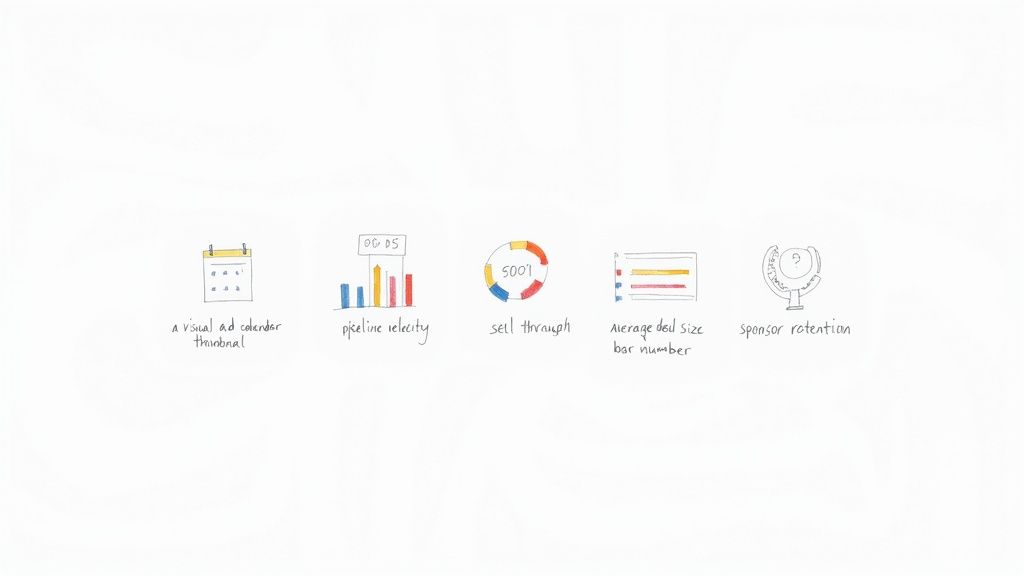
Here are the metrics that truly matter:
- Sales Pipeline Velocity: How fast does a new lead turn into a paying sponsor? For example, The Milk Road newsletter reportedly aims to close new sponsorship deals in under 14 days to keep their pipeline moving.
- Ad Inventory Sell-Through Rate: This is the percentage of your available ad slots you actually sell. A high sell-through rate, like Morning Brew’s reported 90%+, is a fantastic indicator of strong demand.
- Average Deal Size: Knowing the average value of each sponsorship deal tells you what a new partner is worth. If you track this over time, you can see if you’re getting better at selling bigger, more valuable packages.
- Sponsor Retention Rate: What percentage of your sponsors come back for more? High retention, with some top-tier newsletters seeing rates over 60%, is the ultimate sign of happy partners and a sustainable business.
These numbers aren’t just for show. They connect directly to revenue. Think about it: a 2021 Litmus report found that every dollar spent on email marketing can generate an ROI of up to $36. This is the kind of data that proves to sponsors that your well-managed campaigns get real results.
Turning Data into Actionable Insights
Your CRM shouldn’t just be a digital filing cabinet for data. It needs to be a growth engine. Once you start analyzing these KPIs, you can make strategic moves that directly boost your sponsorship revenue.
For example, a low sell-through rate might be a nudge to tweak your pricing or ramp up your outreach. On the flip side, a consistently high retention rate is a huge green light. It means your current sponsors are thrilled, making it the perfect time to ask for a testimonial or a referral. The payoff from these small, data-backed decisions can be huge, which is a core part of maximizing your marketing automation ROI.
Ultimately, measuring success is all about creating a feedback loop. Your CRM gathers the data, you pull out the insights, and then you make smart changes to your strategy. This cycle is what separates a good newsletter from a great business. And with the right systems in place, like automated payment tracking for newsletters, you can spend less time chasing invoices and more time focused on that big picture.
How to Choose the Right Sponsor CRM
Picking a new tool for your business can feel like a huge task. But when it comes to a sponsor CRM for your newsletter, it doesn’t have to be.
The secret is to tune out the marketing hype and ask one simple question: does this tool actually solve the problems a publisher like me faces every day?
So many creators fall into the trap of trying to jury-rig a generic sales CRM to manage their ad inventory. It’s like trying to turn a screw with a hammer. Sure, you might get it in there eventually, but you’ll waste a ton of time and probably make a mess. A platform built specifically for newsletter sponsorships is designed around your exact workflow from the very beginning.
The Publisher-Focused Checklist
As you start looking at different options, use this checklist to cut through the noise. This isn’t just about features. It’s a way to figure out if a platform truly gets the world you operate in.
Is it Actually Built for Publishers? Look for features that scream “newsletter.” Does it have a visual ad calendar to see your inventory at a glance, or is it basically just a fancy contact list? You’re selling time-sensitive ad space, not widgets from a warehouse, and your tools need to reflect that.
Does it Play Nice with Your Other Tools? How smoothly does it connect to your email service provider, like Beehiiv or Substack? What about your payment processor, like Stripe? Solid integrations mean less time spent on mind-numbing manual data entry.
Is the Pricing Model Fair? A good pricing plan should scale as you do. Be very wary of platforms that charge per contact or subscriber, as those costs can balloon quickly as your audience grows.
How Long Will it Take to Learn? You’re a creator, not a full-time software administrator. The right tool should feel intuitive. You should be able to get it up and running in a day, not spend a week buried in tutorials.
A great newsletter sponsor CRM shouldn’t force you to change your entire business to fit its software. It should adapt to your workflow and automate the tedious parts, giving you more time to create content and build relationships with sponsors.
Choosing the right platform is one of the most important decisions you’ll make when turning your newsletter into a real, scalable business. Ask these questions, prioritize a publisher-first solution, and you’ll find a tool that feels more like a partner in your success than just another item on your to-do list.
Still Have Questions? Let’s Clear Things Up
Jumping into a new system always brings up a few questions. It’s completely normal. Let’s tackle some of the most common ones we hear from creators thinking about a newsletter sponsor CRM.
Can I Just Use a Generic CRM like HubSpot?
Technically, yes, you could try to make it work. But honestly, it’s like trying to fit a square peg in a round hole. Generic CRMs are fantastic for what they do, but they weren’t built to manage ad inventory or track availability for specific dates.
A purpose-built sponsor CRM understands that you’re not just selling a product. You’re selling time-sensitive ad slots. This specialized focus saves you from hours of frustrating workarounds and helps you avoid costly mistakes, like accidentally selling the same premium ad spot twice.
When Is It Time to Ditch My Spreadsheet?
The minute your spreadsheet becomes a source of stress, it’s time to upgrade. Is sales admin eating up hours of your week? Are you getting that nagging feeling you might have forgotten to follow up with a promising lead?
If you can’t look at your ad calendar and be 100% sure of what’s available and when, you’ve outgrown your spreadsheet. A real CRM stops these little headaches from snowballing into big revenue problems as you scale.
The real magic of a dedicated sponsor CRM is that it transforms your ad inventory from a chaotic list into a tangible, sellable asset. It gives you a single source of truth for what’s booked, what’s open, and what you can expect to earn, letting you sell with total confidence.
This kind of clarity and control is what separates a side-hustle from a professional media business. It’s the foundation for scaling your sponsorships in a way a spreadsheet just can’t support.
Ready to leave the spreadsheet chaos behind and manage your sponsorships like a pro? AdSlots handles your entire sales workflow from calendar management to invoicing so you can get back to what you love: creating amazing content. See how AdSlots can streamline your business today.