
So, how much should you budget for ad management software? The short answer is it can range from $0 for a basic, free tool to well over $500 a month for a powerhouse platform.
What you'll actually pay boils down to a few key things: the size of your newsletter, how much ad revenue you're pulling in, and which features you really need to run and grow your sponsorships.
How Much Does Ad Management Software Really Cost?
Making the leap to dedicated ad management software is a big move. It’s a sign that you’re ready to ditch clunky spreadsheets and endless manual follow ups. But figuring out the price tag isn’t always straightforward. This isn't like buying a simple subscription; the cost is often tied directly to how well your newsletter is doing.
You'll run into a few common pricing models: a simple flat monthly fee, a cut of your ad revenue, or a rate based on your subscriber count. Each one is built for creators at different stages of their journey.
For example, a new writer with 1,000 subscribers might lean towards a revenue share model to keep costs down at the start. On the other hand, an established publication with 100,000 subscribers and consistent ad deals could save thousands over a year with a predictable flat fee. Understanding these differences is the first step to making a smart investment. To see how your own ad rates play into this, check out our guide on typical email advertising costs.
A Quick Look at Common Pricing Models
Let's break down the most common ways these platforms charge. The table below gives you a snapshot of each model, how it works, and who it's generally best for.
| Pricing Model | How It Works | Best Suited For |
|---|---|---|
| Flat Monthly Fee | You pay a fixed price each month, regardless of revenue or subscribers. | Established newsletters with consistent ad revenue who want predictable costs. |
| Percentage of Ad Revenue | The software company takes a cut (e.g., 10-15%) of the ad revenue you generate. | Creators who are just starting with monetization and want to avoid upfront costs. |
| Per-Subscriber Fee | The cost is based on the total number of subscribers on your list. | Newsletters with a small but highly engaged and valuable audience. |
Choosing the right model is all about aligning the software's cost structure with your newsletter's financial reality and growth trajectory.
The 5 Pricing Models You'll Actually Encounter
Trying to get a handle on newsletter ad management software pricing can feel a bit like reading a foreign language at first. But once you look past the marketing jargon, you will find it almost always comes down to one of five core models.
Each one is built for a different kind of creator and a different stage of business. Getting this choice right is crucial, so let's walk through how each one works.
The email marketing software market is booming. A recent market analysis on OpenPR.com showed it jumped from USD 1.69 billion to USD 1.92 billion in just one year. This explosive growth is why we're seeing so many different pricing options pop up, from simple subscriptions to pay as you go plans.
Here’s a quick visual breakdown of the most common pricing structures you’ll run into.
As you can see, the options range from free plans for those just getting started to revenue sharing models for creators ready to partner up and grow.
Flat Monthly Fee
This is the classic, no surprises approach. You pay a set price every month, regardless of your ad revenue or subscriber count. It’s completely predictable.
For instance, a platform might charge $99 a month. It doesn't matter if you sell $500 in ads or have a great month and hit $5,000, your bill stays the same. This model is perfect for established newsletters with steady ad sales because it makes budgeting a breeze and lets you keep 100% of any extra revenue you generate.
Percentage of Ad Revenue
Instead of you paying them, they take a piece of the pie. With a revenue share model, the platform takes a percentage of the money you make from ads, typically somewhere between 10% and 30%.
Let's say your newsletter brings in $2,000 in ad sales this month. On a 10% revenue share, the platform gets $200. This is a fantastic option if you're just starting to monetize because there's zero upfront cost. You literally don't pay a dime until you're making money, which takes away all the risk.
Key Takeaway: The beauty of a revenue share model is that the platform's goals are perfectly aligned with yours. They only make money when you do, so they have a real incentive to help you succeed.
Per-Subscriber Fee
While less common for tools focused purely on ad management, you'll still see this model around. Here, your cost is tied directly to the size of your audience. As your list grows, so does your bill.
A typical structure might look like this:
- Tier 1: Up to 5,000 subscribers, $29/month
- Tier 2: 5,001 to 15,000 subscribers, $79/month
- Tier 3: 15,001+ subscribers, $149/month
This model can make sense for newsletters with a smaller but highly valuable and engaged audience, where every single subscriber adds significant revenue potential.
Seat-Based and Usage-Based Pricing
These last two models are generally for bigger operations, like media companies or newsletters with a whole team behind them.
-
Seat-Based Pricing: This one’s simple: you pay per user, or "seat." If you have multiple people managing ad sales, inventory, and reporting, this is for you. A plan might cost $50 per seat per month.
-
Usage-Based Pricing: Here, your costs are linked to specific actions, like how many ad campaigns you run or invoices you send. It’s a true pay as you go model, but it’s less common and best suited for creators with very inconsistent ad sales cycles.
Comparing Costs of Popular Ad Management Platforms
Choosing the right tool often comes down to the price tag, but with newsletter ad management software, the cost is more than just a number. It reflects the platform's features, the value of its network, and how it helps you grow. Let's break down a few popular options to see how their costs really stack up.
The market for these tools is booming. One industry report shows the advertiser campaign management software market recently hit nearly $14 billion and is projected to climb over $25.7 billion by 2033. This growth means more competition and more choices for every type of creator, from those just starting out to established media brands.
Paved vs. Swapstack: A Price Comparison
Paved and Swapstack are two heavyweights in this space, but they operate on fundamentally different philosophies. One is a curated marketplace, while the other functions more like a self serve tool.
- Paved: This platform primarily runs on a 10% revenue share from sponsorships you get through their premium marketplace. The big plus? You don't pay a dime until you land a deal directly from their network of advertisers.
- Swapstack: Swapstack also uses a revenue share model but takes a bigger piece of the pie, typically around 25% for ads sourced from their marketplace. However, if you bring your own advertisers to the platform, it’s completely free.
This difference is everything. Paved’s lower commission is attractive, but Swapstack's higher cut on marketplace deals gives them a serious incentive to find sponsors for you. For creators who already have relationships with brands, Swapstack’s free "bring your own" model is an absolute no brainer.
Choosing a platform isn't just a cost analysis; it's about finding the right partner. Does their model motivate them to help you succeed, or are they just handing you a tool and walking away?
Letterwell and All-in-One Platforms
Not every tool is a standalone ad manager. Many are now built directly into the best email newsletter platforms, which can simplify your life immensely.
Letterwell, for instance, is designed for simplicity. It helps you manage your direct sold ads without a complicated marketplace. Its pricing is usually a straightforward flat fee, which is perfect for creators who want predictable costs and already have a list of sponsors lined up.
Then you have platforms like Beehiiv, which bakes ad management right into its core product. This creates a beautifully seamless workflow where your subscriber list and ad inventory live under one roof. We actually dive deep into how this works in our guide to the Beehiiv ad management integration.
The trade off here is usually power versus convenience. An all in one solution might not have the sophisticated analytics of a dedicated tool, but it more than makes up for it in pure ease of use.
Price and Feature Comparison of Top Ad Platforms
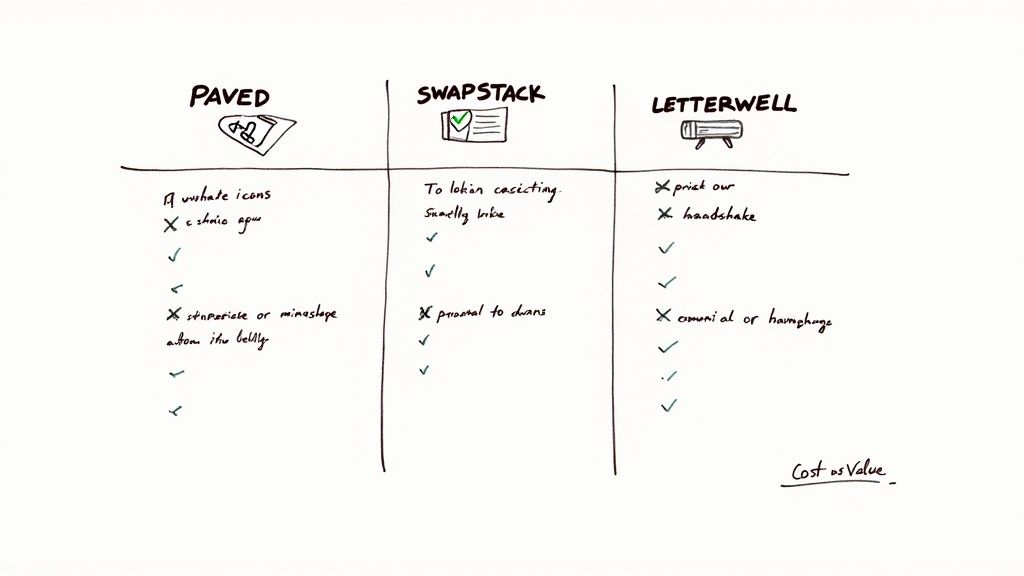
To help you see the differences at a glance, I've put these platforms side by side. This table breaks down their primary pricing model, what you can expect to pay, and the one key feature that really sets each one apart for creators like you.
A side by side view of popular newsletter ad management tools, their pricing, and standout features to help you compare your options effectively.
| Platform | Primary Pricing Model | Typical Price Range | Key Feature for Creators |
|---|---|---|---|
| Paved | Revenue Share (Marketplace) | 10% of marketplace deals | Access to a curated network of high-quality, premium advertisers. |
| Swapstack | Revenue Share (Marketplace) | 25% of marketplace deals, 0% for direct deals | A "bring your own sponsor" model that is completely free to use. |
| Letterwell | Flat Monthly Fee | $29 – $99+ per month | Streamlined tools for managing direct-sold ads with predictable costs. |
Ultimately, the best choice really depends on where you are with your newsletter. If you're just starting and have no advertisers, you might lean on Swapstack’s marketplace, even with the higher fee. But if you’re a seasoned publisher with a solid direct sales pipeline, Letterwell's flat rate could save you a ton of money.
How to Calculate Your Return on Investment
https://www.youtube.com/embed/O-wq-C-52NY
Any new software you bring on board needs to pull its weight. If it costs more than the value it creates, it's a non starter. To figure this out, you need to look at its potential return on investment (ROI).
But ROI isn't just about the new ad revenue you can track. It’s also about the time you get back, time you can spend on growing your newsletter instead of getting buried in admin tasks.
Let's walk through what this looks like in the real world. We'll examine two common scenarios: one for a smaller, growing newsletter and another for a more established publication. This will help you build a solid business case for whatever pricing model you're considering.
ROI Scenario for a Growing Newsletter
Imagine you run a weekly newsletter with 5,000 subscribers. You’re a one person show, and you spend about three hours every week just managing your two ad slots. That includes everything from prospecting and outreach to invoicing and reporting.
Now, you're looking at a tool that costs $50 per month. Is it worth it? Let’s do the math.
- More Ad Revenue: With a streamlined system, you feel confident enough to add one more ad slot per month. That brings in an extra $200.
- Time Savings: The tool cuts your admin work from three hours a week down to just one. If you value your time at $30/hour, you've just saved yourself $240 a month (2 hours/week x 4 weeks x $30/hour).
- Better Advertiser Retention: The professional booking and reporting process convinces one advertiser to book a quarterly package instead of a one off ad. This adds $150 in predictable, locked in revenue.
All told, the monthly gain comes out to $590 ($200 + $240 + $150). After you subtract the $50 software cost, you’re left with a net gain of $540. In this case, the software doesn't just pay for itself, it delivers a return of more than 10x.
ROI Scenario for an Established Publication
Let's shift gears to a bigger operation: a newsletter with 50,000 subscribers and a small team. They’re looking at a more powerful platform that costs $250 per month. Currently, the team sinks a collective eight hours per week into ad operations.
Here's how their potential ROI breaks down:
- Higher Ad Revenue: The new platform comes with advanced analytics, allowing them to offer targeted ad packages. This bumps their average deal size by 15%, adding $750 in monthly revenue.
- Significant Time Savings: Automation slashes the manual work from 8 hours down to 2 hours per week. At a blended team rate of $40/hour, that frees up $960 in labor costs every month (6 hours/week x 4 weeks x $40/hour).
- Improved Advertiser Retention: The platform has a self serve portal that advertisers love. This improves their experience and leads to a 10% drop in churn, protecting $500 in recurring monthly revenue that might have walked away.
The total value generated here is a whopping $2,210 per month ($750 + $960 + $500). Once you factor in the $250 software fee, the net gain is $1,960.
If you want to get even more sophisticated in proving the value of your ad program, this comprehensive guide on how to calculate marketing ROI is a fantastic resource. Or, to make things even easier, you can plug your own numbers into a dedicated newsletter ad ROI calculator and see the results for yourself.
Finding the Hidden Costs in Software Pricing
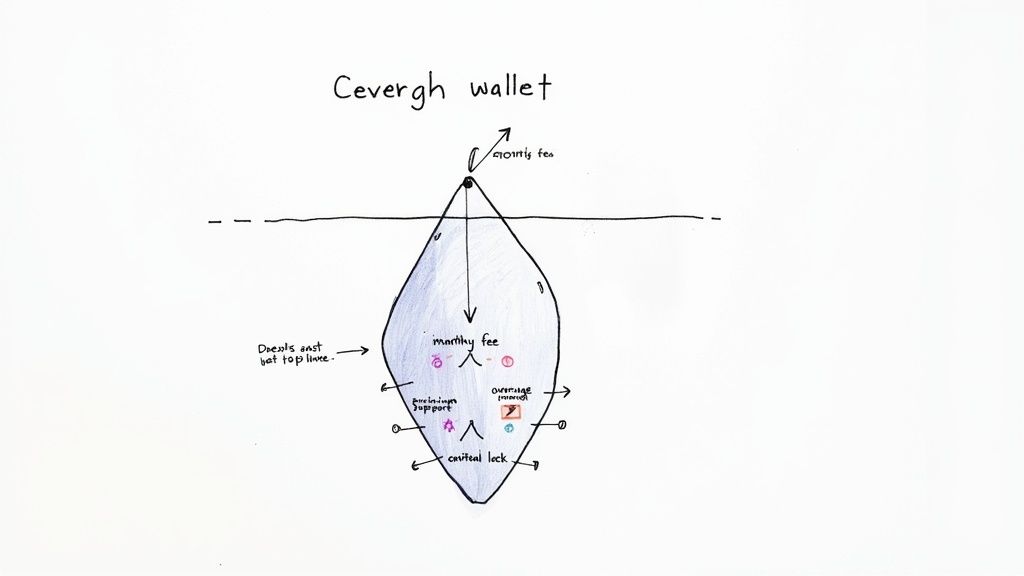
That shiny monthly price tag on a piece of software? It’s often just the tip of the iceberg. The real cost, what you actually pay, is almost always higher once you dig into the extra fees and contract terms hiding just below the surface. A plan that looks like a great deal at first glance can quickly become a major drain on your budget.
One of the most frequent gotchas is overage fees. You might find a great plan for your 10,000 subscriber newsletter, but the moment you hit 10,001, the cost could jump dramatically. Some platforms hit you with steep penalties for crossing subscriber or ad revenue thresholds, essentially punishing you for your own success.
Looking Beyond the Sticker Price
Integration costs are another area where expenses can creep in. Your ad management software has to talk to your email service provider (ESP), and while many of these connections are straightforward, they aren't always free. Some companies will charge a one time setup fee or force you onto a pricier plan just to connect with the ESP you already use.
Key Insight: Don't be afraid to get granular with a sales rep. Ask for a full breakdown of every potential fee that isn't covered by the monthly subscription. This means asking about premium support, onboarding help, and data migration charges.
The digital marketing software market is booming. According to data from The Business Research Company, it recently hit USD 109.36 billion, growing 17.7% in just one year. As the market expands, pricing gets more complicated. Scalable cloud based models are great, but they also give vendors more ways to slice and dice their features. It’s on you to figure out what’s actually included.
Common Hidden Fees and Contract Traps
It’s not just about the direct costs, either. Rigid contracts can chain you to a tool that you’ve outgrown. Be very careful with annual agreements that don’t offer an easy way out if things aren't working.
Here are a few common pitfalls to keep on your radar:
- Premium Support Charges: You might get basic email support for free, but if you need to talk to a human on the phone right away or want a dedicated account manager, expect to pay for it.
- Transaction Fees: Just like Stripe or PayPal, some platforms will skim a small percentage off every ad payment they process for you. It might seem minor, but those fees can really add up as your ad revenue grows. Using a tool with automated payment tracking for newsletters can help you keep a close eye on these details.
- Feature Gating: You might sign up for a plan only to discover that the one feature you really need, like an advertiser CRM or deep analytics, is locked away in a more expensive tier, forcing you to upgrade.
Answering Your Top Pricing Questions
You’ve seen the models, compared the platforms, and even run the numbers on your potential ROI. But as you get closer to making a decision on newsletter ad software, a few nagging, practical questions always seem to pop up.
Let's get those last minute questions answered so you can move forward with confidence.
When Should I Upgrade From a Free to a Paid Tool?
The right time to upgrade is the moment you realize that managing ads manually is costing you more in lost time and missed opportunities than the software subscription. It’s a tipping point.
If you’re spending more than a few hours a week on ad logistics, or you get the sinking feeling that your clunky process is scaring away advertisers, it's time. A good benchmark? When your ad revenue consistently clears a few hundred dollars a month. At that stage, a paid tool’s efficiency, professional advertiser experience, and better analytics almost always pay for themselves.
Does My Newsletter Niche Affect the Price?
While your niche won't change the sticker price on a platform’s website, it absolutely should change which pricing model you choose. It's all about aligning the cost with your revenue potential.
For instance, a high value B2B newsletter with an audience of CFOs might save thousands with a flat fee model, preventing a revenue share from eating into large ad deals. On the other hand, a broad, consumer focused newsletter about movies might prefer a revenue share model to keep costs near zero while they’re still building an advertiser base. Your niche dictates how you make money, which in turn points you to the smartest pricing structure.
Your newsletter's niche is less about the price you pay and more about the value you receive. A highly targeted audience allows you to charge premium ad rates, making the cost of any software a smaller percentage of your overall revenue.
Are There All-in-One Tools for Newsletters and Ads?
Yes, and they’re becoming more common. Many Email Service Providers (ESPs) like Beehiiv and ConvertKit are baking monetization features directly into their core platforms. The convenience of managing subscribers and ads under one roof is a huge selling point.
But there's usually a trade off: simplicity for power. An all in one tool might not have the granular reporting, robust CRM features, or access to an advertiser marketplace that a dedicated ad management platform offers. You just have to decide if that streamlined convenience is worth giving up the specialized tools you might need to truly scale your ad revenue.
Is It Possible to Negotiate Software Pricing?
For the standard, off the shelf monthly plans? Probably not. Those prices are typically set in stone. However, the game changes when you start talking about annual contracts or enterprise level plans.
If you’re running a high volume newsletter or are ready to commit to a long term contract, you absolutely have negotiating power. Don’t hesitate to ask for a discount, a few custom features, or a better revenue sharing percentage. Just be sure to walk into that conversation armed with your data, including audience size, engagement rates, and current ad revenue, to build the strongest case for a custom deal.
Stop drowning in spreadsheet chaos and start scaling your sponsorships. Ad Slots automates your sponsor tracking, invoicing, and scheduling so you can get back to writing great content. See how Ad Slots can save you hours every week.