
When you start looking into email advertising, the first thing you notice is the massive price range. Costs can swing from a couple hundred bucks for a spot in a small, niche newsletter all the way up to $10,000 for a premium placement in a major publication.
The price you end up paying is not random. It all comes down to the newsletter’s audience size, how engaged those readers are, and the industry it serves.
Why There Is No Single Price Tag for Email Ads
Trying to pin down a single price for email ads is a lot like pricing a billboard. A sign on a quiet country road is cheap for a reason. One in the middle of Times Square will cost you a fortune. The difference is the audience, and it is the exact same deal with newsletters. You are not just buying empty space; you are buying access to a hand-picked group of people.
Here is a practical example. A small newsletter like Cybersecurity Weekly with 5,000 highly engaged subscribers can often charge more than a general-interest newsletter with 50,000 subscribers. Why? Because that targeted, high-value audience is pure gold to a company selling security software. The total cost is simply a reflection of that value.
Key Pricing Models You Will Encounter
To set a realistic budget, you need to know how you will be charged. Let’s break down the most common ways newsletter advertising deals are structured.
Here is a quick look at the main pricing models you will run into.
Quick Guide to Email Advertising Pricing Models
| Pricing Model | What It Means | Typical Cost Range | Best For |
|---|---|---|---|
| Flat-Rate Sponsorship | You pay one fixed price for a specific ad placement. | $100 – $10,000+ | Simplicity and predictable budgeting, especially for brand awareness campaigns. |
| Cost Per Mille (CPM) | You pay a set rate for every 1,000 subscribers. | $15 – $50+ | Reaching large audiences where impressions are the primary goal. |
| Cost Per Click (CPC) | You only pay when someone actually clicks your ad’s link. | $1 – $5+ | Performance-based campaigns where driving traffic or leads is key. |
These are the core models, and understanding them is the first step to figuring out your own budget.
Do not forget to factor in the tools you will need to manage your campaigns, too. Research from Ascend2 shows most companies spend between $51 and $1,000 per month on their email marketing software and related services.
The core takeaway is that email advertising prices are not standardized. Your final cost will always be a mix of audience size, reader engagement, and the specific niche the newsletter serves.
Want to get a ballpark figure for your own campaign? A great starting point is to plug some numbers into our free newsletter ad pricing calculator to see what a potential ad slot might cost.
Breaking Down How You Pay for Newsletter Ads
Figuring out what you will pay for email advertising comes down to understanding the three main ways publishers price their ad spots. Each one ties the cost to a different result, so the best fit really depends on what you are trying to accomplish. It is a bit like paying for a taxi. You can pay by the mile, by the minute, or just agree on a flat fee for the whole ride.
This visual gives you a quick snapshot of how different budgets and goals match up with these common pricing models.
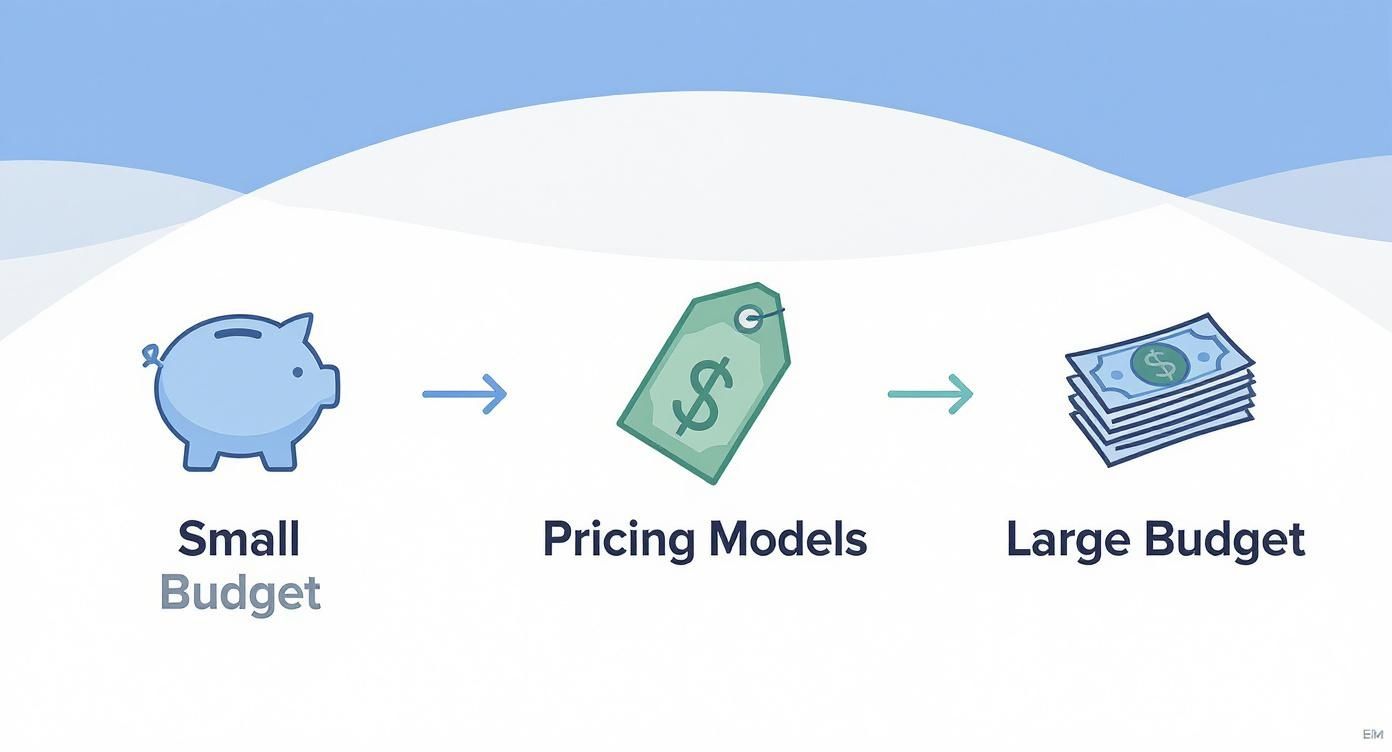
The main thing to remember is that there is a model for every goal, whether you are working with a lean budget and need direct results or you are ready to invest in getting your brand name out there.
Cost Per Mille (CPM): Paying for Eyeballs
The most common model you will run into is Cost Per Mille (CPM), which is just a fancy way of saying “cost per thousand impressions.” In the newsletter world, an “impression” simply means an email with your ad landed in a subscriber’s inbox. This is the go-to for brand awareness campaigns.
You pay a set rate for every 1,000 subscribers who receive the email. So, if a newsletter has 100,000 subscribers and they charge a $40 CPM, the math is pretty simple.
Example Calculation:
(100,000 Subscribers / 1,000) x $40 CPM = $4,000 Total Cost
Under the CPM model, the price is the price, whether one person clicks your ad or a thousand do. It is predictable and perfect for getting your brand in front of a big, relevant audience.
Cost Per Click (CPC): Paying for Action
Next up is the Cost Per Click (CPC) model. With this one, you only open your wallet when a subscriber actually clicks the link in your ad. This approach shifts the risk from you, the advertiser, to the publisher, since they do not get paid unless their audience actually engages.
This performance-based model is fantastic for campaigns where your number one goal is to drive traffic to a specific destination, like a landing page, a product page, or a new blog post. CPC rates can vary quite a bit, often ranging from $1 to $5 or more, especially in competitive industries.
To make a CPC campaign work, your creative has to be on point. It is a good idea to brush up on some newsletter advertising best practices to make sure your copy and offer are compelling enough to actually earn that click. If your ad falls flat, you get no clicks, and the publisher makes no money.
Flat-Rate Sponsorships: Simple and All-Inclusive
Finally, a lot of newsletters offer Flat-Rate Sponsorships. This is as straightforward as it gets. You pay a single, fixed price to sponsor an issue, regardless of the subscriber count or how many clicks it generates.
For instance, a publisher might charge $1,500 for you to be the exclusive sponsor of their weekly send. This is ideal for advertisers who crave budget certainty and want to build a strong association with a trusted voice in their industry. It often comes with perks beyond just an ad, like a “Presented by” shout-out at the top, giving your brand an extra dose of credibility.
While those are the big three, you may occasionally see other performance-based models like Cost Per Acquisition (CPA), where you pay only when your ad leads directly to a sale. It is less common for newsletters, but it is the holy grail for advertisers laser-focused on ROI.
What Really Drives Email Advertising Costs
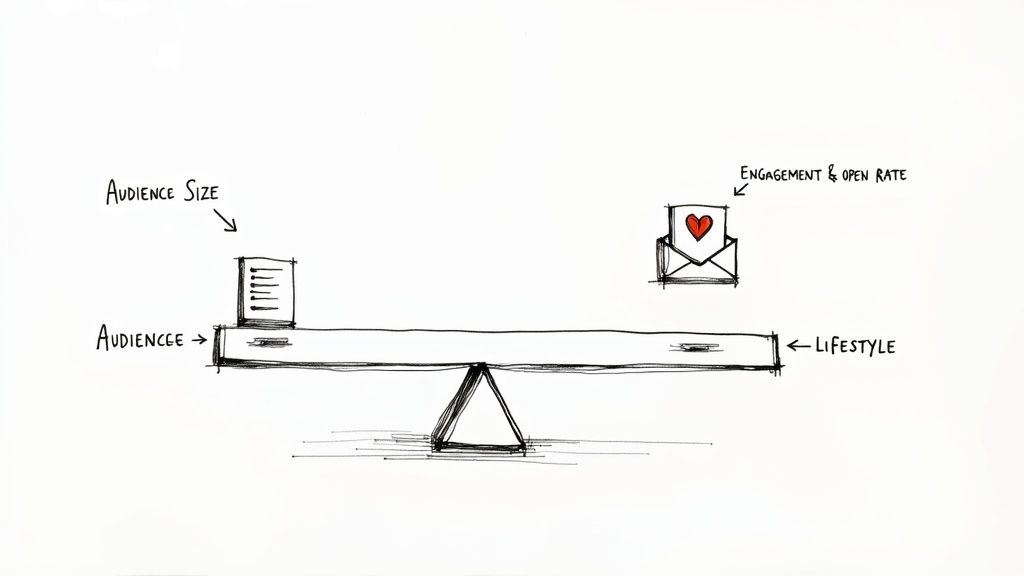
Ever scratched your head wondering why one newsletter with 50,000 subscribers charges $500 for an ad, while another with the same count asks for a whopping $5,000? The answer is pretty simple. Not all audiences are created equal. The sticker price for an email ad is about so much more than just the subscriber count.
Think of it like buying real estate. Two houses might be the exact same size, but one is a quiet bungalow in the suburbs and the other is a penthouse overlooking Central Park. Their values are worlds apart because of location, demand, and the type of buyer they attract. It is the exact same principle in email advertising.
The real value is always in the details. Things like how engaged the audience is, how specific the niche is, and the publisher’s reputation all play a huge role in setting the price. A small, hyper-engaged list is almost always worth more than a huge, passive one.
Audience Engagement Metrics
Subscriber count is just the starting line. The real story is told by how those subscribers actually interact with the emails they receive. High engagement is a clear signal of a loyal, attentive audience, which is precisely what advertisers are willing to pay a premium for.
- Open Rate: This is the percentage of subscribers who actually open the emails. A newsletter with a 45% open rate has a far more valuable audience than one with a 15% rate, even if the second one has more subscribers on paper.
- Click-Through Rate (CTR): This metric tracks how many people clicked on a link inside the email. A strong CTR proves the audience trusts the publisher’s recommendations and is ready to take action.
A newsletter with 10,000 subscribers and a 50% open rate gets you in front of 5,000 engaged readers. Meanwhile, a newsletter with 50,000 subscribers and an 8% open rate only reaches 4,000 people. Size is not everything.
The Power of a Niche
The industry or topic a newsletter covers is one of the biggest drivers of price. The more specialized and valuable the audience, the higher the email advertising costs will be.
For instance, a newsletter that lands in the inbox of C-suite cybersecurity executives will command a premium. Why? Because getting direct access to those decision-makers is incredibly valuable. On the flip side, a general lifestyle or hobby newsletter will usually have lower ad rates because the audience is broader and less targeted. This kind of specialization is a key reason global email advertising spending is projected to hit US$11.48 billion in 2025. Advertisers pay for direct access to the right people. You can dig into more stats about the growth of email advertising on Statista.
How Different Factors Impact Your Final Cost
To see how this all comes together, let’s look at a few scenarios. The table below breaks down how different factors can push your ad price up or down, giving you a better feel for what creates value.
| Influencing Factor | Impact on Price | Example Scenario |
|---|---|---|
| Audience Demographics | Increases | A newsletter reaching high-income VPs in the tech industry can charge more than a general news summary. |
| Ad Placement | Increases | A large, “above the fold” banner costs more than a small text link at the very bottom of the email. |
| Sponsorship Exclusivity | Increases | Being the only sponsor in an issue is a premium feature that will raise the price significantly. |
| Publisher Reputation | Increases | A recommendation from a trusted, well-known industry expert carries more weight and commands a higher fee. |
| Broad, General Audience | Decreases | A newsletter about “daily fun facts” will have lower ad rates than a highly targeted B2B publication. |
| Low Engagement Rates | Decreases | A massive list with a 10% open rate is less valuable than a smaller list where 50% of people open every email. |
Ultimately, a blend of these factors determines the final price. A well-placed ad in a reputable, niche newsletter with an engaged audience is where you will find the highest costs and often, the best return on your investment.
Keeping track of all these variables for multiple sponsors can quickly become a headache. To stay organized and make sure every ad gets delivered correctly, many creators use dedicated newsletter ad management software to automate their scheduling, booking, and invoicing. This is a game-changer for keeping operations running smoothly as you grow.
How to Calculate Your Potential ROI
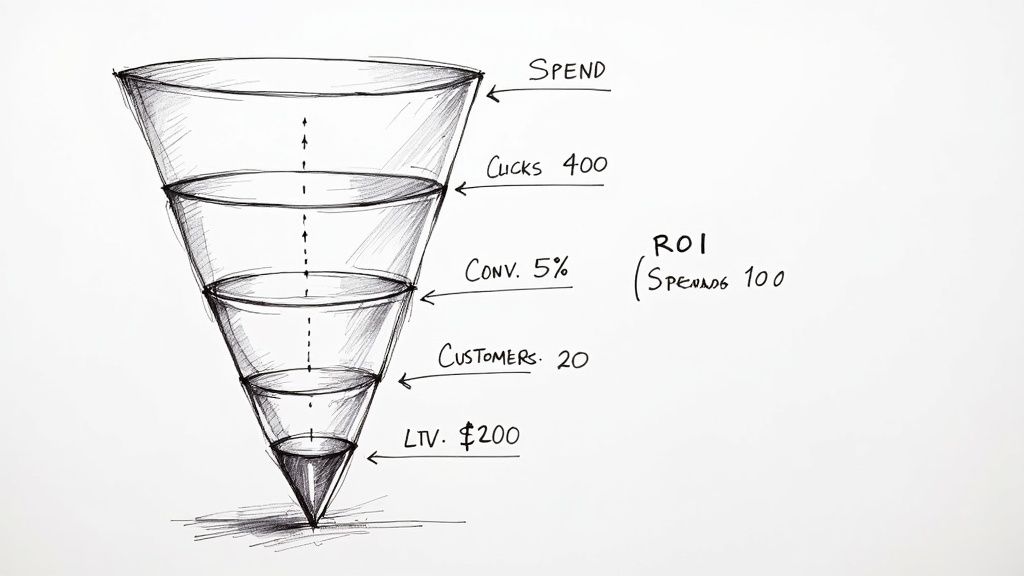
Throwing money at email ads without knowing what you will get back is just a shot in the dark. The good news is that figuring out your potential Return on Investment (ROI) is not rocket science. It is all about shifting your mindset from seeing ad spend as a cost to seeing it as a measurable investment.
What an investment it can be. Data from the Direct Marketing Association shows email advertising pulls in an incredible $36 for every $1 spent. That is a massive 3,600% ROI. Some industries do even better. These numbers alone show why it is so critical to get a handle on your own ROI. It is the only way to make smart calls on where your ad budget should go.
Let’s break down a simple framework to connect your ad spend to real, tangible business results.
A Practical ROI Calculation Example
Let’s walk through a real-world scenario. Imagine you run an online course for project managers. You decide to sponsor a popular project management newsletter to find new students.
Here are the details of the campaign:
- Total Ad Spend: You pay $1,500 for a flat-rate sponsorship.
- Clicks Generated: The ad drives 400 clicks to your course sign-up page.
- Landing Page Conversion Rate: Your page is well-optimized and converts 5% of visitors into paying students.
- Customer Lifetime Value (LTV): The course costs $200, and since it is a one-time purchase, the LTV is $200.
Now, we can crunch the numbers.
Step 1: Calculate Your New Customers
First, how many actual customers did the campaign bring in? This is a straightforward calculation.
Calculation: 400 Clicks x 5% Conversion Rate = 20 New Customers
Step 2: Calculate Your Total Revenue
Next, let’s see how much money those new customers represent. Here is where your LTV comes into play.
Calculation: 20 New Customers x $200 LTV = $4,000 Total Revenue
Step 3: Calculate Your Final ROI
Finally, we can figure out the big number, the ROI. The formula is simply your total revenue minus your ad spend, divided by the ad spend. Multiply by 100 to get the percentage.
Final Calculation: (($4,000 Revenue – $1,500 Ad Spend) / $1,500 Ad Spend) x 100 = 167% ROI
In this example, your $1,500 investment turned into $4,000 in revenue, delivering a very healthy 167% return. Running these numbers before you commit helps justify the cost and gives you clear goals to aim for.
To make this even simpler, you can plug your own numbers into our free newsletter ad ROI calculator and see the potential return for any campaign you are thinking about.
Negotiating Better Email Ad Deals
Think of a newsletter’s rate card as a starting point, not the final word. Just like any good business deal, there is almost always some wiggle room to create a partnership that makes everyone happy. Smart negotiation is not about trying to get the lowest possible price; it is about finding creative ways to add more value for both you and the publisher.
Whether you are the one buying the ad space or selling it, a thoughtful approach can lead to better deals and stronger, more profitable relationships down the road.
Tips for Advertisers Seeking Better Rates
Before you even think about mentioning a price, do your homework. You will have a much better chance of success if you come to the conversation prepared to show why a partnership is a great fit.
Ask for Performance Data: Do not get hung up on the subscriber count alone. It is perfectly fine to ask for a media kit or recent stats on their average open and click-through rates. This information helps you build a case for your offer and confirms you are paying to reach an engaged audience, not just a big one.
Propose a Multi-Issue Campaign: Publishers thrive on predictable income. Instead of just booking a one-off ad, see if you can lock in a series of three or six ads over a few months. It is completely reasonable to ask for a 10% to 20% discount in exchange for that kind of commitment.
Offer Value Beyond Cash: Do you have something else you can bring to the table? A popular move is to offer a cross-promotion, where you agree to feature their newsletter to your own audience. For a publisher looking to grow, that kind of exposure can be just as valuable as cash and a great reason to give you a better rate.
How Publishers Can Create Attractive Packages
If you are a newsletter creator, your job is to make it incredibly easy for an advertiser to say “yes.” The secret is to build flexible, appealing packages that close more deals without forcing you to just drop your prices.
The best deals are the ones where both people walk away feeling like they won. For publishers, that means packaging your ad spots to show undeniable value. For advertisers, it means focusing on long-term partnerships instead of one-off discounts.
A great place to start is by creating tiered options. You could offer a “Gold Package” that includes a main sponsorship in your weekly newsletter plus a separate, dedicated email blast later that month. A more straightforward “Silver Package” could just be the standard newsletter ad. This approach gives advertisers with different budgets and goals a clear way to work with you.
You should also put together a professional media kit. This is your chance to shine! A good media kit shows off your audience demographics, highlights the performance of past campaigns, and includes a few glowing testimonials from happy clients. It instantly builds trust and justifies your rates, making the whole negotiation process feel less like a haggle and more like a smart business decision.
Your Pre-Launch Checklist for Email Ads
You have got the full picture on pricing models and what drives costs. Now, let’s put that knowledge to work.
Think of this as your pre-flight check before your ad campaign takes off. Running through these steps will make sure you have covered all the critical bases for a partnership that actually pays off. This is not just about buying a spot in a newsletter; it is about making a smart investment.
Before You Even Reach Out
The real work starts long before you send that first email to a newsletter publisher. Nailing your prep work is what separates a winning campaign from a wasted budget.
- Know Your “Win” Condition: What does success actually look like for you? Is it getting 200 solid leads? Making 50 sales? Or maybe just introducing your brand to 10,000 new people? Get specific with your goals.
- Find the Right Newsletters: Do not just chase big subscriber numbers. Your goal is to find the newsletters your ideal customers genuinely read and trust. A smaller, passionate audience in the right niche can be a goldmine.
- Dig Into Their Media Kit: A good media kit tells you everything. Look closely at their audience demographics, average open rates, and click-through rates. Does their audience feel like your audience?
Launching and Tracking Your Ad
Once you have found a few promising newsletters, it is time to talk numbers and get ready for go-time. This is where you connect your ad spend to a real, measurable outcome.
- Do the ROI Math First: Before you sign anything, run the numbers. Use the ROI formula we talked about earlier to estimate what you can expect back, based on the newsletter’s stats and your own customer value.
- Do Not Be Afraid to Negotiate: Remember, the prices on a rate card are usually just a starting point. See if you can get a better deal by booking a multi-ad package or bundling a few different ad types together.
- Track Everything: As soon as the ad goes live, keep a close eye on performance. Use a unique UTM link to see exactly how many clicks you get, track conversions on your website, and measure your final ROI. How did it stack up against your initial forecast?
Got Questions About Email Ad Costs? Let’s Clear Things Up.
Even after breaking down the models and factors, you probably still have a few questions rattling around. That is completely normal. Let’s tackle some of the most common ones we hear to clear up any lingering confusion before you dive in.
What is a Good CPM for Newsletter Advertising?
A good starting point for newsletter CPM is typically between $15 and $50. But honestly, that is just a ballpark figure.
A massive newsletter about general lifestyle topics might sit at the lower end of that range. On the other hand, a niche B2B newsletter that lands in the inbox of software engineers or financial advisors could easily charge $60 or more per thousand subscribers. The real key is to look past the CPM and at the open and click-through rates. That is where the true value is revealed.
How Can I Find Newsletters to Advertise In?
Finding the right newsletters to partner with is easier than you might think. Your first stop should be dedicated marketplaces like Paved or Swapstack, which are built specifically to connect advertisers and publishers. They do a lot of the heavy lifting for you.
Another great, low-tech method is to just hop on Google and search for “top newsletters in [your industry].” See what publications your target audience and even your competitors are reading. That is often the strongest signal you will get for finding the perfect fit.
A flat-rate sponsorship is great for predictable budgeting and building brand awareness. If your goal is pure visibility, it is often the simplest choice. Performance-based models like CPC are better when your primary goal is to drive specific actions like website traffic or lead generation.
Is a Flat-Rate Sponsorship Better Than CPM?
One is not automatically “better” than the other. It all comes down to what you are trying to achieve.
A flat-rate deal is fantastic for budget certainty. It is the ideal choice for brand awareness campaigns where getting your name out there is the main objective. You know exactly what you will pay and what you will get in return. A CPM model, however, is tied more directly to audience size and can be a steal if the newsletter has a super-engaged list.
Ready to stop wrestling with spreadsheets and streamline your newsletter sponsorships? Ad Slots automates your ad management, from booking and invoicing to fulfillment, so you can focus on creating great content. Learn how AdSlots can save you hours every week.