
You can absolutely track newsletter ads without getting lost in a sea of spreadsheets. The secret is moving to a dedicated ad management platform designed to automate everything from booking and scheduling to reporting. This shift takes you away from manual data entry and into a centralized system, killing common mistakes like double-booking and handing you back hours every week.
The Spreadsheet Trap in Newsletter Advertising
If you're managing newsletter sponsorships, you know the story. It always starts out simple enough. You create a single spreadsheet to keep track of a few sponsors, and it feels clean, organized, and totally under control.
But as your newsletter gains traction, that simple sheet starts to multiply. Before you know it, you are navigating a labyrinth of interconnected tabs, each one a ticking time bomb for a potential error.
You find yourself constantly copying and pasting sponsor details, manually updating ad schedules, and second-guessing your own formulas just to make sure the revenue numbers add up. This is not just a headache; it is a breeding ground for expensive mistakes. For instance, what happens if you accidentally sell the same premium ad slot to two different sponsors in the same week? Or worse, you send a performance report with last month's click-through rates. These little slip-ups chip away at a sponsor's trust and can cost you a valuable partnership.
When Manual Tracking Becomes a Bottleneck
The real trouble begins when you spend more time managing your ads than actually creating content. Instead of focusing on great writing or finding new sponsors, you are stuck in administrative quicksand. This is the classic growth bottleneck.
Every hour you waste wrestling with a broken VLOOKUP or chasing down an overdue invoice is an hour you cannot invest back into your newsletter.
The hard truth is that manual spreadsheet tracking just does not scale. It puts an invisible ceiling on your revenue because you can only juggle as many sponsors as your manual process can handle.
This inefficiency is a flashing neon sign telling you it is time for an upgrade. Your ad operations should be an engine for growth, not an anchor holding you back. Moving to an automated system is not just about convenience. It is about building a business that can last.
To finally break free from the grind of manual tracking, it’s a good idea to compare the best newsletter services and see what’s out there. A dedicated tool can turn ad management from a daily chore into a powerful, automated asset for your business.
So, you are ready to ditch the spreadsheet. Smart move.
Making the leap from manual tracking to an automated ad management system feels like a huge undertaking, but it is the single best thing you can do to scale your newsletter's revenue. With a bit of prep work, you can shift from a state of organized chaos to automated efficiency without dropping a single ball.
The whole process really begins with a good, honest look at what you have already got. Before you can even think about moving your data into a new system, you need to get it all in one place. That means compiling every bit of sponsor information into one final, clean spreadsheet.
Think of it as packing up before a big move. You want to sort, label, and organize everything now so unpacking on the other side is a breeze.
This is the classic spreadsheet trap. It starts out simple enough, but before you know it, you are drowning in tabs, formulas, and version control issues. It becomes a massive bottleneck that stalls your growth. Moving to a real system is how you break free.
Getting Your Ad Data in Order
First things first: you need to consolidate. It is time to go on a scavenger hunt through old emails, scattered files, and random notes to pull all your sponsor data into a single master document.
Your goal is to build a master list that covers:
- Sponsor Contacts: Company names, key contact info, and any important notes about your relationship.
- Campaign History: A complete log of every ad you've run, for whom, on what dates, and at what price.
- Performance Metrics: The hard numbers such as opens, impressions, and click-through rates for each campaign.
- Ad Creatives: Easy-to-access links to the copy and images used for every ad.
- Payment Status: A crystal-clear view of who has paid and who has not.
I know, this sounds like a drag. But trust me, a clean and complete dataset is the foundation for a smooth, headache-free migration. It is also a good time to check out a dedicated newsletter sponsor CRM just to see how these purpose-built systems are designed to handle this exact kind of information.
Finding the Right Ad Management Tool
Once your data is tidy, you can start shopping for the right platform. Be warned: not all ad management tools are built for the unique world of newsletters.
Your new platform should eliminate manual work, not just relocate it. If you find yourself still copying and pasting info or manually chasing invoices, you have not actually solved the problem.
Look for a tool with features that directly tackle your biggest spreadsheet pain points. Things like integrated booking calendars, automated scheduling to avoid embarrassing double-bookings, and real-time performance dashboards are non-negotiable.
For example, The Hustle, a popular business newsletter, once managed its ad sales in a massive Google Sheet. As they grew to millions of subscribers, this became impossible. They switched to a dedicated ad platform, which allowed them to automate their booking calendar and provide advertisers with real-time performance data, helping them scale revenue significantly.
Migrating Your Data Without Losing Your Mind
You have got your data, you have picked your platform. Now it is time to connect the two. Thankfully, most modern tools make this pretty painless with built-in importers that accept a simple CSV file.
You will take that beautiful master spreadsheet you created and map your old columns to the new fields in the platform. "Sponsor Name" goes into the "Company" field, "CTR" populates the analytics, and so on.
My advice? Take it slow. Run a small test import with a few sponsors first to make sure everything lands where it is supposed to. A few minutes of double-checking now can save you hours of cleanup later.
Building Your New Ad Tracking Workflow
Alright, you have picked a tool. Now, let's build an ad tracking workflow that finally lets you close that spreadsheet for good. An effective system really comes down to three things: making booking effortless for sponsors, having a crystal-clear schedule, and monitoring performance in real time. Getting this right turns your ad sales from a constant headache into a hands-off, revenue-generating machine.
The whole point is to create a single, automated system where every part of the ad process lives. Think about it: you could give sponsors a simple link where they see your available ad slots, pick a date, and pay. All without a single email from you. That self-serve model is the key.
This diagram breaks down how these three core pieces fit together.
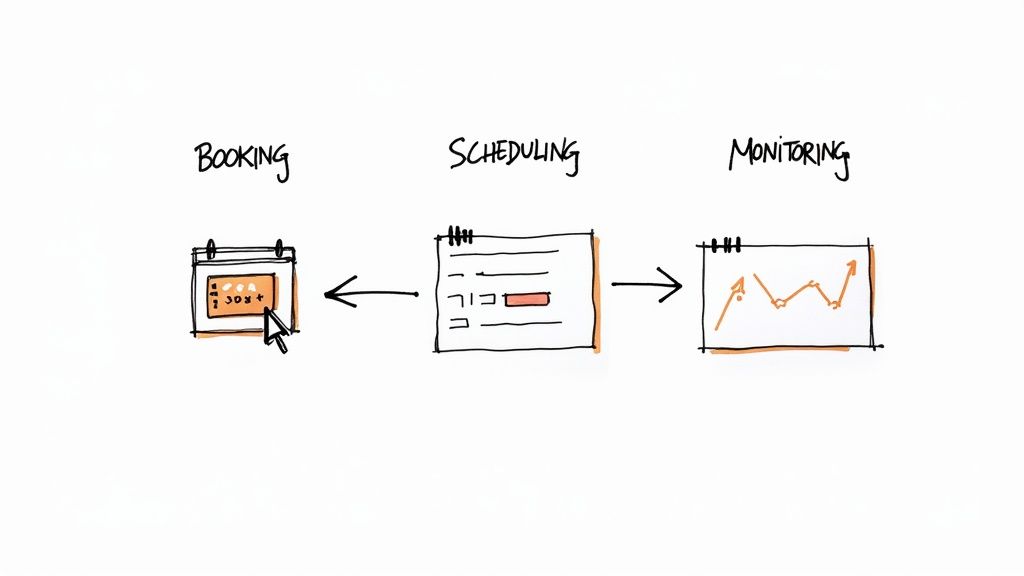
Each stage flows right into the next, automating the tedious stuff and giving you a bird's-eye view of your entire ad operation.
To truly understand the shift you are making, let's compare the old way with the new way.
Spreadsheet Tracking vs Automated Platform Tracking
| Feature | Spreadsheet Method | Automated Platform Method |
|---|---|---|
| Ad Booking | Manual email back-and-forth; checking the sheet for availability. | Sponsors self-book via a public link showing real-time availability. |
| Scheduling | Manually entering dates, sponsor info, and ad copy into cells. | The system automatically blocks off booked slots on a visual calendar. |
| Conflict Risk | High. Easy to accidentally double-book a slot. | Zero. Once a slot is booked, it's instantly unavailable to others. |
| Payments | Manual invoicing, payment reminders, and tracking in a separate tab. | Integrated payment processing; payment is collected at booking. |
| Performance | Manually pulling stats from your ESP and calculating CTR in formulas. | An automated dashboard shows impressions, clicks, and CTR per campaign. |
| Reporting | Building reports from scratch by copy-pasting data into a document. | One-click, professional-looking performance reports to send to sponsors. |
This table really highlights the difference. One is a constant, manual chore, while the other is a system that works for you.
Set Up Your Ad Booking and Scheduling
Honestly, the biggest time-suck for most creators is the endless email tennis just to get an ad booked. A modern ad management tool completely solves this with a visual calendar that shows sponsors your real-time availability. It is basically Calendly, but for your newsletter ad inventory.
Once a sponsor books a slot, it is immediately blocked off. That alone eliminates the risk of double-booking. If you are looking for a tool that can do this, check out some dedicated options for newsletter ad scheduling software to see how a visual calendar can handle everything for you.
Here’s how it plays out in the real world:
- Sponsor A wants to book the main ad slot in your second issue of June.
- They go to your booking page, see the slot is open, and reserve it right there.
- The system instantly marks that slot as "filled" on your end.
- Sponsor B comes along a few minutes later and sees that slot is gone, so they book for the third week instead.
This all happens 24/7 without you having to lift a finger.
Monitor Your Ad Performance
The last piece of the puzzle is your analytics dashboard. This is your mission control, where you track the key performance indicators (KPIs) for every single ad without having to calculate a thing.
A good dashboard will give you instant insights into:
- Impressions: How many eyeballs saw the ad.
- Click-Through Rate (CTR): The percentage of readers who actually clicked the link.
- Conversions: If a sponsor's goal was something like sign-ups or sales, you can often track that, too.
A centralized dashboard means you can generate a professional performance report for a sponsor in seconds. This not only builds a ton of trust but also gives you the hard data you need to justify your ad rates and sell future slots.
Email marketing is not slowing down. We know that segmented campaigns can boost clicks by up to 50%, as shown by email marketing statistics from Hostinger.com. Having a system that tracks all this automatically is how you keep up and grow. For example, the newsletter Morning Brew provides its advertisers with detailed performance dashboards, which has been a key factor in their ability to attract and retain major brands like Microsoft and McDonald's.
Getting Paid and Proving Your Worth: Automating Invoices and Reporting
Let's be honest, getting paid on time and showing sponsors your value are the two things that really matter for a newsletter ad business. These are also the two areas where spreadsheets cause the most headaches. When you automate these financial and reporting workflows, you stop feeling like a freelancer chasing down checks and start operating like a professional media company.
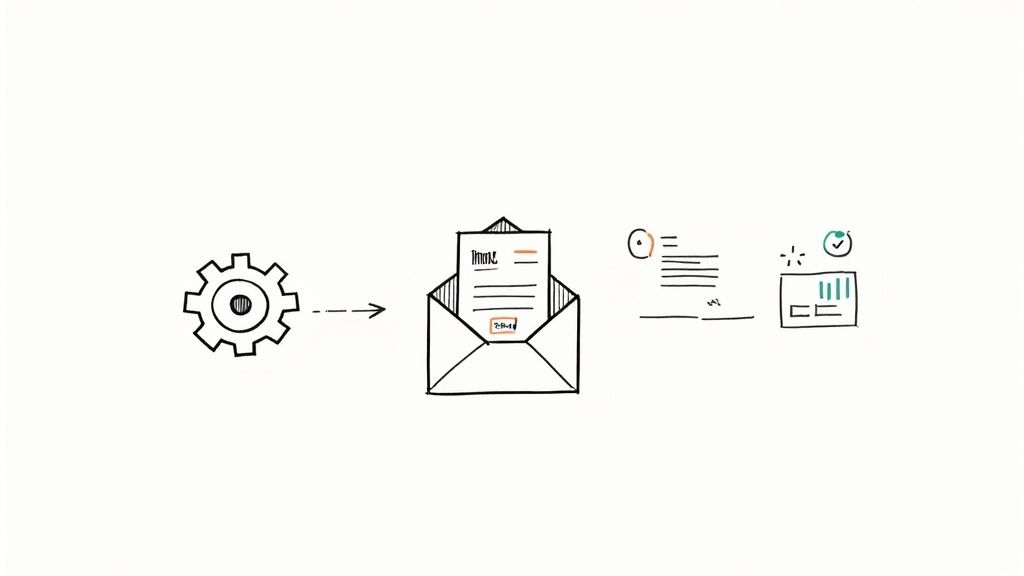
The idea is to have your ad booking system talk directly to your payment processor. As soon as a sponsor books a slot, an invoice should go out automatically. This single change gets rid of all that awkward back-and-forth, the manual follow-ups, and the mental load of trying to remember who has paid and who has not.
Ditch the Drudgery with Automated Invoicing
If you are still creating invoices by hand, you know what a time-suck it is. You have to make it, email it, set a reminder to follow up, and then update your spreadsheet when it is finally paid. It is a slow, clunky process just begging for human error, which can easily delay payments and create friction with your sponsors.
This all changes when you bring a payment gateway like Stripe into the mix. The moment an ad is booked, the invoice is out the door. Sponsors get a simple link to pay with a credit card, and the system logs the payment for you. It is a hands-off process that dramatically improves your cash flow and frees you from playing the part of a collections agent. To get a better sense of how this works, you can check out some examples of automated newsletter invoice software.
This is not just about convenience. The benefits of automated invoicing and error reduction are a key part of the broader accounts receivable automation benefits that help all kinds of businesses get paid faster and more reliably.
An automated payment system does more than save you a few hours. It shows sponsors you are organized and professional, which builds trust and makes them want to work with you again.
Create Data-Rich Reports in a Single Click
Once an ad campaign is over, sponsors want to know one thing: how did it do? Digging through a spreadsheet to pull numbers, calculate click-through rates, and then try to make it all look presentable is not only inefficient, but it also looks unprofessional.
A good system does all the heavy lifting for you.
With the right setup, you can generate a clean, data-packed performance report with a single click. This report should show sponsors the key metrics they actually care about, laid out in a way that is easy to understand.
- Total Impressions: The total number of subscribers who got the email with their ad.
- Open Rate: The percentage of people who actually opened that email.
- Click-Through Rate (CTR): The percentage of openers who went on to click the sponsor's link.
- Total Clicks: The simple, raw number of clicks the ad generated.
Handing over a clear, immediate report like this is how you prove your newsletter’s value. It gives sponsors the hard data they need to justify their ad spend and makes it a no-brainer for them to book again. Ultimately, this simple step helps you command higher rates and builds your reputation as a partner who delivers.
Making Your Tools Work Together
An automated ad system is great, but its real power is unlocked when you connect it to the other tools you use every single day. Think of these integrations as the glue that turns a collection of separate apps into a single, cohesive engine for your newsletter business.
This is how you finally stop the soul-crushing copy-and-paste routine between your ad platform, your email provider, and your payment processor. When everything talks to each other automatically, you get a genuinely smooth operation.
Hook Up Your Payment Gateway
If you only set up one integration, make it this one. Connecting your ad management tool directly to a payment gateway like Stripe is an absolute game-changer. It is the difference between chasing invoices and getting paid on time, every time.
When a sponsor books an ad, the system can automatically generate and send an invoice. They get a simple, professional link to pay online, and you get your money. Our guide on the Stripe integration for newsletter ads shows just how much this one connection can overhaul your entire financial workflow.
It is a simple change that secures your cash flow and frees you up to focus on creating great content instead of playing accountant.
Link to Your Newsletter Platform
Next up is your email service provider (ESP). You need a direct line of communication between your ad system and platforms like Beehiiv or ConvertKit. This connection is what makes ad fulfillment and reporting so much easier.
We are seeing a massive trend where newsletter platforms are building ad management tools right into their core product. They get it because creators are tired of spreadsheets.
In the booming newsletter economy, platforms with built-in ad tools are setting a new standard. They eliminate the drudgery of spreadsheets by providing real-time metrics right inside the user interface, making ad tracking a core part of the content creation process.
Just look at a platform like Beehiiv. They have paid out over $25 million to creators and saw a staggering 96.2% growth in the number of newsletters on their platform last year. That kind of growth sends a clear message: creators are ditching manual methods for integrated solutions that handle both content and monetization. You can dig into more of these insights in the 2025 State of Newsletters report.
Get Notified with Communication Tools
Finally, do not overlook your communication apps. Connecting your ad tool to something like Slack is a simple way to stay on top of everything without drowning in email notifications. You can get real-time pings right where your team is already working.
Imagine getting instant, automated alerts for things like:
- New Ad Bookings: A quick ping the moment a new sponsor buys a slot.
- Upcoming Campaign Reminders: A heads-up a few days before an ad goes live.
- Payment Confirmations: A notification as soon as an invoice is paid.
These little updates give you incredible peace of mind. You know exactly what is happening with your ad business at all times, ensuring nothing ever slips through the cracks. It is how you run a truly professional operation without being glued to your inbox.
Frequently Asked Questions
Jumping from a spreadsheet you know inside and out to a new system is a big change. It is totally normal to have a few questions. But making this switch is often the one thing that unlocks real growth for your newsletter. Let’s tackle some of the most common concerns I hear from creators ditching their spreadsheets.
How Much Do These Tools Cost?
The cost for these ad management tools can vary, but most run on a tiered model. You can usually find a free plan if you are just getting started, which is perfect for handling your first few sponsors.
Paid plans generally kick in around $25 to $50 per month and go up from there, depending on how many sponsors you are juggling or the number of ads you run. Think of it this way: if a tool saves you just three hours of mind-numbing admin work each month, it has already paid for itself. It is an investment in your sanity and efficiency, not just another software bill.
Is It Hard to Set Up a New System?
Honestly, not really. Most of these platforms were built with creators, not developers, in mind. They focus on a simple, guided setup. The biggest lift is usually on your end at the very beginning: getting all your current sponsor info organized and into a single file for import.
Once your data is tidy, the rest is pretty straightforward. You will connect your payment processor like Stripe, link your newsletter platform, and upload your sponsor list. Most services have great tutorials or support to help you out. You can genuinely go from a messy spreadsheet to a fully running system in an afternoon.
Can I Still Use My Current Newsletter Platform?
Absolutely. In fact, you are supposed to. Good ad management tools are designed to work with popular newsletter platforms like Beehiiv, ConvertKit, and Substack. They do not replace your email service; they just handle the ad management part of your business.
This integration is what makes the magic happen. It allows the ad tool to automatically pull in performance metrics like open rates and click-throughs, which is how you generate those slick, one-click reports for sponsors. It keeps everything talking to each other so you are not stuck manually copying and pasting data.
The whole point of a dedicated ad tool is not to mess with your current workflow. It is to take one critical, chaotic piece of it and make it run like clockwork. This frees up your newsletter platform to do what it does best: send awesome content.
What if My Sponsors Prefer Emailing Me Directly?
That is completely fine, and any decent system is built to handle this. While a self-serve booking page is a massive time-saver for new advertisers, you do not have to force your existing partners to use it.
When a long-term sponsor emails you to book a slot, you can just hop into the backend of your new system and create the booking for them manually. From there, the system takes over. It sends the invoice, blocks out the calendar spot, and tracks the ad's performance. You still get all the benefits of an automated, centralized system without making your best sponsors change their ways.
Ready to stop wrestling with spreadsheets and start scaling your newsletter revenue? Ad Slots automates your entire ad management workflow, from booking and scheduling to invoicing and reporting. Save hours every week and give your sponsors a professional experience they’ll love. Get started with Ad Slots today.