
Here's the quick answer: if you’re managing newsletter ads manually, you can easily sink 10 to 15 hours into it every single week. That number usually catches creators by surprise. What starts as a smart monetization plan can quickly turn into a serious time-drain that pulls you away from actually writing.
The True Time Cost of Managing Newsletter Ads

When you first decide to monetize your newsletter, all you see are the dollar signs. What you don't see is the mountain of administrative work waiting for you. That "spreadsheet chaos" you hear about is not just a buzzword. It's a real, time-sucking vortex that quietly eats up hours you could be spending on what you do best, creating great content.
This lost time isn’t spent growing your newsletter or connecting with your audience. Nope. It disappears into a black hole of manual tasks that, while necessary, are mind-numbingly repetitive. Facing this reality is the first step toward getting your schedule back and scaling your sponsorships without completely burning out.
Where Does All the Time Go?
The hours pile up faster than you think, spread across a few core activities. For a solo creator or a small team, it honestly feels like taking on a second, part-time job you never signed up for.
So, what's eating up all your time? It usually boils down to these four things:
- Finding Sponsors: Digging around for potential partners, crafting outreach emails, and sending endless follow-ups.
- Negotiating Deals: The back-and-forth dance on pricing, ad placements, and contract details.
- Sending Invoices: Manually creating invoices, sending them out, and then playing debt collector when payments are late.
- Fulfilling Ads: Double-checking that the right ad copy and images go into the right newsletter on the right day.
Trying to juggle all these moving parts by hand is a recipe for long nights and costly mistakes. For example, a single creator handling just 5-10 deals a month can easily waste over 50 hours sifting through messy spreadsheets and long email chains. Our own data shows that independent newsletter creators often find themselves spending a shocking 10-15 hours per week just on ad ops.
The hidden cost of manual ad management isn't just the hours you lose; it's the creative energy you sacrifice. Every minute spent chasing an invoice or confirming an ad placement is a minute you're not spending writing for your audience.
This manual mess also creates a clunky experience for your sponsors. A disorganized workflow can lead to forgotten ads or incorrect creative, which hurts your reputation and makes it harder to get advertisers to come back.
Before we break down each task, it’s worth knowing what sponsors are actually paying. This context is key to every negotiation you have. For a full breakdown, check out our complete guide on email advertising costs to see how your rates stack up.
Breaking Down the Five Core Ad Management Tasks
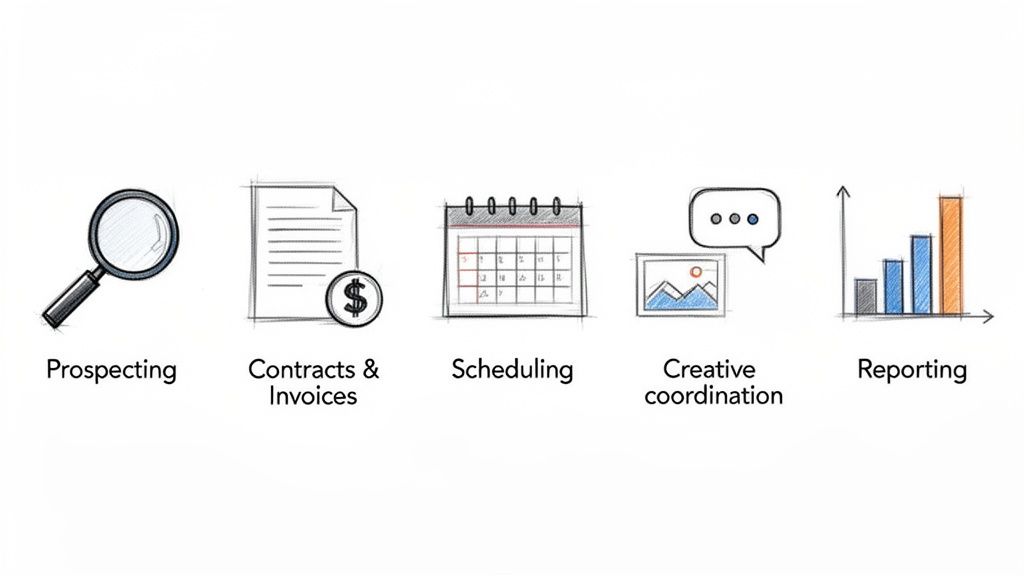
So where does all that time actually go? Managing newsletter ads isn't just one monolithic task. It’s really five distinct jobs rolled into one, each demanding its own slice of your attention. It's like running a mini-agency right inside your newsletter business.
Each one of these jobs pulls you away from what you'd probably rather be doing, which is writing. When you add them all up, you quickly see how 10 hours a week can vanish into thin air. Let's pull back the curtain on each of these core tasks to see what's really involved.
Task 1: Prospecting and Sales
This is the hunt. Prospecting is all about actively seeking out brands that are a natural fit for your audience. It means digging into companies, finding the right person to talk to, and crafting personalized emails that actually get opened.
The sales part is where the real time sink is, the follow-up. You’ll spend hours answering questions, walking sponsors through your ad packages, and negotiating rates. For every "yes," you're likely to get nine rejections or, even more frustrating, radio silence. For example, a creator might send 50 personalized outreach emails just to land two or three new sponsors. That effort alone can fill an entire workday.
- Average Time: 3-5 hours per week
- The Bottleneck: The sheer volume of outreach and follow-up needed just to land one or two new sponsors a month.
The real challenge of prospecting isn’t just finding sponsors; it’s finding the right sponsors. A bad fit wastes everyone's time and can erode the trust you've built with your readers.
Task 2: Contracts and Invoicing
Once you get a verbal "yes," the paperwork kicks in. You need to draft a simple contract or insertion order spelling out the terms, get it signed, and then create and send an invoice.
Then comes the waiting game. You have to keep a close eye on who’s paid and who hasn't. Chasing down late payments is one of the most awkward parts of the job, but it’s a necessary evil that can eat up hours you'd rather spend creating content. A recent industry survey found that small business owners spend roughly 15 days a year just chasing late payments. That's a huge drain.
Task 3: Scheduling and Fulfillment
This is the logistical puzzle of your ad operations. You have to slot each sponsor into the right newsletter issue, making absolutely sure you don't double-book a premium spot. It’s a classic juggling act.
This requires a meticulous calendar, whether that's a color-coded spreadsheet or a dedicated tool. Then, on publishing day, you’re the one responsible for making sure the correct ad copy and links are perfectly placed before that email goes out to thousands of people. One tiny copy-paste error can derail an entire campaign.
- Average Time: 2-3 hours per week
- The Bottleneck: The pre-send scramble of manually inserting creative and triple-checking everything for errors right before your deadline.
Task 4: Creative Coordination
Getting the ad creative from a sponsor is rarely a simple hand-off. This task covers all the back-and-forth communication needed to get their final copy, images, and tracking links.
You’ll often find yourself giving feedback, suggesting tweaks to match your newsletter's voice, and waiting on final approval. This can easily spiral into a long email chain that drags on for days, especially if multiple people on the sponsor’s team need to sign off.
Task 5: Reporting and Analysis
Your job isn't done when the newsletter goes out. Sponsors want to know how their ad performed, and they'll be asking for the numbers. You need to pull key metrics like open rates, clicks, and click-through rates (CTR) and package them into a clean, easy-to-understand report.
This data is your proof of ROI, and it’s what convinces sponsors to come back for more. Manually compiling these reports for multiple sponsors every week is tedious, but it's absolutely vital for maintaining professional relationships. Having an organized system is key, and a solid newsletter sponsor CRM can be a lifesaver for tracking conversations and performance all in one place.
A Day in the Life of Manual Ad Management
To really get a feel for how much time this all takes, let's walk through a common scenario. Meet Alex. He runs a popular weekly tech newsletter on Beehiiv and juggles about five sponsors a month using just Google Sheets and his email.
His week kicks off with a new sponsor inquiry. What looks like a simple booking request quickly unravels into a six-email chain just to lock down a date and price. Once they finally agree, Alex has to manually create an invoice from a template, save it as a PDF, and attach it to yet another email. Then, he has to pop open his master spreadsheet to block off the date, triple-checking that he doesn't accidentally book over someone else.
The Midweek Scramble
By Wednesday, it's time to get the ad creative. The sponsor sends the copy, but the image is way too big and the tracking link is nowhere to be found. This starts a whole new email thread, pushing back the time he'd set aside for writing. Alex easily loses an hour he doesn't have just chasing down the right assets.
Finally, on publish day, he carefully copies and pastes everything into his Beehiiv editor. He then sends himself three separate test emails just to be sure the links click through and the image looks right. This whole insertion and testing dance adds a huge chunk of time to his pre-send checklist, injecting a dose of stress right before his deadline.
A simple task like confirming an ad placement can easily spiral into a multi-email chain that steals focus and creative energy. This is the hidden cost of manual ad operations.
The Never-Ending Follow-Up
Fast forward three weeks. Alex is reviewing his finances and realizes an invoice is still outstanding. Now he has to put on his debt collector hat and draft a polite-but-firm reminder email. The constant switching between "creator" and "admin" is a massive mental drain.
Alex's story is incredibly common. Our synthesized benchmarks show that manual newsletter ad management eats up an average of 8-12 hours weekly for creators dealing with five or more sponsors. With the rise of direct sales to niche sponsors, this kind of spreadsheet chaos is a huge bottleneck for people on platforms like Beehiiv and Substack. For small teams, this can easily swell to over 20 hours a week, a serious drain on resources.
You can explore the 2025 newsletter benchmarks to see how these trends are playing out across the industry. This exhausting cycle is a perfect illustration of where all the hours go, pulling creators away from what they should be doing, creating great content and growing their audience.
How Automation Changes the Entire Equation
Remember Alex’s chaotic week? The endless email chains, the spreadsheet gymnastics, and that constant fear of dropping the ball. Now, let’s imagine that same scenario, but this time, an automated platform like AdSlots is doing all the heavy lifting.
This isn’t about piling on more complex software. It's about swapping a broken, time-sucking process for a system built from the ground up to give you your time back. Automation completely flips the script on how much time you spend on those five core ad management tasks.
From Manual Chaos to Automated Clarity
Instead of you having to chase down leads, a public booking page becomes your 24/7 sales rep. It vets potential sponsors, shows them exactly what inventory is available, and lets them book and pay for a spot, all on their own time. That simple shift can wipe out dozens of back-and-forth emails from the get-go.
Invoicing and payments stop being a source of anxiety. When a sponsor books their slot, the system automatically generates an invoice through a Stripe integration. No more fiddling with manual templates or sending awkward payment reminders. For many creators, this step alone frees up 2 to 3 hours every single month.
This infographic perfectly captures the manual workflow that so many creators find themselves trapped in.
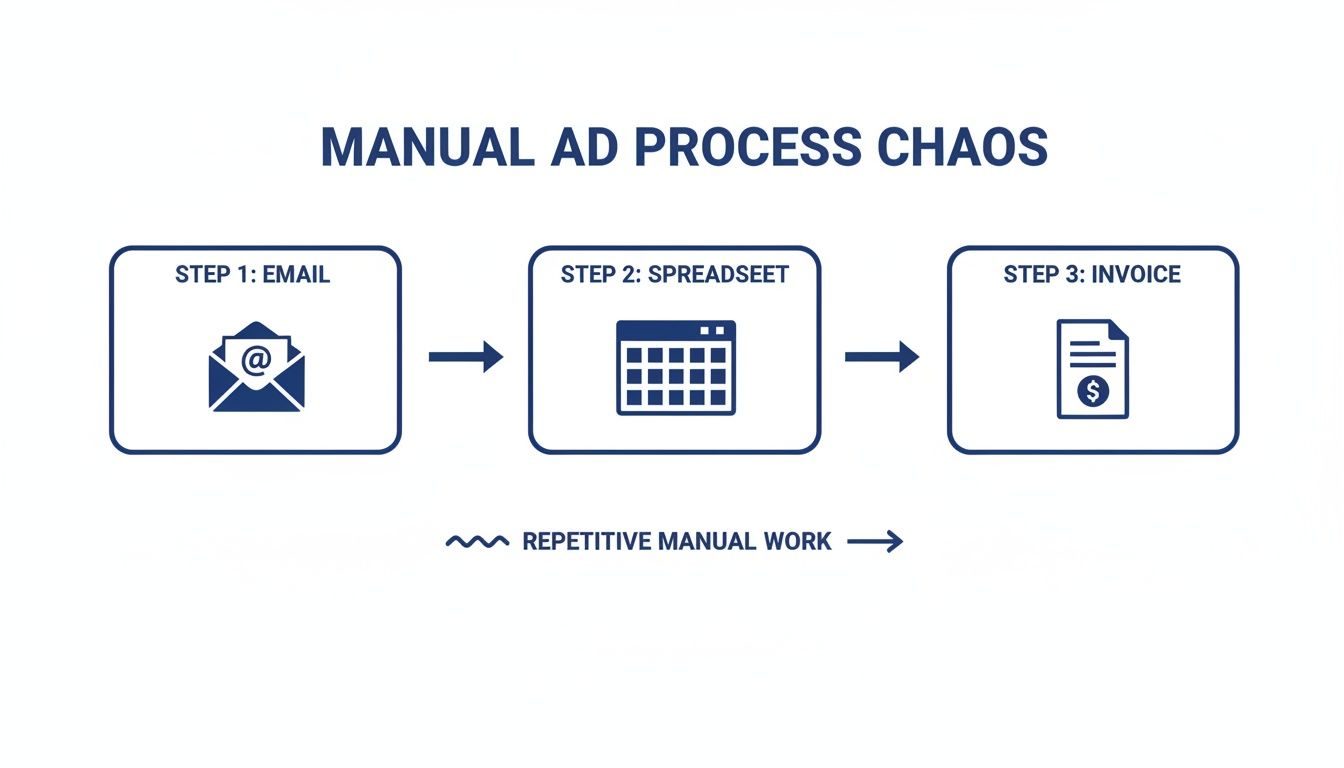
As you can see, every manual step creates a new opportunity for delays and errors, pulling you deeper and deeper into admin work.
Centralizing Your Ad Operations
Scheduling goes from being a high-stakes puzzle to a simple drag-and-drop. A visual calendar makes it impossible to accidentally double-book a premium slot ever again. You can see your entire ad inventory at a glance, which makes managing multiple sponsors across different newsletters feel effortless.
And what about the creative assets? Forget hunting through email threads for copy and images. Everything gets collected and approved in one central hub. Sponsors upload their materials directly, and the system even sends automated reminders if a deadline is creeping up. This keeps your entire production workflow smooth and predictable.
Automation isn't about replacing you. It’s about handling the repetitive, low-value tasks so you can focus on the high-value work only you can do: creating fantastic content.
For a deeper look at how new technologies can completely reshape your ad management, it's worth exploring the possibilities of AI powered workflow automation. These concepts really highlight how modern tools can dramatically cut down on manual effort.
By systematizing these processes, you can get back to focusing on your content while the platform handles the logistics. The real magic, though, is how you can use automated newsletter ad insertion to place approved creatives directly into your Beehiiv or Substack posts. This eliminates that final, nerve-wracking step of manually copying and pasting just before you hit publish. It turns a stressful pre-send checklist into a simple, reliable process, saving you from last-minute scrambles and costly errors. This is how you reclaim your time and scale your sponsorships without burning out.
Practical Steps to Reduce Your Ad Management Time
Saving time on ad management isn't about some secret trick or magic bullet. It’s about making a series of small, smart tweaks to your workflow that really add up. These practical steps can help you reclaim hours, whether you're juggling spreadsheets or trying to get more out of a dedicated tool.
The whole point is to stop being reactive, constantly putting out fires, and start building a system that hums along smoothly in the background. Even adopting just one or two of these strategies can make a huge difference in your administrative workload.
Standardize Your Ad Packages
One of the biggest time-drains is the endless back-and-forth with potential sponsors. You can cut right through that noise by creating clear, standardized ad packages. Define exactly what you offer, set your prices, and lay it all out in a simple, easy-to-digest document or media kit.
This one move accomplishes a few critical things:
- It pre-qualifies sponsors. They immediately see if your rates align with their budget, saving both of you from a pointless conversation.
- It cuts down negotiation time. When pricing is clear and upfront, there’s much less room for haggling.
- It boosts your professionalism. A well-defined set of offerings shows you’re organized and serious about your business.
This is a core concept baked right into a platform like AdSlots. You can create your ad inventory with set prices and availability, which lets sponsors book directly from a public page without you ever having to jump on a sales call.
Use Templates for Common Communications
Think about how many times you’ve typed the same email from scratch. Whether it’s an initial sales pitch, a reminder to submit creative, or a final performance report, templates are your best friend.
Create a go-to folder of pre-written emails for every stage of the sponsor journey. This not only keeps your communication consistent and professional but can easily cut your time spent on email in half.
Pro Tip: Set up canned responses in your email client for common replies like, "Thanks for reaching out!" or "Here's the link to our media kit." It’s a tiny change that stops you from typing the same few sentences over and over again.
Create a System for Ad Creative
Nothing creates stress like scrambling to find ad creative an hour before your newsletter is supposed to go out. Avoid the last-minute panic by setting up a simple, central hub for collecting and tracking these assets. This could be a shared Google Drive folder or a dedicated form where sponsors upload their materials.
A clear system means assets don't get buried in a crowded inbox, and you have one single place to check when it’s go-time. To get the most bang for your buck, applying some effective design hacks to boost ad Click-Through Rate can also make a huge difference.
If you’re ready for a more powerful setup, using newsletter ad scheduling software gives you a visual calendar and sends automated reminders. This makes it almost impossible to miss a placement and ensures sponsors know exactly when their creative is due.
A Few Common Questions About Ad Management
If you're getting serious about newsletter advertising, you probably have a few questions. Let's tackle some of the most common ones that come up when creators are trying to figure out how much time this all really takes.
How Much Time Should I Actually Spend on Ad Ops?
Honestly? As little as possible. Your real job is creating great content, not getting bogged down in administrative muck.
For a solo creator, if you're spending more than 2-3 hours a week on ad operations, that’s a red flag. It means your manual process is starting to hold you back. Once you’re juggling five or more sponsors, that number can easily jump to 10+ hours a week, and that’s just not sustainable for most people.
The whole point is to minimize the manual grind. If you find yourself consistently losing half a day (or more) every week just to keep the ads running, it's time to find a better system.
When Is It Time to Ditch the Spreadsheet?
For most creators, the spreadsheet starts to fall apart when they're trying to manage 3-5 sponsors at the same time. That's usually the breaking point.
It might be time to switch if you're nodding along to any of these:
- You've had that sinking feeling of accidentally double-booking an ad slot.
- You spend hours every month chasing down sponsors for late payments.
- You get a knot in your stomach right before hitting "publish," wondering if you remembered to put the right ad creative in the right spot.
It's less about your subscriber count and more about how complex your ad business has become.
The moment you feel more like a full-time ad operations manager than a content creator is the moment you've outgrown your spreadsheet.
Can Automation Just Handle Everything for Me?
Not quite, but it gets pretty close. Automation is a lifesaver for all the repetitive, error-prone tasks that eat up your day, but it can't replace your strategic brain.
Here’s what automation is fantastic at:
- The Admin Grind. Think sending invoices, tracking payments, and firing off automatic reminders.
- Smart Scheduling. It prevents you from selling the same ad slot twice and keeps your inventory organized.
- Performance Reporting. It can automatically pull key stats and send them to your sponsors.
What’s left for you? The important stuff. You'll still be the one building relationships with sponsors and making sure their campaigns are a great fit for your audience. Automation just gives you the time to actually do that high-value work well.
What's the Single Biggest Time-Saver for a Beginner?
If you're just starting out, do this one thing: create standardized ad packages.
Instead of custom-building and negotiating every single deal from the ground up, create a few clear offerings with set prices. This one move eliminates a mountain of back-and-forth emails and makes your entire sales process way faster.
Ready to stop the spreadsheet chaos and get your time back? Ad Slots turns your ad operations into a smooth, automated system so you can focus on what you do best, writing. See how much time you can save.