
Figuring out what to charge for newsletter ads can feel like a shot in the dark. You've built an audience that trusts you, but how do you put a dollar value on that relationship without selling yourself short?
Let's clear that up. You don't need a finance degree or a massive spreadsheet to get this right. The key is to start with a pricing model that fits where your newsletter is right now. For most people, that means starting simple with a flat fee, then graduating to a CPM (cost per mille) model as you grow, and maybe even exploring performance-based deals once you have a solid track record.
The goal is to find a price that truly reflects your audience's value, not just its size.
Choosing Your First Newsletter Ad Pricing Model
So, where do you begin? The first step is to get familiar with the three main ways newsletter ads are priced. Which one you pick really comes down to your newsletter's size, your niche, and frankly, how much complexity you want to deal with.
Let’s break down the options so you can confidently pick the right one and start earning.
The Simple Flat-Fee Model
If you're just starting to monetize, the flat-fee model is your best friend. It’s exactly what it sounds like: you charge one fixed price for an ad in your newsletter. Simple, predictable, and no complicated math involved. The advertiser pays your fee, you run their ad, and you're done.
This approach is perfect for smaller, growing newsletters. It keeps the conversation focused on giving an advertiser access to your unique audience, not on performance metrics you might not have enough data for yet. It takes the pressure off guaranteeing a certain number of clicks or conversions right out of the gate.
A practical example comes from Matt McGarry, creator of the Substack-focused newsletter Growth Notes. When he had around 2,000 subscribers, he charged a simple flat rate of $99 per ad. This made it easy to attract sponsors looking for targeted reach without the hassle of a complex CPM deal.
The Industry-Standard CPM Model
Once your list starts to grow, you'll likely want to switch to the CPM model. CPM stands for "cost per mille," with "mille" being Latin for a thousand. You're charging a set rate for every 1,000 subscribers you have. For example, if you have 10,000 subscribers and your CPM is $40, a sponsorship costs $400.
This is the standard for most established newsletters because it directly ties your ad rates to your audience size. As you grow, your revenue automatically grows with you.
A niche B2B newsletter that reaches software engineers might command a premium CPM of $60 to $90, while a broader B2C lifestyle newsletter might land closer to $25 to $40. The real value isn't just in the numbers; it's in how targeted your audience is.
If you want a quick ballpark figure, you can plug your numbers into our free newsletter ad pricing calculator to see what a reasonable CPM looks like for your niche.
The High-Risk, High-Reward Performance Model
Finally, you have performance-based models, like Cost Per Acquisition (CPA) or Cost Per Click (CPC). With this setup, you only get paid when a reader actually does something like clicks a link, signs up for a free trial, or buys a product.
The upside here can be huge. If a sponsor has an offer that your audience absolutely loves, you could earn way more than you would with a flat fee. The catch is that all the risk is on you. If the sponsor’s creative is weak or their landing page doesn’t convert, you get paid nothing for giving them valuable ad space.
Because of that risk, this model is usually best for seasoned creators who know their audience inside and out and can practically predict what they’ll respond to.
Quick Guide to Newsletter Ad Pricing Models
Choosing the right model is all about matching it to your newsletter's current stage. This quick comparison should help you decide which path is best for you today.
| Pricing Model | How It Works | Best For |
|---|---|---|
| Flat-Fee | You charge a single, fixed price for an ad placement. | Beginners & Smaller Newsletters (<10k subs). It's simple, predictable, and easy to sell. |
| CPM (Cost Per Mille) | You charge a set rate for every 1,000 subscribers. | Growing & Established Newsletters. It scales with your audience and is the industry standard. |
| Performance (CPA/CPC) | You get paid only when a reader clicks or converts. | Advanced Creators with highly engaged audiences and a deep understanding of what converts. |
Ultimately, you can always change your model as your newsletter evolves. The most important thing is to just get started.
Calculating an Ad Rate You Can Stand Behind
Alright, you've picked a pricing model. Now comes the part that trips up most creators: landing on an actual number. It feels like pulling a price out of thin air, but it doesn't have to be. Let's walk through how to build a rate you can confidently pitch to any sponsor, because it'll be backed by real data.
The best way to start is by using the CPM model to find your footing, even if you plan on selling flat-fee sponsorships later. It gives you a logical, industry-standard benchmark based on your audience, making your price feel solid, not random.
This chart breaks down the common ways to think about pricing.
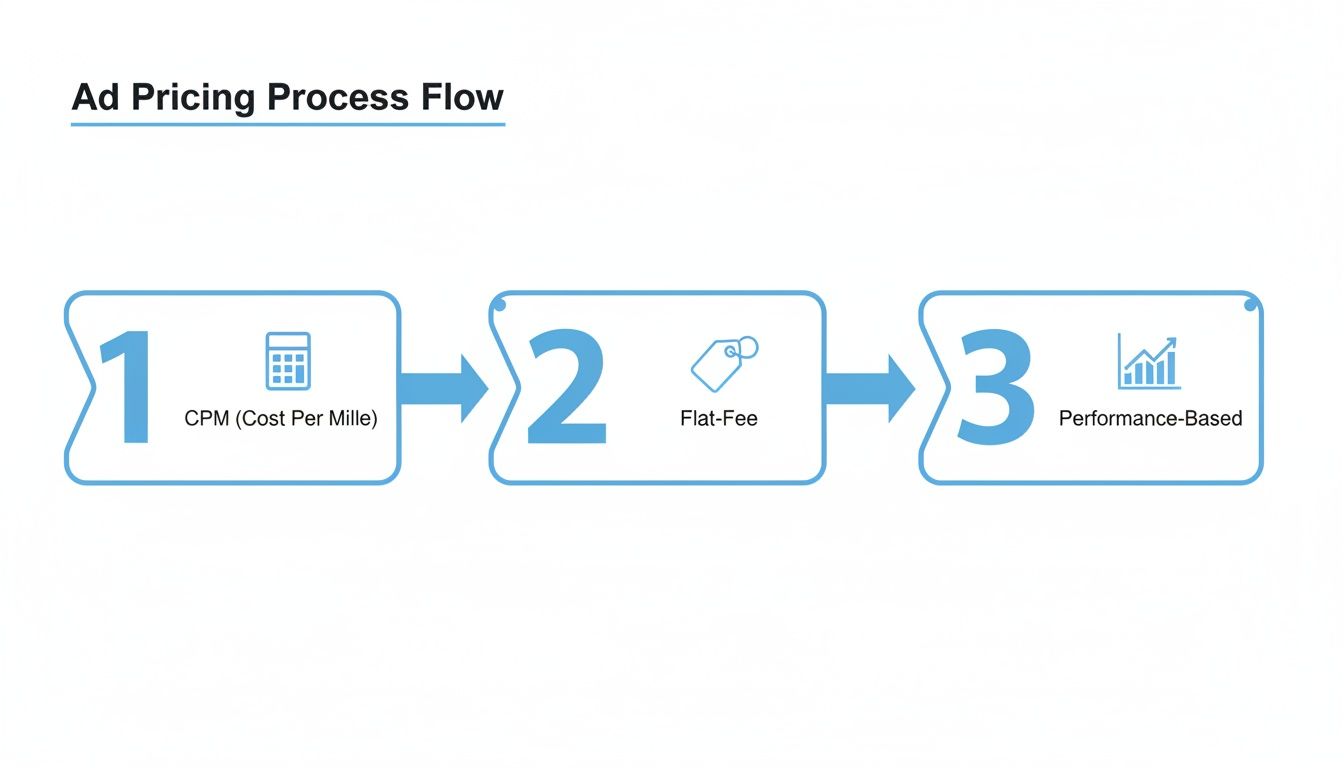
Whether you price by audience size (CPM), a simple package deal (Flat-Fee), or direct results (Performance-Based), it all starts with understanding your baseline value.
Finding Your Baseline CPM
Let's start with a simple formula that connects your subscriber list to what advertisers are used to paying. This will give you a real number to work from.
The formula is straightforward: (Subscriber Count / 1,000) x CPM = Baseline Rate
Let's make this real. Imagine you have 10,000 subscribers and a decent open rate. For a general consumer-focused newsletter, a CPM between $25 to $40 is a pretty standard ballpark.
If you pick a $30 CPM:
- (10,000 / 1,000) x $30 = $300
Boom. You now have a $300 baseline rate for an ad placement. It's not a guess; it's a price directly tied to your audience reach.
Layering on Your "Value Multipliers"
A baseline rate is a great start, but it’s just that, a start. It doesn't capture what makes your newsletter truly special. The real money is in the quality and focus of your audience. This is where "value multipliers" come into play, and they are your best friend for justifying a premium price.
Think about it. A highly specialized B2B newsletter for fintech executives can easily charge a CPM of $60 to $90. Why? Sponsors are paying a premium to get in front of a very specific, high-value group of people they can't easily reach anywhere else.
Your niche is your superpower. A general news roundup with 50,000 subscribers might charge a $25 CPM ($1,250 per ad), but a focused AI developer newsletter with just 10,000 subscribers could command an $80 CPM ($800 per ad). Per subscriber, the smaller, niche newsletter is far more valuable.
When you're thinking about your rate, consider these multipliers:
- Who are your readers? Are they high-income earners? C-suite decision-makers? Hobbyists in a notoriously hard-to-reach industry? Any data you have on job titles, income, or specific interests is leverage.
- How engaged are they? Strong open and click-through rates are cold, hard proof that your audience pays attention. If your open rate is consistently north of 40%, you absolutely should be charging more.
- Where is the ad? A main sponsorship right at the top is prime real estate. It's worth a lot more than a small link buried at the bottom. You can, and should, charge a premium for that "above the fold" visibility.
Going beyond basic stats is key. Learning how to measure customer engagement with deeper metrics gives you powerful talking points to bring to a negotiation.
A Quick Detour: Pricing Based on Opens
Some savvy creators and data-driven sponsors prefer to calculate CPM based on average unique opens instead of the total subscriber count. This is sometimes called "effective CPM" or eCPM, because it zeroes in on how many people actually see the ad.
Let's go back to our example:
- You have 10,000 subscribers.
- Your average open rate is a solid 40%.
- That means you have 4,000 unique opens per issue.
Now, the formula gets a slight tweak: (Average Opens / 1,000) x CPM = Adjusted Rate
Using a $50 CPM (which is totally fair for a list with that kind of engagement):
- (4,000 / 1,000) x $50 = $200
This approach can be really appealing to advertisers who care about performance, as it ties their cost directly to proven eyeballs. By starting with a baseline CPM and layering on multipliers like your niche and engagement stats, you build a price that makes sense. It shifts the conversation from "How much?" to "Here's the incredible value I deliver for that price."
Creating Ad Packages Sponsors Actually Want to Buy
Selling one-off ad slots is fine when you're just starting, but if you want predictable revenue, you need to think in terms of sponsorship packages. This is a game-changer. It shifts the entire conversation from a simple transaction to a long-term partnership which is exactly what you and your ideal sponsors should be aiming for.
The whole idea behind bundling is to give advertisers options that fit different budgets and goals. Not every brand can afford your top-tier placement, and that’s perfectly okay. By creating a few different packages, you make it incredibly easy for sponsors of all sizes to find a way to work with you.
Building Your Tiered Sponsorship Packages
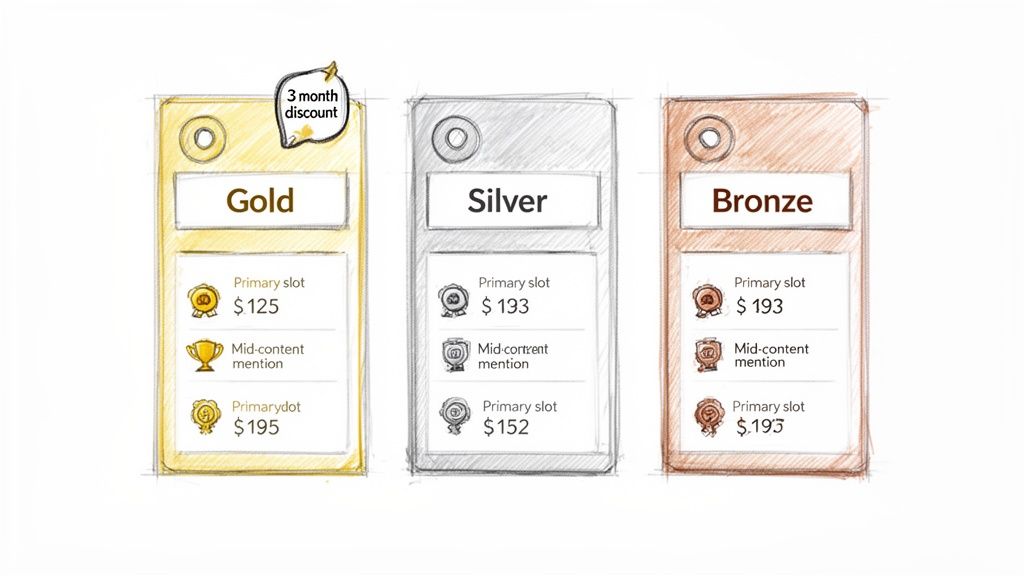
Think of your ad inventory like a restaurant menu. Sure, you can order a single item, but the "combo meals" are often the best value and the easiest sell. A classic and very effective approach is to create three distinct tiers. You can call them whatever you want, but Gold, Silver, and Bronze get the job done.
-
The "Gold" Package (Premium): This is your all-in, top-dollar offering. It should always include your most valuable real estate, like the primary sponsorship right at the top of the newsletter. But don't stop there. Toss in some extra perks, like a dedicated social media mention or a special feature. This package is built for sponsors who want maximum impact and are willing to pay for it.
-
The "Silver" Package (Standard): This will likely be your most popular option. It’s the middle-of-the-road choice that offers a fantastic balance of visibility and cost. It usually includes a main ad slot but maybe without all the bells and whistles of the premium tier. It's the sweet spot for most advertisers.
-
The "Bronze" Package (Entry-Level): Here’s your most affordable option, designed to get new sponsors in the door. This could be a smaller classified-style ad or even just a text link at the bottom of an issue. It’s the perfect low-risk choice for sponsors with smaller budgets or those who just want to test the waters before committing to a bigger spend.
For instance, the Future Party newsletter boosted its ad revenue by 40% in a single quarter by introducing sponsorship packages. They stopped selling single ads and instead focused on multi-month bundles. It was a simple switch, but it created predictable income and started attracting higher-quality, long-term partners.
Pricing Your Bundles and Offering Discounts
Once you've defined your tiers, you have to price them strategically. The goal is to make the packages feel like a better deal than just buying a single ad. The easiest way to do this is by offering discounts for multi-issue commitments.
This approach isn't just about locking in recurring revenue for you; it's also better for the sponsor. We all know that ad campaigns perform better over time as an audience gets familiar with a brand. A sponsor who commits to a three-month package is almost guaranteed to see a better return than one who just runs a single, forgotten ad.
To help you visualize this, here's a simple table showing how you might structure your packages.
Sample Newsletter Ad Packages
This table shows an example of a tiered ad package structure that you can adapt for your own newsletter.
| Package Tier | Includes | Price (Example) | Best For Sponsors Who… |
|---|---|---|---|
| Gold Sponsor | 1 Primary Ad per month, Social Media Shoutout, Logo in Footer | $1,800/mo (3-month min) | Want to build strong brand recognition and maximum exposure with your audience. |
| Silver Sponsor | 1 Secondary Ad per month | $1,000/mo (3-month min) | Are looking for consistent visibility and solid performance at a balanced price point. |
| Bronze Mention | 1 Classified Ad per month | $400/mo (3-month min) | Are on a tighter budget or want to test the effectiveness of your newsletter. |
Notice the "3-month minimum" in there? That little detail is key. It's your ticket to moving away from one-off sales and creating a stable, predictable income stream. It also gives the sponsor's campaign enough runway to actually start working.
Remember, how you present these packages is just as important as how you build them. A polished, professional media kit can make all the difference. To get a head start, you can use a free newsletter media kit generator to create a document that lays everything out packages, audience stats, and pricing in a way that makes sponsors eager to sign on.
How to Negotiate and Close Sponsorship Deals
You’ve got your prices and packages ready to go. Now for the fun part: actually selling them. This is your playbook for navigating those sponsorship conversations without feeling awkward or overly "salesy." The whole game is about being prepared, professional, and confident in the value you bring to the table.
Having a solid rate card is the first step, but the real work starts when you begin talking to potential sponsors. Let's walk through how to handle that first email, gracefully manage objections, and close deals that feel like a win for everyone involved.
Crafting Outreach That Actually Gets a Response
That first email you send sets the tone for the entire relationship. My advice? Ditch the corporate jargon and those long, rambling emails that no one reads. Your goal is to be concise, personal, and focused on them, not just you. A simple, effective script can make all the difference.
Here’s a template I’ve seen work wonders:
Subject: Partnership with [Your Newsletter Name]?
Hi [Sponsor Name],
I've been a big fan of [Sponsor's Brand] for a while, especially your recent [mention a specific project or product]. I run [Your Newsletter Name], a weekly newsletter for [describe your audience, e.g., 15,000 product managers].
I think our audience of engaged [audience type] would be a perfect fit for what you're doing.
Would you be open to seeing our media kit? It has all our stats and partnership options.
Best,
[Your Name]
This approach is effective because it’s short, proves you’ve done your homework, and ends with a clear, low-commitment ask.
The Power of a Professional Media Kit
Before a sponsor even has a chance to ask for your numbers, you should have them ready to go in a professional media kit. Honestly, this single document is your most powerful sales tool. It's designed to answer a sponsor's questions before they even think to ask them, which immediately makes you look organized and serious.
Make sure your media kit includes:
- A quick bio: Who are you and what’s your newsletter all about?
- Audience demographics: Who reads your stuff? Include key stats like job titles, interests, or any other data that makes your audience valuable.
- Key metrics: Don't just list your subscriber count. Show off your average open rate, click-through rate, and growth trends.
- Sponsorship packages: Clearly lay out your tiered packages with pricing and exactly what’s included in each.
- Testimonials: Got happy sponsors? Include a quote or two from past partners who had a great experience working with you.
A well-designed media kit saves you countless back-and-forth emails and instantly positions you as a professional they want to work with.
Handling Price Pushback Without Caving
It’s going to happen. A sponsor will love your newsletter but balk at the price. This is a totally normal part of any negotiation, so don't take it personally. The trick is to shift the conversation from cost to value.
When a sponsor says your price is too high, resist the urge to immediately offer a discount. Instead, re-center the conversation on the unique value of the audience you’ve worked so hard to build.
Here's how you might respond:
"Thanks for the feedback on the pricing. I understand it's an investment. To give you some context, our rates are based on the direct access we provide to a highly engaged audience of [your specific audience niche], which our partners have found delivers a strong return. Our last sponsor, [Previous Sponsor Name], saw a [mention a specific positive result, e.g., 7% click-through rate] on their campaign."
This response does a few important things:
- It validates their concern.
- It calmly reinforces your value.
- It provides social proof with a real-world result.
If they still push back, that's when you can start thinking about a strategic discount but only in exchange for something valuable. For instance, you could offer a 10-15% discount for a multi-issue commitment (like booking three months instead of one). This way, you’re not just cutting your price; you're securing a long-term partner and predictable revenue.
Closing the deal really comes down to showing confidence in what you've built. Stand firm on your rates when you know they're fair, focus on the unique audience you serve, and you'll attract sponsors who respect your work and are more than happy to pay for it.
Nailing Your Workflow to Keep Sponsors Coming Back
Closing the deal feels great, but what happens next is what really matters. The way you handle the nuts and bolts onboarding, getting ad copy, scheduling is what turns a one-time advertiser into a long-term partner. If your process is a mess of scattered emails and spreadsheets, it screams amateur hour.
A smooth, professional workflow, on the other hand, does more than just save you a headache. It builds the sponsor’s confidence and makes them excited to work with you again. Let’s build a system that gets you out of the operational weeds and helps you lock in that sweet, sweet repeat business.
A Simple, Effective Ad Management Workflow
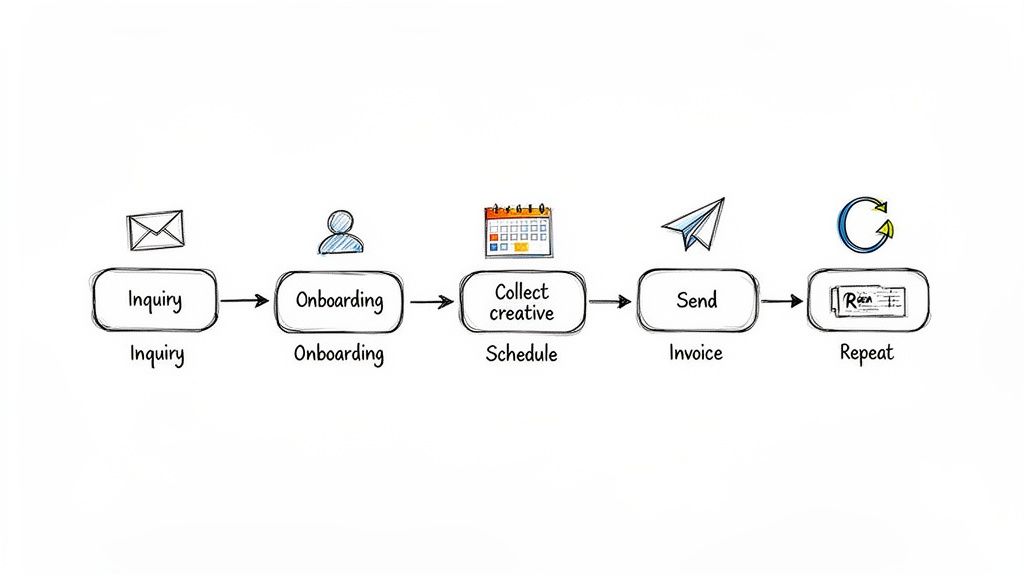
You don’t need some overly complicated system to look like you've got it all together. A simple, repeatable process is all it takes to manage sponsorships like a pro. Here’s a breakdown of the key stages that will take you from a signed deal to a happy, recurring sponsor.
First, Create a Welcome Packet
As soon as a sponsor says "yes," send them a welcome packet. This can be a simple PDF or even just a well-structured email that tells them exactly what to expect and what you need from them.
Your packet should include:
- Ad Specs: Get specific. List the exact requirements for their ad creative image dimensions, headline character limits, body copy word count, the works.
- Key Deadlines: Be crystal clear about when you need their materials. I always recommend setting this deadline 5-7 days before the newsletter send date. It gives you a buffer.
- Next Steps: Briefly walk them through what happens next. A simple "I'll send you a preview for final approval before we go live" goes a long way.
This one small step cuts down on so much back-and-forth. You set expectations right away, prevent last-minute fire drills, and instantly show the sponsor that you run a tight ship.
Centralize How You Collect Ad Creative
Stop digging through email chains for ad copy and images. It's a nightmare. Instead, use a single, dedicated place to collect all sponsor materials. A simple Google Form works wonders here.
By using a form, you ensure you get everything you need, in the right format, all at once. Ask for each piece separately: headline, body copy, URL, and an image upload field. This little bit of organization will save you from that frantic "wait, where's the link?!" moment right before you hit publish.
It's Time to Graduate from Spreadsheets
Look, spreadsheets are fine when you're just starting out with one or two sponsors. They become a massive liability as you grow. Trying to manually track payments, ad run dates, and creative assets for multiple clients is a recipe for disaster. Something will fall through the cracks.
This is where dedicated tools become your best friend. Platforms built for newsletter creators can automate this entire workflow. Imagine invoices sending themselves, payments getting tracked automatically, and your ad calendar always being up-to-date. Using a tool like a newsletter sponsor CRM can replace that chaotic spreadsheet with a clean, automated dashboard.
This isn't just about saving a few hours a week. It’s about presenting a polished, reliable image to sponsors the kind that makes them comfortable signing those bigger, long-term deals.
Scheduling and Sending It Off
With all the creative in hand, the final steps are scheduling and fulfillment. A shared ad calendar is non-negotiable for avoiding double-bookings. It gives you a bird's-eye view of your ad inventory for the coming weeks and months.
And one last thing: always send a test or preview to the sponsor before the newsletter goes live. This final check-in ensures they're happy with how everything looks and that all the links work. It's a small professional touch that catches potential errors and reinforces that you're a partner they can trust. For those running more complex ad operations, it can even be helpful to see how pros who offer outsourced PPC campaign services manage their own internal workflows.
Ultimately, a smooth operational flow is a core part of justifying your ad rates. When sponsors see that you’re organized and professional, they perceive more value in what you offer, making them far more likely to agree to your prices and book again.
Got Questions About Newsletter Ad Pricing? We've Got Answers
Even with the best plan, you're going to have questions when you start selling ad space in your newsletter. That's totally normal. Let's walk through a few of the most common ones that come up for creators just getting started.
What Should I Charge for My First-Ever Newsletter Ad?
For your very first ad, think simple. Your goal is to get a win on the board and build some momentum. A flat fee is your best friend here it cuts through the complicated math and makes it an easy "yes" for a potential sponsor.
If you have under 5,000 subscribers, aim for something in the $50 to $150 range. This is perfect for attracting those initial niche brands or even local businesses who want to test the waters.
Your first sale isn't about making a killing. It's about proving the concept, landing a great testimonial, and smoothing out your own workflow. Once you have a few successful campaigns under your belt, you’ll have the data and the confidence to start charging more.
How Often Should I Re-evaluate My Ad Rates?
It's a good idea to take a fresh look at your pricing every 3-6 months. Another great trigger is hitting a big growth milestone, like when you cross a new 5,000-subscriber threshold.
When you do your review, dive into your key metrics. If your subscriber count, open rates, and click-throughs are all heading in the right direction, your ad inventory is officially more valuable. Your pricing needs to reflect that.
And don't forget to be transparent with your long-term partners.
- Give them a heads-up that rates are increasing next quarter.
- Offer them a chance to lock in the current rate if they book another package now.
This is a simple way to reward their loyalty while still fairly valuing the audience you've worked so hard to build.
Should I Offer Performance-Based Pricing?
Performance models like cost-per-click (CPC) or cost-per-acquisition (CPA) can sound great to advertisers, but they shift a ton of risk onto your shoulders. Suddenly, your revenue depends on factors you have zero control over, like the sponsor’s landing page conversion rate or the quality of their offer.
It’s almost always safer to stick with flat-fee or CPM models. You get paid for providing access to your audience not for the final outcome of their marketing campaign.
Now, if a sponsor is really dug in on a performance deal, you could meet them in the middle with a hybrid model. Try offering a lower base fee plus a bonus for each conversion. This way, you guarantee some income for your work while still giving them the performance-based upside they’re after.
What Metrics Do Sponsors Actually Care About?
When it gets down to brass tacks, sponsors are looking at four key things. Make sure these are front and center in your media kit because they tell the full story of the value you bring to the table.
- Total Subscribers: This is the first number they'll look at to gauge your overall reach.
- Average Open Rate: This proves your audience is actually engaged and sees your content.
- Average Click-Through Rate (CTR): This shows your readers are willing to take action based on your recommendations.
- Audience Demographics: This is all about fit. Who are your readers? What do they do?
Remember, a massive subscriber list isn't everything. A super-high open rate on a smaller, niche list can be way more valuable. If you can share specific details like job titles, common interests, or the industry your readers work in you make your newsletter an irresistible choice for the right sponsor.
Let's be honest, managing sponsorships can feel like a full-time job. Between pricing, invoicing, and scheduling, it gets out of hand fast. With a tool like Ad Slots, you can automate that entire workflow, from tracking payments to placing the ads. This frees you up to focus on what you do best: writing great content. Stop drowning in spreadsheets and start streamlining your ad operations today.