
Thinking about selling ads in your newsletter? It's a great way to monetize, but it's more than just dropping a "Sponsor Here" link in your footer. The real work begins long before you send your first pitch. It's all about building something sponsors actually want to be a part of.
Building a Sponsor-Ready Newsletter
Before you can sell anything, you need a solid product. In this case, your newsletter is the product. Sponsors are not just buying ad space; they are buying access to your audience's attention and trust. That means your first job is to build a publication that’s valuable to readers first.
A newsletter ready for sponsorship has two non-negotiable parts. First, a well-defined, engaged audience. Second, a professional way to present your value proposition. If you are missing either of these, your outreach is going to be a tough sell.
Know Your Audience and Metrics
Sponsors need specifics. "Tech enthusiasts" just does not cut it anymore. They want to know exactly who they are paying to reach. You need to get granular and paint a clear picture of your readership.
Who are they really? What are their job titles, their biggest challenges, their goals? The more detailed you are, the easier it is for a sponsor to see the connection. For instance, instead of saying "people interested in marketing," try something like, "My audience is made up of over 5,000 B2B marketing managers at SaaS companies actively looking for new growth strategies." Now that gets a sponsor's attention.
Beyond the "who," you need the "what." This is where your metrics come in. These are the vital signs of your newsletter's health and the hard proof of its value.
- Subscriber Count: The size of your list.
- Open Rate: The percentage of subscribers opening each issue. Anything over 40% is fantastic and a huge selling point.
- Click-Through Rate (CTR): The percentage of people clicking on links. This shows your audience is not just opening your emails, they are actively engaging with the content.
These numbers tell a story. A small, highly engaged list is often way more valuable to the right sponsor than a massive, passive one. Choosing the right platform from the start is crucial for tracking these metrics accurately; you can even see how some of the best free newsletter platforms stack up.
Craft a Compelling Media Kit
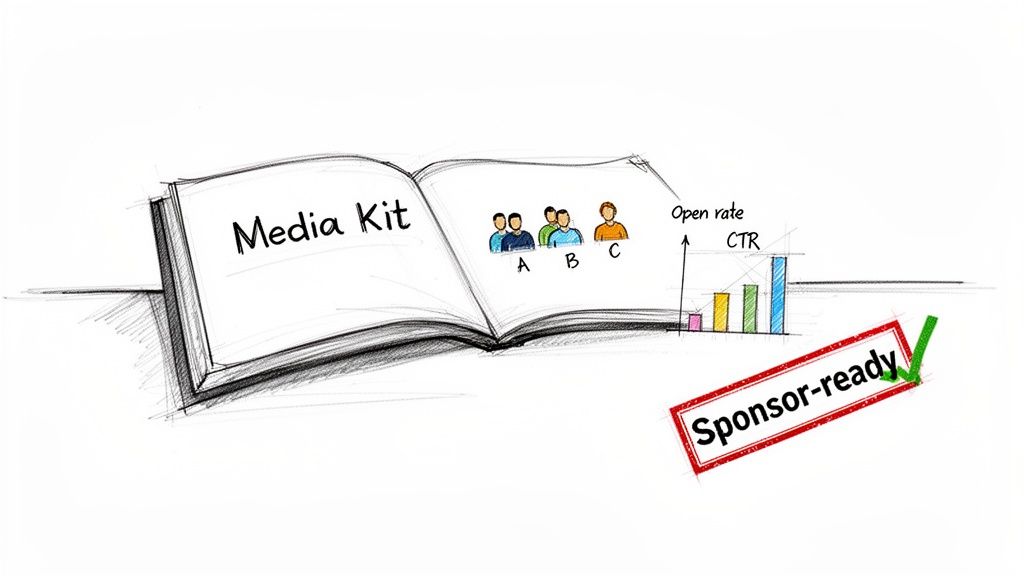
Your media kit is basically your newsletter’s resume. It is a clean, professional document that packages all this crucial information for potential advertisers. It needs to anticipate their questions and answer them clearly and persuasively.
A great media kit should always include:
- A quick intro to your newsletter and its mission.
- Detailed audience demographics (who they are, what they do).
- Your key performance stats: subscriber count, open rate, and CTR.
- A clear menu of your ad options and pricing.
- Social proof like testimonials or case studies from past sponsors, if you have them.
Your media kit's job is to make a sponsor's decision easy. It should immediately communicate the value of your audience and build trust in your ability to deliver results.
The good news is that you have picked a great channel to monetize. A recent study found that 46% of creators say their newsletters generate ad revenue faster than other channels like podcasts or blogs.
If you are feeling stuck on creating this, do not worry. There are tools that can help. You can use a newsletter media kit generator to whip up a professional-looking document in just a few minutes. With a strong newsletter and a polished media kit, you are no longer just asking for money. You are offering a premium opportunity the right sponsors will not want to miss.
Creating Your Ad Products and Setting Prices
With a professional media kit ready to go, it is time to figure out what you are actually selling. This is where you define a clear menu of ad products and put a price tag on them that reflects the real value of your audience’s attention. If your offering is vague, sponsors get confused, and you almost always leave money on the table.
Think of your ad inventory as the real estate inside your newsletter. You need to structure it. Most successful newsletters offer a few distinct ad formats, which gives sponsors some much-needed options.
Defining Your Ad Inventory
The simplest way to start is by creating different sponsorship tiers. This gives sponsors with different budgets and goals a way to work with you. The idea is to build a product suite that feels both premium and accessible.
Here are the most common ad formats you will want to consider:
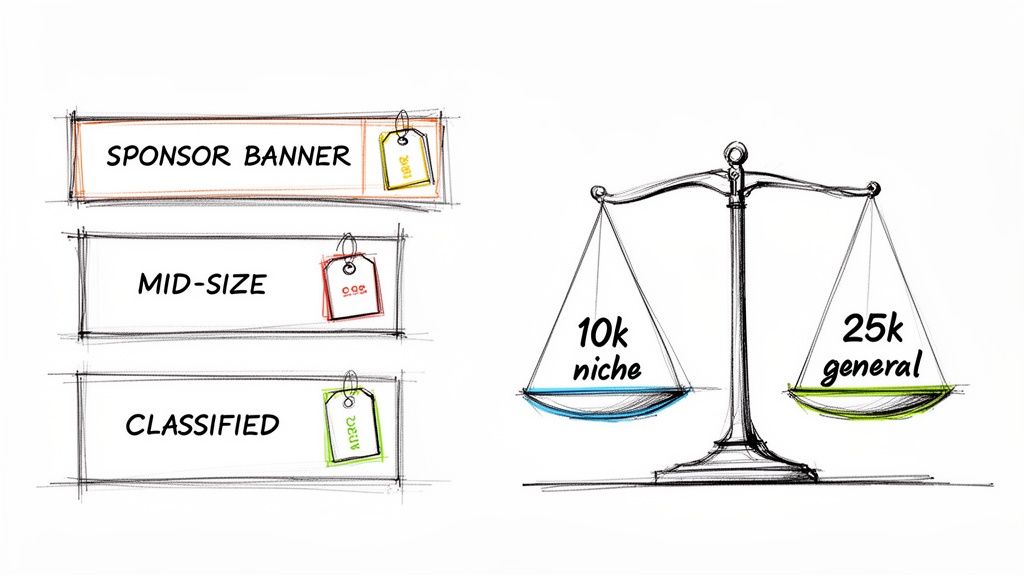
- Primary Sponsorship: This is your top-tier, main event offering. It is the most prominent ad, usually placed right near the top of the newsletter. It typically includes a headline, a few sentences of copy, an image or logo, and a clear call-to-action link.
- Mid-Content Placement: Think of this as a smaller, more subtle ad placed further down in your content. It might just be text-based and is a great option for sponsors with smaller budgets or those just looking to test the waters with your audience.
- Classifieds or "Shout-outs": These are short, text-only ads, often grouped together in their own section at the bottom. They are a fantastic low-cost, high-volume option perfect for other creators, small businesses, or people selling digital products.
The market for these placements is incredibly strong. In 2024, the beehiiv Ad Network alone generated $3,726,453.84 in revenue for its creators, which just shows the massive potential of selling ads directly. You can read the full report on the state of newsletters to see how direct monetization is taking off.
Setting Your Ad Rates
Pricing your ads is part art, part science. While metrics are important, you should not get stuck on a simple CPM (Cost Per Thousand Impressions) formula. For most independent creators, a flat-rate pricing model is the way to go. It is simple, predictable, and easy for everyone involved to understand.
Instead of getting bogged down in complex calculations, a flat rate says, "Access to my audience for this specific placement costs X." It communicates confidence and clarity.
So, how do you land on that flat rate? The key is to start by looking at your audience's value, not just its size. A highly-focused finance newsletter with 10,000 subscribers who are active investors can easily charge more than a general pop culture newsletter with 25,000 casual readers.
Your niche and engagement are your most valuable assets. Period.
To find your starting point, think about these factors:
- Audience Niche: How specific and valuable is your audience to a potential advertiser?
- Engagement Metrics: What are your average open and click-through rates? High engagement is your proof, and it justifies higher prices.
- Ad Placement: The primary sponsorship slot at the top should always be your most expensive product.
Take a practical example. A newsletter like Fintech Brain Food by Simon Taylor can command premium rates because its audience is laser-focused and influential within the financial technology world. A sponsor knows they are reaching decision-makers, not just hobbyists.
Choosing the right pricing model is crucial. Here is a quick breakdown of the most common ones:
Newsletter Ad Pricing Models Comparison
This table compares common pricing models for newsletter ads, helping you choose the right one for your business.
| Pricing Model | How It Works | Best For | Example Rate |
|---|---|---|---|
| Flat-Rate | A fixed price per ad, per newsletter issue. Simple and predictable for both parties. | Most creators, especially those with engaged, niche audiences. | $500 for a Primary Sponsorship slot |
| CPM (Cost Per Mille) | Price is based on every 1,000 opens (impressions). | Larger newsletters with massive, predictable open numbers. | $40 CPM on a 50,000-subscriber list |
| CPC (Cost Per Click) | Advertiser pays only when a subscriber clicks the ad link. | Newsletters with very high, proven click-through rates. | $3 per click |
| CPA (Cost Per Action) | Advertiser pays only when a click leads to a specific action (e.g., a sale, signup). | Performance-focused campaigns where attribution is easy to track. | 15% commission on sales generated from the ad |
For most creators, starting with a Flat-Rate model is the most straightforward and effective approach. It keeps things simple and focuses the conversation on the value of your audience, not just the raw metrics.
Still, figuring out the exact numbers can feel like a shot in the dark. For a helping hand, a good newsletter ad pricing calculator can give you a data-backed estimate based on your list size, open rate, and industry. It is a solid baseline to work from.
By creating a clear menu of ad products and setting strategic, value-based prices, you build a solid foundation for a sustainable ad business. You are not just selling space; you are selling a direct line to a targeted, trusting audience that you built from the ground up.
Finding and Pitching the Right Sponsors
You have got your ad inventory defined and your prices set. Now for the fun part: finding great brands to partner with. This is not about blasting out a thousand cold emails and hoping for the best. It is about being smart, doing a little digging, and building real relationships with sponsors who will actually see a return from getting in front of your readers.
The trick is to put yourself in the sponsor's shoes. They are constantly hunting for new ways to find their ideal customers. Your job is to connect the dots and show them that their ideal customer is your ideal reader. When you nail that alignment, your pitch does not feel like a salesy ask, it feels like you are offering them a genuine opportunity.
Where to Find Potential Sponsors
Forget buying generic lists or scraping "top company" websites. Your best potential sponsors are often hiding in plain sight. You just have to know where to look.
Here are a few places to start your search:
- Your Own Content: Who are you already talking about? Go back through your last few months of content. Every tool, product, or brand you have mentioned organically is a warm lead. They are a natural fit because you already value what they do.
- Competitor Newsletters: Sign up for every other newsletter in your niche. Who is sponsoring them? This is a goldmine. These brands have already bought into the power of newsletter advertising, which means half your work is already done.
- Social Media and Podcasts: Keep an eye out for brands sponsoring podcasts or running social media ads that target an audience similar to yours. If a company is paying to reach your demographic on Instagram, there is a good chance they will be interested in your newsletter, too.
Once you have a running list of companies, the next step is finding the right person to email. Do not waste your time with the generic info@ address. Jump on LinkedIn and search for titles like "Marketing Manager," "Partnerships Manager," or "Head of Growth." A personal email to the right individual is worth ten shots in the dark.
Crafting a Pitch That Actually Gets a Reply
Your first email has to be short, personal, and focused entirely on what is in it for them. Skip the long-winded intro about your newsletter's origin story. Lead with the value you can bring to their brand.
A winning pitch is not just a sales email; it is the start of a conversation. It proves you have done your homework and that you genuinely believe a partnership would be a win for both of you. The newsletter ad economy is booming because creators are building incredible value. Just look at Stacked Marketer. With 100,000 subscribers, they hit $2.5 million in cumulative revenue by 2023 by mixing ads with subscriptions.
A great pitch answers one simple question for the sponsor: "Why should I care?" Don't sell an ad slot. Sell a direct line to their target audience, an audience that trusts you.
To make this process less painful, it helps to work from a solid template you can quickly personalize. If you need some inspiration, we have put together some free newsletter sponsor outreach email templates to get you started.
Following Up and Handling Objections
Most deals do not close on the first email. A friendly, professional follow-up is almost always necessary to get a response. If a week goes by with no word, send a quick nudge. A simple, "Just wanted to bring this back to the top of your inbox" can work wonders.
What if they say no, or push back on your pricing? Do not sweat it. A "no" today is not a "no" forever. Thank them for their time, and ask if you can keep them on your list for future opportunities. It is a professional move that keeps the door open. You would be surprised how often a rejection turns into a partnership down the road when their budget or marketing priorities shift.
Streamlining Your Ad Management Workflow
Getting a "yes" from a sponsor is an amazing feeling, but it is really just the starting line. Now the real work begins: managing the entire campaign from kickoff to the final report. A professional, organized workflow does not just save you from a ton of administrative headaches; it makes sponsors happy and eager to come back for more.
This is your playbook for building an ad operations system that just works. We will walk through everything from welcoming a new sponsor and getting their ad creative to handling approvals and scheduling. A clunky process cobbled together with spreadsheets and endless email chains is a recipe for disaster. Think missed deadlines, double-booked ad slots, and a damaged reputation.
Onboarding New Sponsors
The moment a sponsor agrees to a campaign, your first move should be to kick off a clean, professional onboarding process. This sets the tone for your entire partnership and immediately shows them they made the right call. The goal here is simple: get everything you need in one clean sweep so you are not chasing down details a week later.
A solid onboarding flow usually involves these three things:
- A Simple Agreement: Send a straightforward contract that clearly lays out the ad package, run dates, total cost, and payment terms. This protects both of you.
- Creative Asset Collection: Give sponsors crystal-clear instructions on what you need. Specify image dimensions (like 1200×628 pixels), headline character limits, and the exact copy required for the ad.
- Invoice and Payment: Send the invoice right away with clear instructions on how to pay. The sooner you send it, the sooner you get paid. Simple as that.
Your onboarding process is a direct reflection of your professionalism. A smooth, organized experience builds immediate trust and makes sponsors feel confident in their investment.
Getting this first step right is crucial. It replaces potential confusion with clarity and starts the relationship off on the right foot.
Managing Creative and Approvals
Once you have the advertiser's assets, the next step is to manage the creative and get their final approval. This is where a lot of creators get tripped up. Miscommunications about ad copy or last-minute change requests can throw your whole schedule off track.
Set a firm timeline for approvals from the very beginning. For example, let sponsors know you need their final, approved creative at least 72 hours before the newsletter is scheduled to publish. This buffer gives you enough time to review everything, suggest minor tweaks to match your newsletter's voice, and get their final sign-off without a frantic last-minute rush.
The graphic below shows the outreach process that comes just before this stage, from doing your homework on a brand to pitching them and following up.
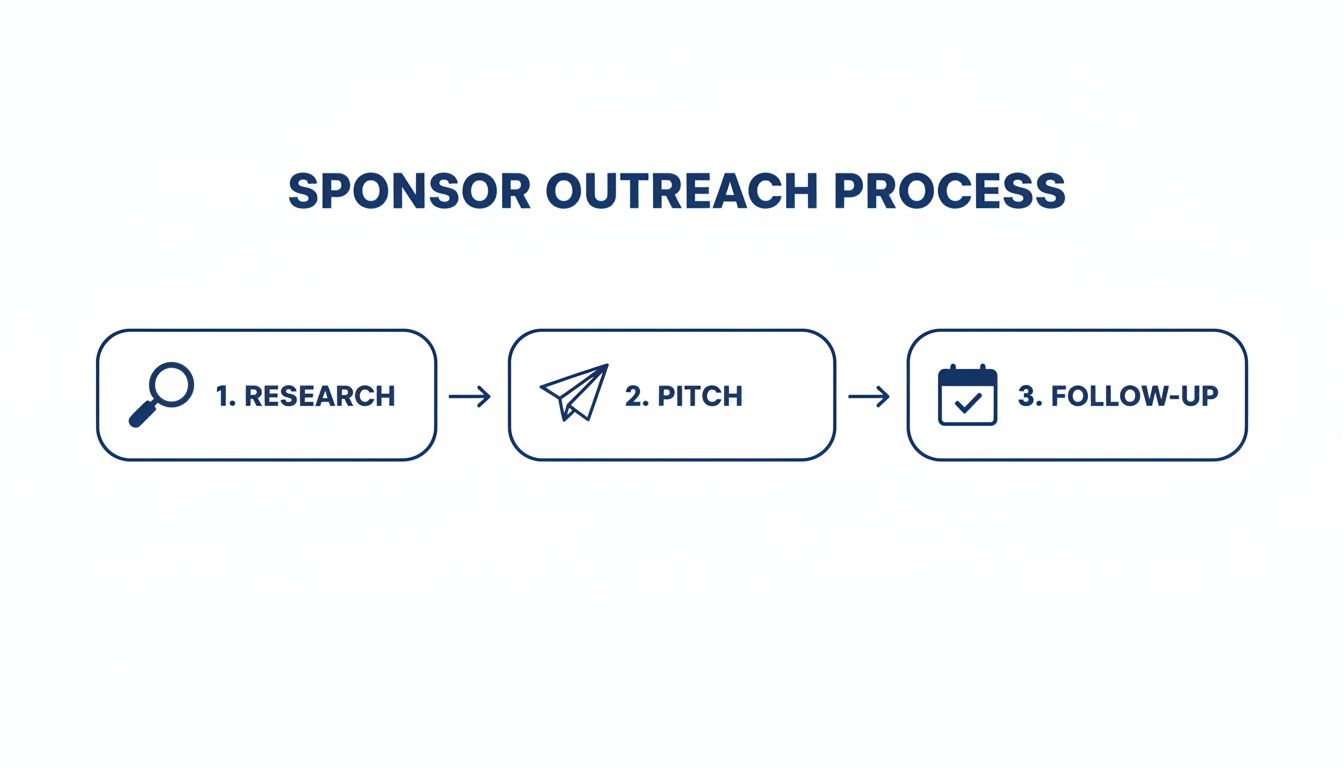
A structured approach is key during outreach, and it is just as important to carry that discipline into managing the ad campaign itself after you get the green light.
Comparing Manual vs Automated Workflows
As you start landing more ad deals, your manual system of spreadsheets and email reminders will quickly become a major bottleneck. It is incredibly time-consuming, wide open to human error, and just does not scale. Let's look at how this old-school method stacks up against a modern, automated approach.
Manual vs Automated Ad Management
This table breaks down just how much time and effort you can save by ditching the spreadsheets for a purpose-built platform like AdSlots.
| Task | Manual Method (Spreadsheets) | Automated Method (AdSlots) | Time Saved |
|---|---|---|---|
| Scheduling | Manually updating a calendar and checking for conflicts. | Visual calendar with one-click booking and conflict prevention. | 1-2 hours/week |
| Invoicing | Creating and sending invoices, then manually tracking payments. | Automatic invoice generation and payment reminders via Stripe. | 2-3 hours/week |
| Asset Collection | Chasing sponsors for ad copy and images via email. | Centralized portal for sponsors to upload their creative assets. | 1-2 hours/week |
| Reminders | Setting manual calendar alerts to follow up on deadlines. | Automated reminders for upcoming deadlines and payments. | 1 hour/week |
The difference is night and day. Spreadsheets might get the job done when you only have one or two sponsors, but they become a serious liability as you grow. Accidentally double-booking a premium ad slot or forgetting to send an invoice makes you look disorganized and can easily cost you a valuable partnership.
An automated system essentially becomes your virtual ad ops manager. For any creator serious about turning their newsletter into a real business, checking out a dedicated newsletter ad scheduling software is the logical next step. It frees you from the administrative grind so you can focus on what really matters: creating great content and building relationships with sponsors. This is what separates the hobbyists from the pros.
Measuring Performance and Scaling Revenue
Once your sponsored newsletter goes out, the job is not quite done. What you do next is the secret to building a long-term, sustainable ad business. Proving the value you delivered is how you turn a one-time advertiser into a repeat partner who books you for months to come.
This all comes down to a simple, clear way to measure ad performance and report back to your sponsors. They need to see a return on their investment, and it is your job to show it to them. A solid report does not just wrap up the campaign; it makes booking the next one an easy decision for them.
Tracking the Right Metrics for Your Reports
Sponsors live and breathe data. They want to see exactly how their ad performed and what kind of impact it had. You do not need to overwhelm them with a dozen different stats, but you absolutely have to provide the core metrics that matter.
Your post-campaign report should be clean, easy to read, and get straight to the point. Here are the essentials to include:
- Total Impressions (Opens): This is the total number of subscribers who opened the email and saw the ad. It sets the stage by showing the campaign's total reach.
- Total Clicks: For most sponsors, this is the most important number. It shows how many people were genuinely interested enough to click the ad's link.
- Click-Through Rate (CTR): This is just the total clicks divided by the total impressions. A strong CTR, typically 2% or higher, is powerful proof that your audience is highly engaged with your content, ads included.
Present this information in a simple PDF or even just a brief, professional email. For instance, your report might say: "The sponsorship in our May 15th issue was sent to 12,500 subscribers and received 128 unique clicks, resulting in a 2.3% CTR on the ad placement." It is direct, professional, and gives the sponsor exactly what they need to see.
Turning One-Time Sponsors into Long-Term Partners
Your real goal is not just to sell one-off ads; it is to build a predictable, scalable revenue stream. That only happens when you turn first-time advertisers into long-term partners who see your newsletter as a critical part of their marketing plan.
It all starts with delivering that great experience and a solid report. After that, it is all about strategic follow-up. Wait about a week after sending the performance report, then reach out with a friendly email. Mention the solid results again and ask if they would be interested in booking another campaign.
The easiest sale you will ever make is to a happy existing customer. Focus on retention, and your ad revenue will become far more predictable and less stressful to manage.
This is the perfect moment to offer them a little something extra for booking multiple slots. A simple offer like a 10% discount for a package of three ads can be incredibly effective. It gives them a reason to commit right away and secures your revenue for the months ahead. Proving a clear Return on Investment (ROI) is everything for keeping sponsors and attracting new ones. If you want to go deeper on this, there is a great guide on how to measure marketing ROI effectively.
Scaling Your Newsletter Ad Business
Eventually, you will hit a great milestone: demand for your ad slots will start to outpace your supply. This is a fantastic problem to have, and it is your cue to start thinking about scaling your operations.
Here are a few strategies that have worked for others to manage growth and maximize revenue:
- Create a Waitlist: When your calendar is booked out for a month or two, do not just say you are full. Start a waitlist. This creates scarcity and social proof, making your ad slots even more desirable.
- Upsell Bigger Packages: Use that strong performance data from past campaigns to upsell sponsors on more comprehensive packages. If they saw great results from one ad, offer them a quarterly sponsorship that includes multiple placements and maybe even a dedicated email blast.
- Raise Your Prices: This is a big one. As your audience grows and demand increases, you have to periodically raise your rates. A good rule of thumb is to consider a price hike every six months or after every 5,000 new subscribers you gain.
By focusing on performance, retention, and smart growth strategies, you can transform your ad sales from a side hustle into a core pillar of your business. A smooth, professional system for measuring and scaling lets you manage more sponsors without burning out, creating a truly sustainable income source.
Common Questions About Selling Newsletter Ads
Once you decide to sell ads in your newsletter, a whole bunch of questions pop up. That's completely normal. Let's walk through some of the most common ones so you can get started with confidence.
How Many Subscribers Do I Need to Start Selling Ads?
This is the big one, and the answer usually surprises people: there is no magic number. An engaged, niche audience of 1,000 true fans can be way more valuable to the right brand than a disengaged list of 10,000 random subscribers.
Do not fixate on the subscriber count. Look at your engagement instead. If you are rocking an open rate consistently over 40%, you have a valuable asset. Sponsors are really buying access to a specific group of people who trust you, not just a number on a spreadsheet.
A small, targeted, and active audience is your greatest asset. Prove that your readers trust you and take action, and sponsors will see the value, regardless of your list size.
What Should I Include in a Sponsorship Contract?
A simple contract is your best friend. It protects you and the sponsor. It does not have to be some scary, 20-page legal document. The goal is just to get everything in writing to avoid any "I thought you meant…" conversations later.
Make sure your agreement clearly covers:
- The Parties: Who is this between? (e.g., "Advertiser X" and "My Awesome Newsletter").
- The Details: What are they getting? Specify the ad format, where it goes, and the exact date(s) it will run.
- The Cost: How much does it cost, and when is payment due? (e.g., "$500, due upon receipt of invoice").
- Creative Clause: A quick line saying you have final say on the ad copy and creative. This ensures you can reject anything that feels off-brand for your audience.
How Do I Handle an Unhappy Sponsor?
It is going to happen at some point, so be prepared. The first thing to do is listen. Hear them out without getting defensive. Then, pull up the performance data you have been tracking and walk through it together. How did their ad’s clicks and CTR compare to your newsletter's average?
Remember, you are selling exposure to an audience, not a guarantee of sales. If the ad performed right around your typical benchmarks, you have delivered on your end. Your job is to get the message in front of your readers; you can not force them to pull out their credit cards.
To keep the relationship positive, you could offer a small olive branch, like a free shout-out on social media or a small discount on a future ad. A little goodwill goes a long way.
Should I Use CPM or Flat-Rate Pricing?
For almost every independent newsletter creator, flat-rate pricing is the way to go. It is clean, predictable, and simple for everyone involved. You set a price, say, "$500 for the main sponsor slot," and that is what they pay. Easy.
CPM (Cost Per Thousand Impressions) models can get messy fast. They involve more tracking and are really built for huge media companies with millions of predictable impressions.
When you are building your business, a flat rate projects confidence. It keeps the conversation focused on the unique value you provide, not on complicated math.
Juggling sponsorships can feel like a full-time job on its own. The good news is, you do not have to do it all manually. AdSlots can automate the entire workflow for you, from booking and invoicing to chasing down ad creative. Stop wrestling with spreadsheets and get back to writing. Learn more and streamline your ad sales today.