
So, what’s a good email open rate?
If you’re looking for a quick number, many marketers say anything 20% or higher is solid. That’s just a starting point, though. The real answer depends on your industry, your audience, and even the type of email you’re sending.
What Is a Good Email Open Rate
Think of your open rate like the number of people who walk into a coffee shop. A crowd outside looks promising, but it doesn’t tell you who actually bought a latte. A high open rate means your subject line worked its magic and got people in the door. To know if you’re truly successful, you need to look at the bigger picture.
Chasing a universal “average” isn’t a productive use of your time. A much smarter approach is to understand what actually goes into that single percentage. Once you get the hang of the moving parts, you can set goals that actually make sense for your newsletter.
More Than Just a Number
To get a true read on your performance, you need to look at a few related metrics. These all work together to paint a complete picture of your email’s health.
Deliverability: This is the absolute first step. Did your email even make it to the inbox? Or did it get bounced or sent straight to spam? If your deliverability is poor, even the world’s best subject line won’t save your open rate.
Total Opens vs. Unique Opens: This is a crucial distinction. “Total opens” counts every single time an email is opened, even if one super-fan opens it 10 times. The more telling metric is “unique opens”, which only counts the first time each person opens it. This gives you a much clearer idea of how many individual subscribers you actually reached.
A healthy email list is the bedrock of a good open rate. By focusing on deliverability and unique opens, you get a far more honest look at your engagement than a simple open rate percentage can provide.
To help you get a feel for where your numbers might fall, here’s a quick breakdown of what different open rates generally signal.
Quick Guide to Email Open Rate Benchmarks
| Performance Level | Typical Open Rate Range | What This Means |
|---|---|---|
| Needs Improvement | Below 15% | Your subject lines might not be connecting, or your list health could be an issue. Time to investigate. |
| Solid | 15% – 25% | You’re doing well! This is a healthy range for many industries. Your content is likely resonating. |
| Excellent | 25% – 35% | You’ve got a highly engaged audience. Your subscribers trust you and look forward to your emails. |
| Exceptional | Above 35% | This is top-tier stuff, often seen in niche communities or with highly anticipated content. |
Remember, these are just general guidelines. The real magic happens when you compare your rates to those in your specific field.
Finding Your Industry Benchmark
Context is everything. The global average open rate sits around 22%, but that number swings wildly from one industry to another.
For instance, healthcare communications often see high rates. Constant Contact’s data shows the Health Services industry averages a 21.78% open rate. On the other hand, a typical e-commerce brand might be perfectly happy with an open rate between 15% and 25%.
You can dig deeper into how to calculate and improve your email open rate to see where you stand. Knowing your industry’s standard helps you set realistic goals and stop comparing your niche newsletter to a completely different type of business.
Email Open Rate Benchmarks by Industry
What’s a “good” email open rate? A number that’s fantastic for a retail brand might be a red flag for a B2B service provider. The trick is to stop chasing some mythical universal average and start looking at what’s normal for your specific field.
Think about it this way. A nonprofit sending out a fundraising appeal to a dedicated list of supporters might easily hit a 35% open rate. People are emotionally invested. But a marketing agency sending its monthly newsletter? A 22% open rate could be a huge win in that space. Context is everything, and setting goals based on your industry is the first, most crucial step.
This chart gives you a quick visual of how much these averages can swing from one sector to the next.
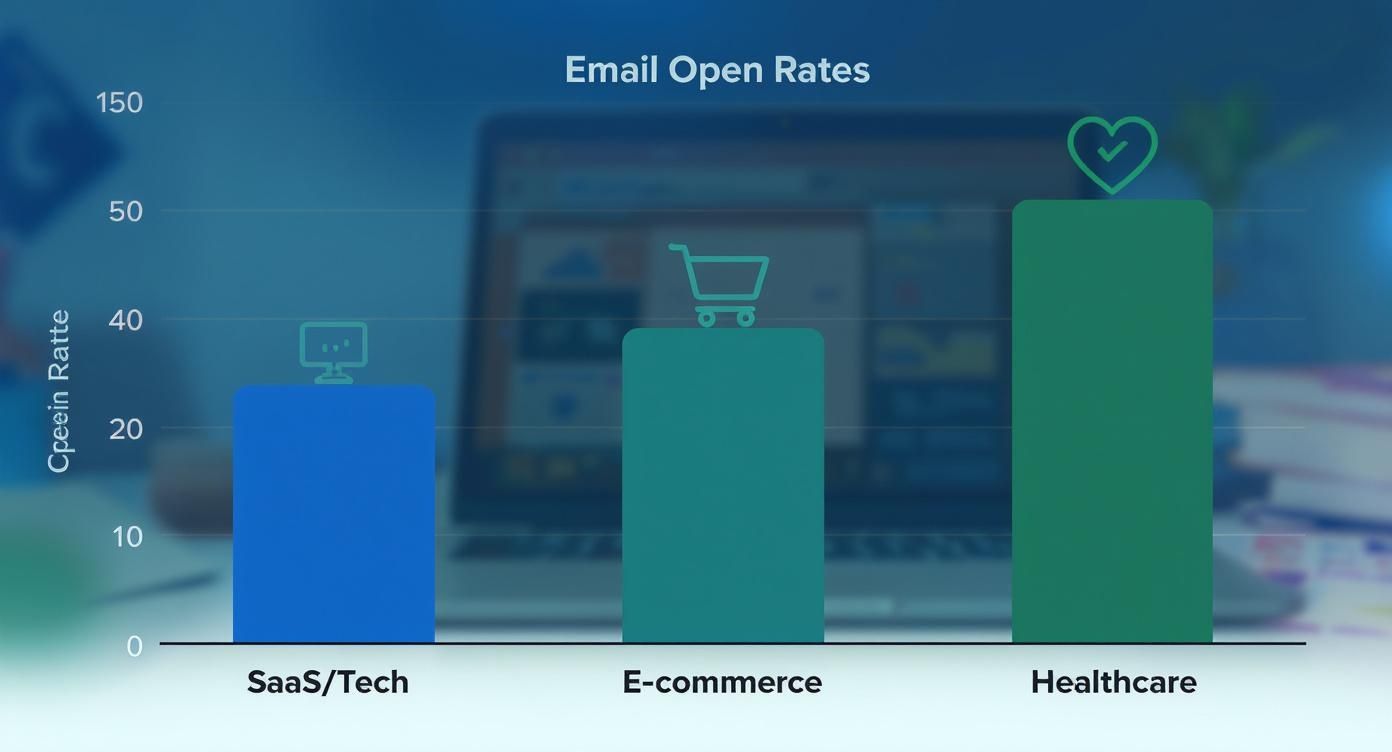
As you can see, industries like healthcare often get more opens because the information feels essential. On the flip side, e-commerce rates can dip a bit, often because we all get a lot more promotional emails in our inboxes.
Average Email Open Rates Across Different Industries
To help you get a clearer picture of where you stand, we’ve put together a table with some typical open rates. This detailed breakdown lets you compare your performance against others in your specific industry.
| Industry | Average Open Rate (%) |
|---|---|
| Nonprofits | 45% |
| Hospitality & Travel | 45% |
| B2B Services | 39% |
| SaaS/Tech | 38% |
| Retail/E-commerce | 38% |
These figures give you a solid baseline. They show how much audience intent, email frequency, and the nature of the content itself can influence whether someone clicks “open.”
Using Benchmarks to Set Realistic Goals
So, what do you do with all this data? First, don’t treat these averages like a final grade on a test. They are not pass/fail numbers. Instead, think of them as a compass. They show you where you are and point you in the direction you want to go.
If you’re in the SaaS world and your open rate is sitting at 25%, you are not failing. You simply have a clear opportunity to work your way toward the 38% industry average. This perspective is way more productive. It keeps you from getting discouraged and helps you focus on what really matters, like improving your subject lines or cleaning up your email list.
For a more granular look at how your campaigns stack up, it’s always a good idea to explore comprehensive resources that track email open rate benchmarks by industry.
The 5 Factors That Control Your Open Rate
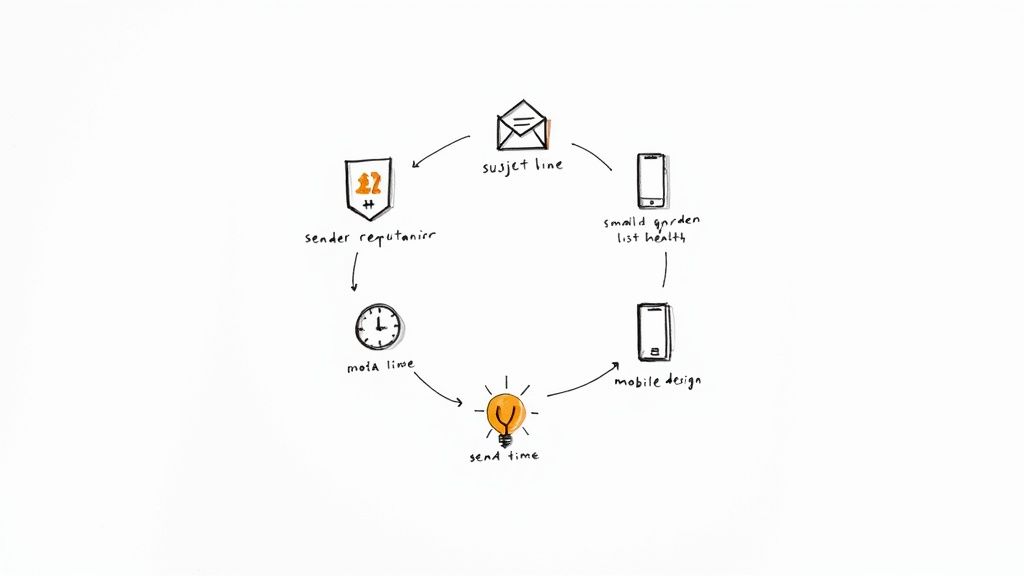
Hitting a great open rate isn’t about crossing your fingers and hoping for the best. It’s the result of getting a handful of key things right. Nail these, and you’ll turn a so-so newsletter into one your audience actively looks for.
Let’s break down the five most important elements that make the difference between an email that gets opened and one that gets ignored.
1. Sender Reputation Is Your Digital Handshake
Think of your sender reputation as a credit score for your email address. Internet Service Providers (ISPs) like Gmail and Outlook are constantly judging you. Are you a trustworthy sender or just another spammer? A high score gets you a VIP pass to the primary inbox. A low score sends you straight to the junk folder.
What builds a strong reputation? Things like a consistent sending schedule, very few spam complaints, and a low number of bounced emails. If people start flagging your content as spam, that score will tank, and even your most loyal fans might never see your emails again.
2. The Subject Line Makes the First Impression
In a crowded inbox, your subject line is your one chance to grab someone’s attention. It has to be compelling enough to stop their thumb from scrolling. A vague or boring subject line is basically asking to be deleted on sight.
Here’s a real-world A/B test from a B2B newsletter that shows just how much it matters:
- Version A: “Our Q3 Company Updates” (This pulled an 18% open rate)
- Version B: “What 2,400 CMOs Are Doing Differently This Quarter” (This hit a 35% open rate)
Version B crushed it because it was specific, sparked curiosity, and promised a genuine insight. All things that make people need to click.
3. A Healthy List Produces Healthy Results
Your email list is a lot like a garden. If you tend to it carefully, it will flourish. But if you let the weeds take over, you’ll get nothing. Sending emails to dead addresses or people who haven’t opened a single email in months is a recipe for disaster. It drags down your sender reputation and messes up all your metrics.
Regularly cleaning your list by removing inactive subscribers is one of the quickest ways to boost your open rates. It proves to ISPs that you’re only sending to people who actually want to hear from you, and they love that.
4. Send Time and Mobile Design Matter
When your email lands in an inbox and how it looks on a phone can make or break its success. Sending an important email at 2 AM on a Saturday is a great way to make sure it gets buried under a pile of weekend notifications. Most modern email platforms can help you with send-time optimization, delivering your message precisely when each subscriber is most likely to open it.
And don’t forget mobile. With well over half of all emails now opened on a smartphone, a clunky, pinch-and-zoom design is an instant turn-off. The look and feel of your email is a huge piece of the puzzle. For a deeper look at this, you can check out our guide on plain text vs HTML emails to see what might resonate best with your readers.
5. Your Content and Consistency Build Trust
At the end of the day, people open emails from senders they trust. If you consistently deliver valuable, entertaining, or genuinely helpful content, your subscribers will start looking forward to hearing from you.
This isn’t about a single amazing email. It’s about the relationship you build over time. Consistency is what turns a casual reader into a true fan who opens every time.
How to Reliably Measure Your Open Rate
You can’t fix what you don’t measure, but your analytics dashboard can sometimes feel like it’s speaking another language. To get a real sense of your newsletter’s health, you have to look beyond the big, flashy open rate and understand what’s actually happening behind the scenes.
Let’s start by clearing up two metrics that often get mixed up: total opens and unique opens. Total opens is just what it sounds like. It counts every single time an email is opened. If one of your biggest fans opens your email five times to re-read it, that’s five opens.
While that’s nice to know, it can give you a slightly inflated sense of success. The number you really want to watch is unique opens. This metric only counts the first time each subscriber opens your email, telling you how many individual people you actually reached. It’s a much more honest look at how well your subject line did its job.
Understanding Unique vs Total Opens
Looking at both of these numbers together can actually tell a pretty interesting story. If you see a big gap between your total and unique opens, it’s often a sign that a small group of people found your content so useful they kept coming back to it.
Here’s what that looks like in the real world for a creator’s weekly newsletter:
- Sent to: 5,000 subscribers
- Unique Opens: 1,250 (25% unique open rate)
- Total Opens: 1,800
The 25% unique open rate is your true measure of how many people were intrigued enough to open the email. Those extra 550 opens? That’s your bonus insight. It tells you that a good chunk of your audience found something worth revisiting.
The Impact of Mail Privacy Protection
Now for the modern-day curveball: Apple’s Mail Privacy Protection (MPP). This feature, which is on by default for Apple Mail users, automatically preloads email content in the background. This triggers the tracking pixel that registers an “open,” even if the person never actually laid eyes on your email.
Since Apple Mail is used by a massive number of people, MPP has artificially inflated open rates across the board. After it was introduced, some studies saw average open rates jump by as much as 18 percentage points.
So, what does this mean for you? It means your open rate might look rosier than it really is. The metric isn’t useless now, but you absolutely cannot rely on it as your single source of truth anymore.
Smart creators are shifting their focus to metrics that show genuine action, like click-through rates and conversions. The goal has changed from measuring inbox activity to measuring real, human interest.
Actionable Strategies to Boost Your Open Rates
Alright, you know your numbers. Now for the fun part: making them better. The good news is that you don’t need a bunch of fancy, complicated tools to move the needle on your open rates. It really just comes down to a focused effort on what actually matters to your subscribers.
Let’s get into some practical, hands-on tactics you can put to work right away to get more people opening your emails.
Craft Compelling Subject Lines and Preheaders
Think of your subject line as your first impression, a digital handshake. In a sea of unread emails, it’s got one job: spark enough curiosity to earn a click. This is where you need to ditch the generic stuff and get specific.
Just look at the difference between these two:
- Before: “Weekly Newsletter”
- After: “The 1 Thing Successful Creators Do Differently”
The second one is far more intriguing, right? It promises an exclusive insight that feels valuable. If you’re looking for a creative spark, it’s always a good idea to check out some proven newsletter headline examples to get the ideas flowing.
And don’t forget about the preheader text. That little snippet of text following the subject line is prime real estate. Use it to expand on your hook or add crucial context. Whatever you do, don’t let it default to the dreaded “View this email in your browser.”
Personalize Beyond the First Name
Dropping a subscriber’s first name into the greeting is a solid start, but real personalization goes much deeper. It’s about delivering the right message to the right person, at exactly the right time.
This is where segmenting your list is a game-changer. You can group your audience by their interests, their past behavior (like what they’ve clicked on), or even where they originally signed up. When the content feels like it was made just for them, open rates naturally climb.
A study from Campaign Monitor found that emails with personalized subject lines are 26% more likely to be opened. It’s a simple change, but it tells your subscribers you see them as a person, not just another email address.
Re-Engage Your Inactive Subscribers
Every email list has them: the subscribers who, for whatever reason, have gone quiet. Instead of letting them weigh down your metrics, it’s time to run a re-engagement campaign.
Here’s a simple plan to win them back:
- Build a segment: First, identify everyone who hasn’t opened one of your emails in the last 90 days.
- Send a targeted email: Try a subject line like, “Is this goodbye?” or “Still want to hear from us?” to grab their attention.
- Remind them why they signed up: Offer a great piece of content or remind them of the value they’re missing.
- Clean your list: If they still don’t bite, it’s time to say farewell. Removing them keeps your list healthy and protects your sender reputation.
Putting these tactics into practice can make a real difference in your open rates. For a deeper dive, you can explore additional strategies to increase your email open rate to keep the momentum going.
Answering Your Toughest Questions About Email Open Rates
Even the most seasoned newsletter creators hit a wall now and then. If you’re staring at your metrics and scratching your head, you’re not alone. Let’s tackle some of the most common questions that pop up when you’re trying to make sense of your open rates.
Why Did My Open Rates Suddenly Tank?
Seeing your open rates take a nosedive can be alarming. One week you’re cruising at 25%, the next you’re struggling to hit 10%. Before you panic, take a breath. The culprit is often something happening behind the scenes.
Email providers like Gmail and Apple are constantly tweaking their algorithms. A recent change could be sending your emails to the promotions tab or, worse, the spam folder. Another possibility? A recent email might have triggered more spam complaints than usual, putting a dent in your sender reputation.
The first step isn’t to rewrite your entire content strategy. Instead, dig into your deliverability stats and spam complaint rates. Those numbers will tell you whether you have a technical problem or a content problem.
Does a Low Open Rate Mean My Content is Bad?
Not necessarily. While a weak subject line can certainly be the cause, a chronically low open rate often points to a bigger issue: your list’s health. If you’re sending emails to a list packed with subscribers who haven’t engaged in months (or even years), your average is going to suffer.
It’s a classic case of quality over quantity.
A small, fired-up list with a 35% open rate is infinitely more valuable than a giant, sleepy one that barely cracks 15%.
How Often Should I Clean My Email List?
Think of it like tidying up your house. It’s a task that needs regular attention. A good rhythm is to prune your email list every three to six months. This usually means saying goodbye to subscribers who haven’t opened a single email from you in the last 90 days.
Regular list hygiene keeps your engagement high and your sender reputation sparkling. For a deeper dive into the process, check out our guide on how to effectively manage your email list.
Why Is My Open Rate High but My Clicks Are So Low?
Ah, the classic bait-and-switch dilemma. A high open rate is great. It means your subject line did its job and got people in the door. But if nobody is clicking on the links inside, it’s a sign that your email’s content didn’t deliver on the promise your subject line made.
Think of it this way: your subject line is the movie trailer, and the email is the full film. If the trailer is amazing but the movie is a dud, people will walk out. Revisit your email body and make sure the value you’re offering is just as compelling as the headline that got them there.
At Ad Slots, we believe you should spend more time creating and less time juggling admin tasks. Our platform helps you ditch the spreadsheets and manage your newsletter advertising effortlessly. From scheduling and invoicing to making sure sponsors are happy, we automate the entire workflow. Discover how we can streamline your ad operations at https://adslots.co.