
If you've been building a newsletter, you're sitting on one of the most powerful assets a creator can own. Selling ads is a straightforward and proven path to turn that audience into a real, sustainable income stream. It's a classic win-win: brands get to connect with your dedicated readers, and you get paid for the community you've built.
Why Your Subscriber List Is a Goldmine for Advertisers
Before we get into the nuts and bolts of selling ad space, let's talk about why your subscriber list is so incredibly valuable. It all comes down to the direct connection. Unlike social media, where you're at the mercy of a constantly changing algorithm, your newsletter lands directly in your subscribers' inboxes.
These aren't just random followers. Your subscribers chose to hear from you. They trust your voice and look forward to your content. For an advertiser, getting their message in front of an audience like that is pure gold.
The Power of a Trusted Channel
Think about it from your own perspective. You open certain emails because you know they will be useful, interesting, or just plain fun. Advertisers understand this dynamic and are more than willing to pay a premium to be a part of that trusted space.
An ad in a newsletter you love feels less like a jarring interruption and more like a friendly recommendation. It’s this unique relationship between you and your readers that gives your newsletter its advertising power.
An engaged email list is one of the most valuable assets a creator can build. It’s a direct, algorithm-proof connection to an audience that trusts you, making it an ideal channel for advertisers seeking authentic engagement.
There's a reason the newsletter economy is booming. Creators are building entire businesses right from their inboxes. For example, a platform like beehiiv paid out over $3.7 million to newsletters in just one year through its ad network. This is part of a massive trend that saw a 96.2% year-over-year jump in monetizing newsletters. The opportunity is real, and it's growing fast.
Building Your Foundation for Success
Your journey to selling ads doesn't start with a cold email to a potential sponsor. It starts way earlier, with the hard work of building a high-quality audience.
To catch an advertiser's eye, you need to have a few key things in place:
- A Defined Niche: Brands aren't looking for a general audience; they want to reach people with specific interests. Whether you write about AI tools, vegan cooking, or local real estate, a tight focus makes your list irresistible.
- High Engagement Rates: Metrics matter. Strong open rates (aim for 35% or higher) and solid click-through rates prove that your audience is genuinely paying attention.
- Consistent Growth: A subscriber list that's steadily growing tells advertisers that your influence is expanding. It makes sponsoring your newsletter a smart investment for the future.
Nailing these fundamentals is non-negotiable. Before you can make money, you need to understand how to build email lists that attract both loyal readers and high-paying sponsors. That initial effort is what turns a simple email list into a profitable business.
How to Land Your First Sponsor
Getting that first "yes" from a sponsor is a huge milestone. It’s the moment your passion project officially starts looking and feeling like a real business. The secret isn't having a giant subscriber list. It's about finding the right brand that wants to connect with your specific, loyal audience.
Your journey begins by figuring out who your ideal sponsor is. Don't just dream of big, household names. Instead, think about brands that genuinely fit with what your readers care about. If you write a newsletter for minimalist hikers, a small company selling ultralight, sustainable gear is a much better fit than a massive fashion brand.
This kind of natural alignment is what makes a sponsorship feel like a cool recommendation from a friend, not a jarring ad. That authenticity is exactly what smart brands are paying for.
Building Your Prospect List
You know the type of sponsor you're looking for. Now it's time to go find them. This isn't a random Google search; it's more like a strategic treasure hunt. The goal is to build a focused list of potential partners who are already spending money to reach people like your readers.
Here are a few practical ways to hunt down great prospects:
- Spy on Other Newsletters: Subscribe to other newsletters in your niche. Who's sponsoring them? Those companies have already bought into the power of newsletter advertising.
- Check Industry Hangouts: Look at the sponsor lists for industry blogs, podcasts, or virtual events that your audience loves. These businesses are actively trying to get in front of your exact type of person.
- Use Your Own Social Feeds: Pay close attention to the ads you see on Instagram, X, or LinkedIn. If their targeting is on point, there's a good chance they'd be a great fit for your newsletter, too.
I recommend keeping a simple spreadsheet to track your finds. Jot down the company name, a contact person if you can find one, and a quick note on why they would be a good match. This simple step will make your outreach process so much smoother.
Creating a Compelling Media Kit
Think of your media kit as your newsletter’s resume. It’s a clean, sharp document that quickly shows a potential sponsor why they should work with you. Even if your list isn't massive, a professional media kit signals that you take this seriously.
A great media kit does not need to be fancy. It just needs to answer a sponsor's main questions, fast.
Your media kit should tell a story about your audience. Focus less on the raw number of subscribers and more on who they are and how engaged they are. You're proving that you've earned the trust of a very specific group of people a sponsor wants to reach.
Here’s what you absolutely need to include:
- Audience Demographics: Who are your readers? Include details like job titles, interests, or location. You can get this by running a simple survey with your subscribers.
- Key Engagement Stats: Don't just flash your subscriber count. The real magic is in your average open rate and click-through rate (CTR). An open rate over 40% in a tight-knit niche is way more impressive than a low rate on a huge, generic list.
- Ad Options and Placements: Clearly show what you’re selling. Use screenshots or mockups to illustrate exactly where a sponsor’s ad will live inside your newsletter.
- Reader Testimonials: Nothing builds trust like social proof. Include a few short, punchy quotes from your biggest fans.
Once your prospect list and media kit are ready, you have the two core tools you need to start selling. The next step is writing that perfect pitch. To get a running start, you can find some fantastic examples in these newsletter sponsor outreach email templates to help you craft your message.
Setting Your Ad Rates with Confidence
Pricing your newsletter ads shouldn't feel like a guessing game. Setting the right rates is a critical step that instantly communicates the value you bring to the table. It ensures you’re paid fairly for your work while giving sponsors clear, predictable costs.
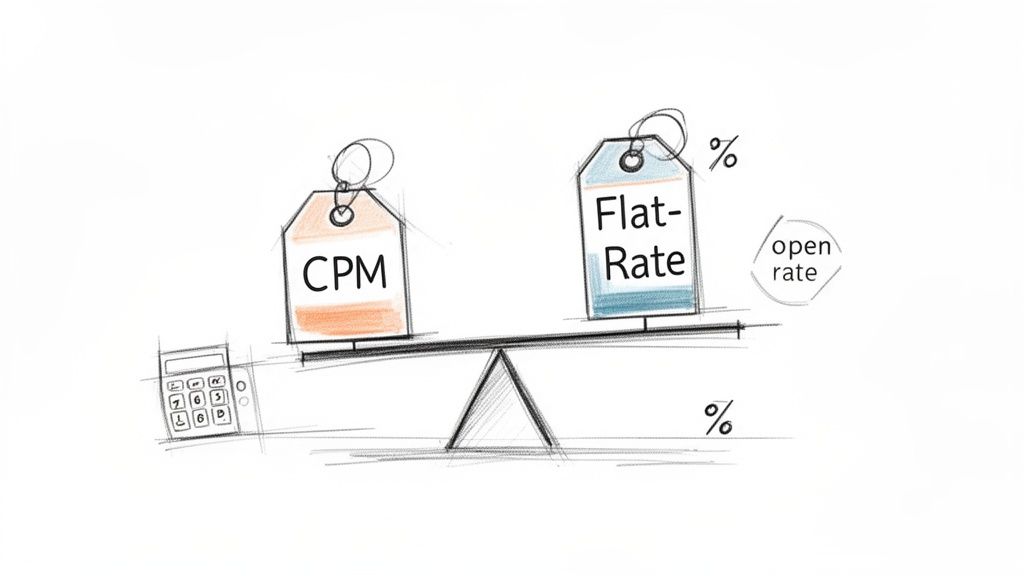
Think of your pricing model as the language you use to talk about money with advertisers. The goal is to pick a model that's easy for everyone to understand and lines up with the value you deliver. In the newsletter world, this usually comes down to three common options: CPM, flat-rate, and CPC.
Understanding the Three Main Pricing Models
Each pricing model has a different job, kind of like using a screwdriver versus a hammer. The right tool depends on what you're trying to build. Let's break down the options so you can choose the best fit for your newsletter.
The three main ways to price your ads are CPM, flat-rate, and CPC. This table offers a quick look at how they work and which might be right for you.
A Simple Comparison of Newsletter Ad Pricing Models
Use this table to understand the three main pricing models and decide which is best for your newsletter.
| Pricing Model | How It Works | Best For Newsletters That… | Example Calculation |
|---|---|---|---|
| CPM (Cost Per Mille) | The advertiser pays a set price for every 1,000 subscribers on your list. | Have a large, stable subscriber base and predictable open rates. | 10,000 subscribers at a $25 CPM = $250 per ad. |
| Flat-Rate | You charge a single, fixed price for an ad placement in one or more issues. | Are newer, have a smaller but highly engaged niche audience, or want maximum predictability. | A main sponsorship slot costs $400, regardless of performance. |
| CPC (Cost Per Click) | The advertiser only pays you when a reader clicks on their ad link. | Have a proven track record of high click-through rates. (Less common for direct sales). | An advertiser pays $2 for every click, and the ad gets 150 clicks = $300. |
For most creators just starting out, flat-rate or CPM pricing hits the sweet spot. CPC (Cost Per Click) is less common for direct-sold ads because it puts all the risk on you. Your income can swing wildly based on how many people happen to click that week.
For most independent creators, a flat-rate or CPM model offers the best balance of simplicity and fair value. They allow you to price based on your audience's proven value, not on unpredictable click performance.
If you’re still not sure where to start, take a look at what similar newsletters in your space are charging. A little competitive research can give you a solid benchmark. You can also plug your numbers into a free newsletter ad pricing calculator to get a data-driven estimate.
How to Calculate Your Rates
Once you have picked a model, it’s time to crunch the numbers. While industry averages are a good starting point, the real value is in the unique engagement you have with your audience. Don't sell the trust you've built short.
For CPM-based rates, the industry standard often lands somewhere between $15 and $50. A general-interest newsletter might be on the lower end, but a super-specialized B2B newsletter read by decision-makers can easily command a CPM of $50 or more.
If you go with a flat rate, you'll want to consider a few key factors:
- List Size: The total number of subscribers you have.
- Open Rate: A high open rate (think 40% or more) is proof of an engaged audience and justifies a premium price.
- Click-Through Rate (CTR): Your average CTR demonstrates how likely your readers are to take action on a link.
- Audience Niche: A small, dedicated list of surgeons is far more valuable to a medical device company than a massive, general-interest audience.
Example Calculation (Flat-Rate):
Let's say you have 5,000 subscribers and an awesome 45% open rate.
- Calculate engaged subscribers: 5,000 subscribers * 45% open rate = 2,250 opens per issue.
- Apply an industry CPM: Let’s use a reasonable $30 CPM as our baseline.
- Find your base rate: (2,250 opens / 1,000) * $30 CPM = $67.50.
This simple math gives you a solid starting point. From here, you can adjust the price up based on how specialized your niche is and which ad slot you're selling.
Designing a Professional Rate Card
Your rate card (or media kit) is your menu of advertising options. It needs to be clean, professional, and easy for a potential sponsor to understand in a single glance. A good one eliminates back-and-forth and makes you look like a pro.
It should clearly lay out the different ad packages you offer. Think beyond just a single ad slot.
- Main Sponsorship: The prime real estate, often placed right at the top of the newsletter.
- Sponsored Link: A simple, effective text link placed within your main content.
- Classified Ad: A short, text-only ad in a dedicated section with other classifieds.
- Issue Takeover: An exclusive sponsorship where one brand is the sole advertiser for an entire newsletter.
For each ad type, list the price, what’s included (e.g., word count, image dimensions), and any key stats that prove your value. This simple document is what turns a casual inquiry into a professional transaction.
Mastering Outreach to Secure More Deals
You have your ad packages and pricing sorted. Now comes the fun part: finding sponsors and actually starting conversations. This is where the magic happens, and a smart outreach strategy is what separates the newsletters that thrive from those that just don't. The whole point is to turn a list of potential sponsors into a signed deal, and it all begins with that first email.
A killer cold email is your secret weapon. Forget those generic templates that everyone can spot a mile away. The name of the game is personalization. Seriously, a study of over 12 million outreach emails found that just personalizing the subject line can jack up reply rates by a massive 30.5%. This proves that spending a few extra minutes researching your prospect is absolutely worth it.
Crafting a Cold Email That Actually Gets a Reply
Your first email needs to be short, sharp, and all about what the sponsor gets out of it. The person you're emailing is busy, so your message has to immediately answer their silent question: "What's in it for me?"
If you really want your outreach to work, you need to nail that initial message. There are some great frameworks out there for how to write cold emails that get replies that can give you a solid starting point.
A great outreach email really only needs three things:
- A Personalized Hook: Kick things off by showing you’ve done your homework. Mention a recent product they launched, a blog post they wrote, or just let them know you’re a fan of their brand.
- The Value Proposition: Get straight to the point. Tell them exactly who reads your newsletter and why that audience is a perfect match for their product. Dropping a key stat, like your open rate, adds instant credibility.
- A Clear Call to Action (CTA): End with a simple, easy-to-say-yes-to next step. Ditch the vague "Let me know if you're interested." Instead, try something like, "Are you open to seeing how [Your Newsletter] can help you reach [Target Audience]?"
Example Subject Line: Your new [Product Name] & [My Newsletter]'s audience
Example Opening: "Hi [Name], I'm a big fan of the work your team is doing with [Product Name]. The new [Feature] is a brilliant update. I'm reaching out because the audience for my newsletter, [Your Newsletter], is made up of [describe your audience in a way that matches their customer profile]."
Navigating Negotiations and Handling Objections
Once you get that coveted positive reply, the real conversation begins. Be ready for the questions and pushback. Sponsors will almost always ask about pricing, performance guarantees, or want more details on your audience. The key here is confidence. Stand by your rates, but don't be so rigid that you can't create a custom package if it’s a good fit for everyone.
The most common hurdle? Price. If a sponsor says your rates are too high, your first instinct might be to offer a discount. Don't. Instead, circle back to the value you offer.
Common Objection: "Your price is a bit higher than we were expecting."
Effective Response: "I understand. Our rates are based on a highly engaged audience of [number] subscribers with a [your open rate]% open rate, which means your message gets in front of a very targeted group. Could a smaller ad package, like a sponsored link, be a better fit for your current budget?"
See what that does? It holds firm on your value while still offering a flexible solution.
Keeping track of all these back-and-forths is critical. To stay organized and make sure no potential deals slip through the cracks, you should really consider using a dedicated newsletter sponsor CRM. It’s a lifesaver compared to a messy spreadsheet.
Sealing the Deal with a Simple Contract
Once you have shaken hands on the terms (virtually, of course), make it official with a simple contract or agreement. This does not need to be a 20-page document drafted by a high-powered law firm. Its only job is to make sure you and the sponsor are on the same page about everything.
Your agreement should clearly outline:
- The Parties Involved: Your name/company and the sponsor's.
- The Deliverables: What they bought (e.g., "One Main Sponsorship").
- The Schedule: The exact date(s) the ad will run.
- The Cost and Payment Terms: The total price and when it's due (e.g., "Payment due within 15 days of signing").
- Ad Creative Deadline: The final date for them to send you their ad copy and images.
A simple, one-page agreement looks professional and heads off any potential misunderstandings later. It’s the final step that turns a good conversation into a great partnership.
How to Manage Ad Campaigns Without the Headaches
Closing the deal is just the start. The real work, and where you truly show your professionalism, begins now. A smooth, well-managed campaign is what turns a one-time advertiser into a repeat partner.
This is where a lot of creators drop the ball. They end up drowning in messy spreadsheets, endless email chains, and manual follow-ups. Building a simple, scalable system isn't just about staying organized; it's about giving your sponsors a professional experience they'll want to come back for.
Building Your Ad Management Workflow
Every successful ad campaign follows a clear path, from the signed contract to the final performance report. Your job is to make this journey feel effortless for your advertiser. You don't need fancy software to start, just a solid process.
A simple way to think about it is turning a prospect into a paying partner.
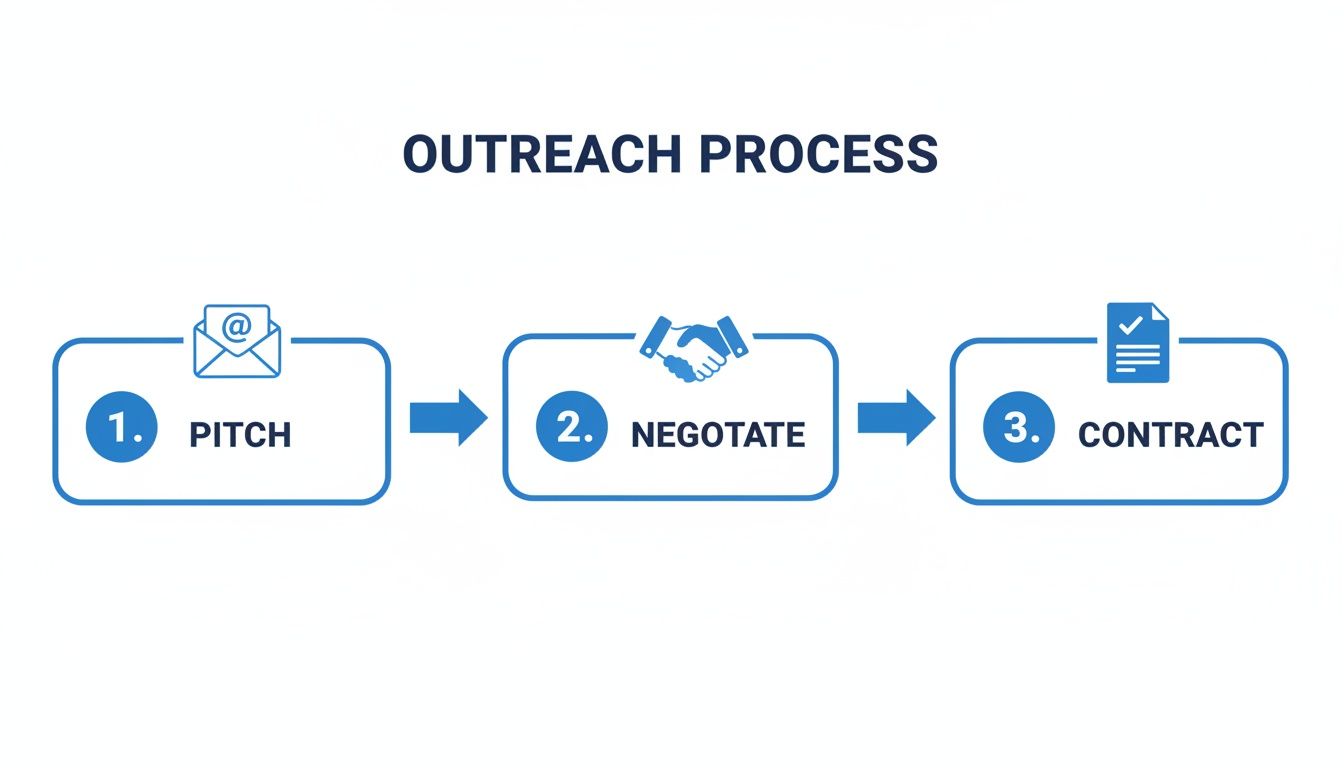
Once that contract is signed, your internal workflow kicks into high gear.
Here are the four essential steps you’ll need to nail for every ad you sell:
- Onboard the Sponsor: As soon as the deal is official, send a welcome email. Clearly lay out the next steps, including ad creative specs (like image dimensions and word count) and the submission deadline.
- Collect Ad Creative: Use a simple intake form like Google Forms or Jotform to gather everything you need. This keeps ad copy, images, and tracking links all in one tidy place. No more digging through emails.
- Schedule the Ad Placement: Immediately block out the ad run dates on a master calendar. This becomes your single source of truth and prevents you from ever double-booking a slot.
- Invoice and Get Paid: Send the invoice right after the agreement is signed. Be clear about your payment terms (e.g., "Due upon receipt" or "Net 15") to ensure you get paid on time.
This manual approach is perfectly fine when you're juggling one or two sponsors. But as you grow, it quickly becomes a massive time-suck.
Using Automation to Save Time and Look Pro
Picture managing ten sponsors a month with nothing but spreadsheets and your inbox. You'd be spending half your week chasing down ad copy, sending payment reminders, and triple-checking your calendar. This is where automation becomes your secret weapon, turning your ad operations from a chaotic mess into a smooth, efficient machine.
A good ad management system should make you look like you have a whole team working behind the scenes, even if it’s just you. Automation takes care of the grunt work, freeing you up to focus on creating great content and building sponsor relationships.
Tools like AdSlots are designed specifically to solve this problem by pulling your entire ad sales workflow into a single dashboard.
A dedicated platform gives you a bird's-eye view of your ad inventory, so you never miss a deadline or accidentally sell the same spot twice.
Instead of wrestling with a dozen different tools, a single platform can handle the entire process:
- Automated Invoicing: Connect Stripe to automatically generate and send invoices the moment a slot is booked.
- Payment Tracking: The system keeps an eye on who has paid and sends polite, automated reminders so you don't have to.
- Centralized Scheduling: A visual calendar shows all your booked and available ad slots, making inventory management a breeze.
- Sponsor Portal: Advertisers get their own login to upload creative assets and see their campaign schedule.
By putting a simple, powerful system in place, you slash human error and reclaim hours of your time. This level of professionalism doesn't just make your life easier. It builds trust with your advertisers and is essential for scaling your newsletter into a real business.
Proving Your Value with Performance Reports
Getting that first sponsorship deal signed is a fantastic feeling. But the real goal? Turning that one-time advertiser into a repeat partner. That's how you build a sustainable business, and it all comes down to proving their investment paid off. A clean, simple performance report is the final, essential step that builds trust and paves the way for the next deal.
Think of it like this: when a brand sponsors your newsletter, they're not just buying space; they're buying a result. Your report is the receipt that shows them exactly what they got for their money. It validates their decision and gives them hard numbers to take back to their team.
Identifying the Metrics That Matter Most
Your sponsors are busy. The last thing they want is a convoluted spreadsheet packed with every data point you can think of. Your job is to cut through the noise and deliver a concise summary of what actually matters. It shows you're a professional who respects their time.
The trick is to focus on the numbers that align directly with their goals. For most newsletter ads, it really boils down to three core metrics.
- Total Sends: This is the total number of subscribers the email went out to. It’s simple confirmation that you delivered the audience size they paid for.
- Open Rate: The percentage of subscribers who actually opened the email. A strong open rate proves your audience is engaged and, more importantly, that they saw the ad.
- Click-Through Rate (CTR): This is the percentage of people who opened the email and then clicked the sponsor's link. For many advertisers, this is the money metric because it shows direct interest in their offer.
Presenting these three numbers clearly is the difference between saying, "Yeah, the ad did pretty well," and proving it with cold, hard data.
Assembling a Clear Performance Summary
Your report does not need to be some work of art. A simple email or a clean one-page PDF gets the job done perfectly. You're aiming for clarity and professionalism, not a graphic design award.
Here’s a straightforward template for what to include:
- Campaign Overview: A quick one-liner stating the advertiser's name, the ad format (e.g., "Main Sponsorship"), and the date it ran.
- Key Metrics: List the core numbers in an easy-to-scan format. For example: 5,420 Sends, 46.2% Open Rate, and 3.8% Click-Through Rate.
- Total Clicks: Always include the raw number of clicks (e.g., 95 total clicks). This is a concrete number sponsors can easily grasp and plug into their own internal reports.
For advertisers, the bottom line is always about return on investment. Knowing how to calculate marketing ROI helps you frame your results in a language they understand and value.
Your performance report is more than just a summary of metrics; it's a tool for building relationships. By proactively sharing results, you show transparency and confidence in your newsletter's value, making it an easy decision for sponsors to book again.
This simple act of following up closes the loop on the current campaign and immediately opens the door to the next one. It’s this final touch that shifts you from just selling ad slots to building profitable, long-term partnerships.
A Few Common Questions About Selling Ads
As you start selling ads in your newsletter, a few questions always seem to pop up. Let's walk through some of the most common ones so you can move forward with confidence.
How Many Subscribers Do I Need to Start Selling Ads?
There is no magic number here. While many creators start landing their first sponsors around the 1,000 subscriber mark, what really matters is engagement.
Advertisers would much rather reach a smaller, dedicated audience that hangs on every word than a massive, indifferent one. A tight-knit list with a 40%+ open rate can be far more valuable than a huge list where most people ignore your emails.
The real key is proving your audience is listening. If you have a loyal readership in a specific niche, you have a valuable asset, regardless of the list size.
What Is the Difference Between a Sponsorship and an Ad?
People often use these terms interchangeably, but there's a subtle distinction. It helps to think of it this way:
- Sponsorship: This feels more like a deep partnership. A brand might be a "presenting sponsor" for an entire issue or a series. These deals usually cost more and involve more seamless integration with your content.
- Advertisement: This is more transactional and specific. Think of a classified ad, a sponsored link, or a banner with a clear start and end date.
Knowing the difference allows you to create different packages for advertisers, catering to various budgets and marketing goals.
How Should I Handle Invoicing and Payments?
When you’re just starting out, a simple invoice from a Google Doc and payments through PayPal or Stripe will get the job done. But be warned: as you grow, this manual approach quickly becomes a major headache.
You will find yourself chasing payments, losing track of conversations, and spending more time on admin than on your actual newsletter.
Manually tracking payments and ad schedules in spreadsheets is one of the biggest bottlenecks for growing creators. It pulls you away from creating content and building relationships with sponsors.
This is where specialized tools come in handy. Platforms built for selling newsletter ads can automate invoicing and payment tracking. This not only saves you a ton of time but also makes your operation look far more professional.
Stop drowning in spreadsheets and start scaling your newsletter ads. Ad Slots automates the entire ad management process, from scheduling to invoicing, so you can focus on writing great content. Check out how Ad Slots can save you hours every week.