
Building an email list is a simple value swap. You give your audience something they actually want, like a killer guide, a checklist, or an exclusive discount. In return, they give you their email address. That permission opens up a direct, reliable connection with people who are genuinely interested in what you have to say.
Why Your Email List Is Your Most Valuable Asset
Before we get into the nuts and bolts of how to build your list, let’s talk about why it is worth the effort. Do not think of your email list as just another marketing channel. It is a core business asset, one you completely own and control.
Unlike your social media following, where a sudden algorithm change can tank your reach overnight, your email list is your own private line of communication. You are not playing by someone else’s rules. This ownership gives you a stable, predictable way to build relationships, drive traffic, and make money.
The Unmatched ROI of Email
The data does not lie: email marketing delivers a staggering return on investment. According to a 2023 Litmus report, the average ROI for email marketing is $36 for every $1 spent. Good luck finding that kind of efficiency anywhere else. This makes list-building a non-negotiable for sustainable growth.
Why is it so effective? Because you are talking to people who have already raised their hand and said, “Yes, I want to hear from you.” That permission-based relationship is infinitely more powerful than trying to interrupt someone’s scrolling with an ad. To really capitalize on this, you can check out our guide on newsletter advertising best practices.
An engaged email list is not just a collection of contacts; it is a community you can serve directly. It becomes your primary launchpad for new products, your go-to source for feedback, and your most reliable driver of sales.
A Direct Line to a Growing Global Audience
Email is not going anywhere. In fact, it is only getting bigger. Oberlo data shows that by 2025, projections show there will be an estimated 4.6 billion email users worldwide. That is more than half the planet. With over 375 billion emails sent around the globe daily, its reach is undeniable. This massive user base ensures you can connect with almost any audience you can think of.
At the end of the day, building an email list is about building lasting relationships. It is your chance to move beyond one-off interactions and earn real trust and loyalty. By consistently showing up in their inbox with something valuable, you create a dedicated audience that will stick with you for the long haul. That is the real secret to predictable revenue and long-term success.
First Things First: Know Your Reader and What They Really Want
Before you even think about signup forms or landing pages, let’s get one thing straight. You cannot build a quality email list if you do not know who you are talking to and what they desperately need. This is the foundation. If you mess this up, everything else you do will feel like pushing a boulder uphill.
The first step is getting laser-focused on your ideal subscriber. Forget vague descriptions like “women, ages 25-40.” That is not a person; it is a statistic. You need to build a simple persona that feels like a real human being with real problems.
Pinpoint Your Ideal Subscriber
Think about one person who would absolutely love your newsletter. Give them a name. What keeps them up at night? What specific problem are they trying to solve right now?
A few key questions will help bring this person to life:
- What are their biggest frustrations? Are they a new freelancer totally lost on taxes? A busy parent who cannot figure out meal planning? Get specific.
- What are their immediate goals? Do they want to learn a new software, save time on a tedious chore, or land a promotion at work?
- Where do they hang out online? Are they asking for advice in a niche subreddit, scrolling Pinterest for inspiration, or networking on LinkedIn?
This is not just a creative writing exercise. When you truly understand their pain points, you can create a solution they will happily trade their email address for. This clarity is the secret to building an email list full of engaged fans, not just random names.
Create an Offer They Can’t Refuse
Once you know who you are talking to, it is time to create an irresistible offer. Marketers call this a lead magnet. This is a free, high-value goodie that solves a very specific problem for your ideal subscriber. The key here is to offer a quick, tangible win.
A great lead magnet is not about giving away your most complex work. It is about providing a focused solution that delivers immediate value and showcases your expertise. People are busy; they want a shortcut, not a textbook.
Your offer should be something they can consume and use in minutes, not hours. For example, a marketing agency called Single Grain increased their conversion rate by 224% by offering a highly specific “SEO Contract Template” instead of a generic marketing guide. The same logic applies to your offer. Fast, easy value always wins.
Lead Magnet Ideas That Actually Convert
The best lead magnets are hyper-specific. Instead of a generic ebook, think about a precise tool that makes their life easier right away.
- For busy parents: A “5-Minute Kitchen Cleanup Checklist” is way more compelling than a general guide to home organization.
- For home baristas: A short video tutorial on “Perfecting Your Drip Coffee” provides an immediate, actionable skill they can use tomorrow morning.
- For newsletter creators: A simple quiz can be a surprisingly powerful tool. If you’re curious about your own newsletter, for instance, you can discover your newsletter’s earning power with this free monetization quiz.
The goal is to create something so perfectly suited to their needs that signing up feels like a no-brainer. This focused approach is how you attract subscribers who are genuinely interested in what you have to say. That is the only kind of list worth building.
Create Signup Forms and Landing Pages That Actually Convert
You’ve got a fantastic offer ready to go. Now, how do you get it in front of people in a way that makes them want to sign up? This is where your signup forms and landing pages step in. Think of them as the front door to your newsletter. If they are clunky or confusing, people will just walk away, no matter how great your lead magnet is.
The goal is to make signing up feel like the most natural next step for your visitors. You need to find that sweet spot between being too aggressive and so subtle that you are completely ignored.
Finding the Right Form for the Job
There is a whole toolbox of signup forms out there, and the best approach is usually to use a mix of them. What works for one audience might completely annoy another, so a little experimentation is key. Do not be afraid to test different types to see what resonates.
Here are a few of the most common options I have seen work well:
- Embedded Forms: These are the quiet workhorses. You can place them right within your content, like at the end of a blog post or in your site’s sidebar. They are not in-your-face, which is a plus, but they can sometimes get overlooked.
- Pop-up Forms: I know, I know, pop-ups have a bad reputation. But when used smartly they can be shockingly effective. For example, the brand Digital Marketer found that exit-intent pop-ups, which appear when a user is about to leave, converted 10-15% of abandoning visitors.
- Welcome Mats: This is the bold choice, a full-screen overlay that greets new visitors. It forces a decision right away, which can either lead to a huge conversion boost or cause some people to bounce. Use this one carefully.
- Header/Footer Bars: These are the less-intrusive cousins of the pop-up. They stick to the top or bottom of the screen, keeping your offer visible without disrupting the user’s experience too much.
A killer combo I often recommend is an embedded form at the end of every article paired with a well-timed exit-intent pop-up. This strategy catches both the highly engaged readers and those who are on their way out.
Designing Forms People Won’t Ignore
When it comes to form design, less is almost always more. Seriously. Every extra field you ask for is another hurdle for your potential subscriber.
In fact, research from Quick Sprout showed that limiting your form to just three fields can boost conversion rates to at least 25%.
Keep your copy punchy and focused on the benefit. Ditch the generic “Submit” button. Instead, use a call-to-action that reinforces the value they are getting, like “Get My Free Checklist” or “Send Me the Cheatsheet!” It is a tiny change that makes a big psychological difference.
Just look at how the newsletter The Hustle does it on their homepage.
It’s perfect. A clear headline, a one-sentence promise, a single box for the email, and a bright, obvious button. It is frictionless. It takes two seconds. That is what you are aiming for.
The Underrated Power of a Dedicated Landing Page
While sprinkling forms across your site is a great start, a dedicated landing page is your secret weapon for maximizing signups from specific campaigns.
A landing page is a standalone page with one single, solitary goal: getting someone to subscribe. There is no navigation menu, no links to other posts, no distractions. It is just you, your offer, and the signup form. This laser-focus is why they work so well.
When you are running a social media ad, a paid campaign, or promoting a partnership, always send that traffic to a dedicated landing page, not your homepage. The results will speak for themselves. A focused experience consistently delivers more subscribers because you are removing all the noise and making the decision to sign up incredibly easy.
Drive Consistent Traffic to Your Signup Pages
You could have the world’s best lead magnet and a signup page so beautiful it makes designers weep, but none of it matters if nobody ever sees it. Getting the right people to your signup forms is the engine that actually drives list growth.
The goal here is not a one-time traffic spike. It is about building a reliable system that consistently brings in new subscribers, so you are not just crossing your fingers and hoping for the best. Luckily, this does not have to be complicated or expensive. The best place to start is often with the channels you already own.
Leverage Your Existing Platforms
Your current audience, no matter how small, is your lowest-hanging fruit. These are people who have already raised their hand and shown they are interested in what you do. Your job is to make it incredibly obvious and easy for them to take that next step and join your list.
Here are a few simple but surprisingly effective places to start:
- Social Media Bios: Your bio link is prime real estate. Stop linking to your homepage and hoping people find the subscribe button. Point that link directly to your newsletter landing page.
- Email Signature: Think about how many emails you send every single day. Add a short, compelling link to your newsletter signup in your signature. Each email you send becomes a tiny, passive advertisement for your list.
- Teaser Content: Use your social media accounts to give a sneak peek of the exclusive content your subscribers get. Share a juicy tidbit or a key insight from your latest newsletter, then cap it off with a clear call-to-action to subscribe for the full story.
This decision tree can help you visualize which type of signup form to use based on where your visitor is coming from and how engaged they are.
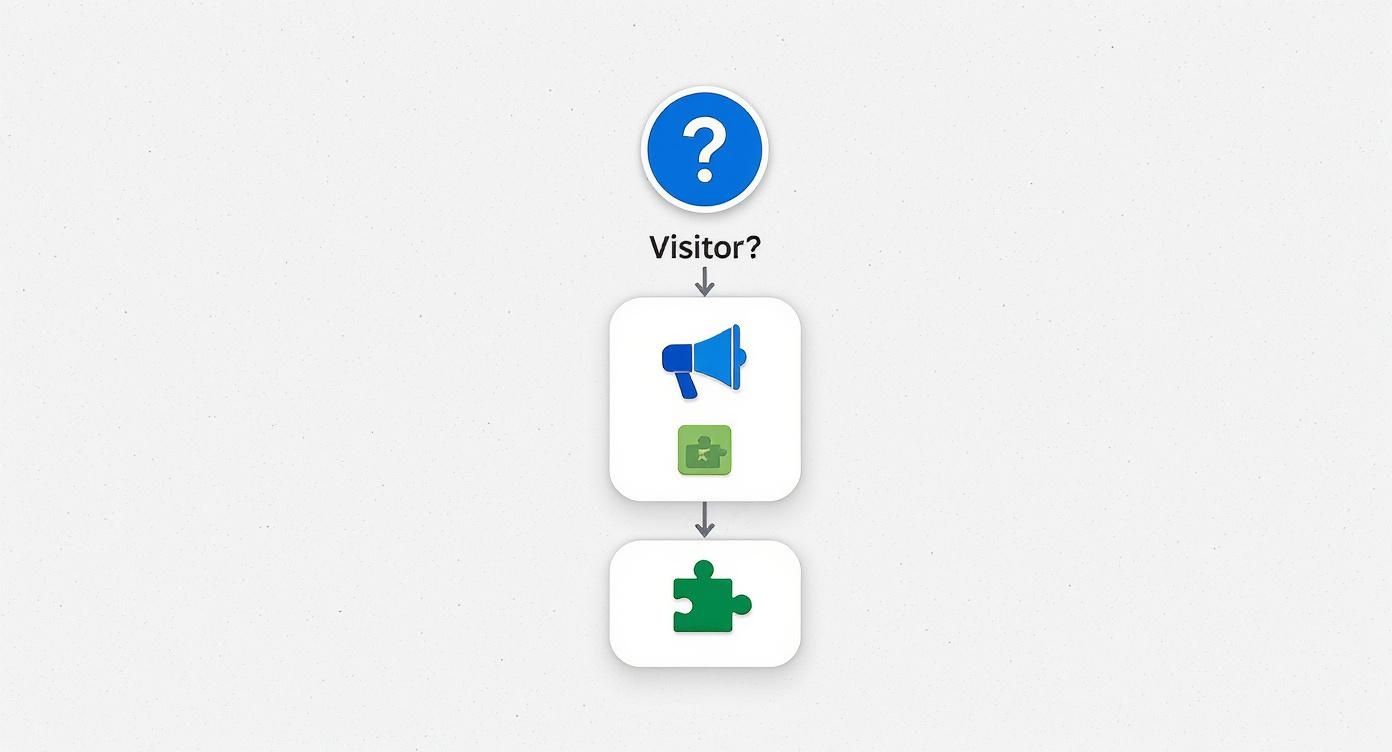
As you can see, for visitors already browsing your site, an embedded form or a well-timed pop-up works great. But for traffic you are sending from other channels, a focused, distraction-free landing page is almost always the right move.
Go Where Your Audience Already Gathers
Once you have maxed out your own channels, it is time to venture out. This means proactively finding the communities, blogs, and other newsletters where your ideal subscribers are already hanging out and adding real value there. This is how you attract highly qualified people to your list.
Guest posting is a classic for a reason. Find blogs or newsletters in your niche that serve a similar audience. Write a genuinely helpful article for them, and in your author bio, include a strong call to action that links back to your newsletter. It is a true win-win: they get fantastic content, and you get direct exposure to a brand-new, relevant audience.
Collaboration is the ultimate growth hack. Partnering with another creator for a cross-promotion or a joint webinar can expose your newsletter to a fresh audience overnight. Look for creators who serve the same audience but are not direct competitors.
Another killer strategy is collaborating with other creators. This can be as simple as a shoutout swap in your respective newsletters or as involved as co-hosting a webinar. These partnerships are so effective because they come with a built-in layer of trust. An endorsement from a creator someone already follows is pure gold.
Comparing Subscriber Acquisition Channels
Not all traffic sources are created equal. Some demand more of your time, others more of your money, and each tends to attract a different quality of subscriber. Understanding these trade-offs is key to deciding where to focus your energy and budget.
Here is a quick comparison to help you map out your strategy.
| Channel | Typical Cost | Effort Level | Subscriber Quality |
|---|---|---|---|
| Social Media Bio | Free | Low | High |
| Guest Posting | Free (time investment) | High | Very High |
| Creator Collaborations | Free or Low Cost | Medium | Very High |
| Paid Social Ads | Variable | Medium | Medium to High |
| SEO & Content | Free (time investment) | High | High |
The takeaway here is pretty clear. While paid ads can certainly bring in subscribers quickly, organic methods like guest posting and creator collaborations often result in a more engaged, higher-quality audience over the long run.
Ultimately, a healthy list growth strategy will mix several of these approaches. By building a diverse and resilient system for attracting subscribers, you will not be overly reliant on any single channel.
Turn New Subscribers into Loyal Fans (and Keep Your List Healthy)

Getting someone to give you their email is a huge win, but let’s be honest, it is just the starting line. Now comes the real work: turning that flicker of interest into a genuine connection. The first few days after someone subscribes are your make-or-break moment to prove you are worth a spot in their crowded inbox.
This is where a solid welcome email sequence is your best friend. It is a short, automated series of emails that rolls out the red carpet for new subscribers, delivers on whatever you promised, and gives them a taste of what you are all about. Do not feel like you need to build some massive, complex funnel. A few well-timed emails are all it takes.
Your First Impression: The Welcome Sequence
Think of your welcome sequence less as a marketing push and more as the beginning of a conversation. You just want to show them they made a smart choice by signing up.
Here is a simple three-email flow that I have seen work wonders for countless newsletters:
- Email 1 (The Welcome Mat – Send Immediately): Deliver the goods! This first email needs to arrive instantly with the lead magnet you promised. Keep it short, sweet, and to the point. Thank them for joining and make the download or resource impossible to miss.
- Email 2 (The Introduction – Send 1-2 Days Later): Time to introduce yourself and your mission. Share a little backstory on why you started the newsletter and what they can expect. This is your shot to build a real human connection.
- Email 3 (The Greatest Hits – Send 2-3 Days Later): Point them toward your best content. Link out to a few of your most popular articles, guides, or tools. It is an easy way to provide immediate value and get them clicking around.
This simple setup takes a new subscriber from a cold lead to a warm contact who actually knows who you are and is looking forward to your next send.
The Unspoken Rule: Keep Your List Clean
Okay, let’s talk about something that feels completely backward but is absolutely crucial for long-term growth: deleting subscribers. I know it sounds crazy. But regularly cleaning your email list, a practice we call list hygiene, is one of the most powerful things you can do for your newsletter.
Over time, people will stop opening your emails. It is inevitable. They might switch jobs, lose interest, or their email address simply goes defunct. These inactive subscribers are dead weight, dragging down your open rates and damaging your sender reputation. A bad reputation means your emails are more likely to land in spam for everyone, even your most loyal fans.
A smaller, highly engaged list is infinitely more valuable than a massive list of people who ignore you. Quality over quantity is not just a cliché here; it is the golden rule for building an email list that actually drives results.
Keeping a clean list also improves your deliverability, gives you a truer sense of your open rates, and can even save you a few bucks, since most email platforms charge you based on list size. Plus, a clean list of engaged readers is exactly what potential sponsors want to see. This is a core part of managing your inventory, a topic we cover in our guide to newsletter ad management software.
A Simple Quarterly Cleanup Plan
You do not need a complicated process for this. Just put a recurring event on your calendar for once a quarter and follow these steps.
- Find the “Cold” Subscribers: Start by creating a segment of subscribers who have not opened a single email from you in the last 90 days.
- Send a “Last Chance” Email: Send this group one final email. Use a clear, direct subject line like “Is this goodbye?” or “Do you still want to hear from me?” Ask them to click a link if they want to stay on the list.
- Say Goodbye: Wait about a week. Anyone who did not open or click that email? It is time to remove them permanently. It stings a bit, but it is for the best.
This disciplined approach to engagement pays off. Marketers who use segmented campaigns report 30% more opens and 50% more click-throughs than those sending generic blasts, as highlighted in this deep dive into email marketing stats. Ultimately, focusing on a quality audience ensures you are building a valuable asset that serves both your readers and your business goals.
A Few Common Questions About Building an Email List
Even with a killer strategy, you are bound to run into questions when you start building your email list. It is a game of small, crucial decisions that add up over time. Getting a handle on these common sticking points early on will save you a ton of headaches down the road.
Let’s dive into some of the questions I hear most often from creators who are just getting their feet wet.
How Often Should I Actually Email My List?
This is the classic balancing act, is it not? You want to stay on their radar, but you do not want to be that person who clogs up their inbox and gets sent straight to spam. There is no magic number that works for every single newsletter, but the data does give us some strong clues.
For example, a study by Constant Contact found that brands sending 2 to 5 emails per month saw the highest open rates. But, context is everything. If you are sending a daily news brief, your audience expects to hear from you every day. If you write a long-form essay once a week, stick to that.
The most important thing is to be predictable. Tell people what they are signing up for. If it is “a weekly dose of marketing tips every Tuesday,” then make sure it lands in their inbox every Tuesday. Consistency builds trust and gets people in the habit of looking for your emails.
What Metrics Should I Really Be Tracking?
It is so easy to get fixated on your total subscriber count. I get it. But that number is mostly for your ego. It does not actually tell you if your list is healthy or valuable. If you want to know how you are really doing, you have to look at how people are interacting with your emails.
Here are the numbers that matter:
- Open Rate: This is simply the percentage of people who open your email. It is your first and best signal for whether your subject lines are hitting the mark and if people recognize and trust your name.
- Click-Through Rate (CTR): This tracks the percentage of subscribers who clicked on at least one link. A solid CTR is proof that your content is genuinely interesting and useful to your readers.
- Conversion Rate: This is the big one. It measures how many people took the action you wanted them to, whether that is buying your product, registering for an event, or clicking an affiliate link.
- Unsubscribe Rate: Do not freak out when you see people unsubscribe. A small, steady trickle is perfectly normal. It is the sudden spikes you need to watch out for. That is a sign that something is off with your content or frequency.
Watching these engagement metrics gives you a much truer story of your newsletter’s performance.
Is It Ever Okay to Buy an Email List?
Let me make this crystal clear: No. Never.
I know it sounds like a tempting shortcut, but buying a list is a trap that will do more harm than good. You are essentially paying for a list of people who have no idea who you are and never asked to hear from you.
Sending emails to a list you bought is the fastest way to get flagged as spam. This torpedoes your sender reputation, which can get you blacklisted by providers like Gmail and Outlook. It is incredibly hard to recover from that.
Beyond the technical nightmare, it just goes against the entire spirit of email marketing. This channel works because it is built on permission and trust. Buying a list is like showing up to a party you were not invited to and trying to sell something. You are starting the relationship as an unwelcome pest. Take the time to build your list the right way. It is the only way to get an audience that actually wants to hear from you.
What Should I Put in My Very First Email to a New Subscriber?
That first email is your golden opportunity to make a great impression. This is your welcome email, and honestly, it is probably the most important email you will ever send. A good one confirms the subscription, delivers whatever you promised them for signing up, and sets the stage for everything to come.
Welcome emails have a staggering average open rate of 51%, which blows normal marketing emails out of the water. People are actively waiting for this email, so you need to make it count. This is your chance to shine, especially since 60% of consumers say email is their preferred way to hear from brands. If you are curious, you can discover more about these email marketing statistics and how they can inform your strategy.
Your welcome email only needs to do three simple things:
- Give them the goods. Deliver that checklist, e-book, or discount code you promised.
- Say hello. Briefly introduce yourself and remind them why they made a great choice by subscribing.
- Set expectations. Let them know what is coming next, like “Keep an eye out for my weekly newsletter every Tuesday morning.”
Once your list starts growing, you will naturally start thinking about monetization. To get a better feel for what that landscape looks like, take a look at our guide on email advertising costs.
Ready to stop wrestling with spreadsheets and start scaling your newsletter sponsorships? Ad Slots automates the entire ad management process, from tracking sponsors to invoicing and scheduling. We give you back the time to focus on what you do best: writing great content.