
Turning your Ghost blog's newsletter into a direct and powerful revenue stream is more achievable than you might think. By using Ghost's built-in analytics and capitalizing on the high engagement rates of your audience, you can build a solid advertising model completely independent of old-school ad networks. This strategy puts you in the driver's seat, allowing you to connect directly with sponsors who truly value your readers.
Your Ghost Newsletter Is an Advertising Goldmine
If you're already running a newsletter on Ghost, you're sitting on a valuable asset. Unlike many other platforms, Ghost was designed from the ground up to foster direct relationships with your audience. That is exactly what premium sponsors are looking for these days. The entire platform encourages high engagement.
In fact, it's not uncommon for Ghost newsletters to see average open rates hitting 50% or more. That number is huge. It means sponsored content in your newsletter actually gets seen by people who are paying attention, making it far more valuable than a random banner ad lost on a cluttered webpage.
Why Ghost Is Built for Monetization
Ghost's entire philosophy is about helping independent publishers succeed on their own terms. This is not just marketing fluff; it's baked into how the platform works and is reflected in the success of its users.
The numbers don't lie. When Ghost 6.0 was announced, publishers on the platform had collectively earned over $100 million in revenue. That's a massive tenfold jump from the $10 million they reported just a few years prior, which shows the incredible financial opportunity available to creators like you.
This kind of success is not an accident. It comes from a specific set of features designed to help you build a real business:
- Detailed Analytics: Ghost gives you the data you need to see which posts are driving opens, clicks, and even paid member sign-ups. This is the exact information you need to prove your value to potential advertisers.
- Direct Audience Ownership: You own your email list, period. This allows you to create a direct-to-creator advertising model where you keep 100% of the revenue instead of giving a cut to some middleman network.
- Flexible Content Editor: The editor makes it incredibly easy to insert sponsored content that looks and feels like it belongs, adding value for your readers instead of interrupting them.
Before we dive deeper, it's worth seeing just how much of an advantage a Ghost newsletter gives you over the standard email marketing noise.
Ghost vs. Industry Averages for Ad Effectiveness
| Metric | Typical Ghost Newsletter | Email Marketing Industry Average |
|---|---|---|
| Open Rate | 40-60% | 21.33% |
| Click-Through Rate | 5-10% | 2.62% |
| Audience Relationship | Direct, high-trust | Indirect, often transactional |
| Ad Revenue Split | 100% to Creator | 50-70% to Creator |
As you can see, the numbers speak for themselves. The engaged, niche audience you have built is far more valuable to an advertiser than a blast sent to a generic, low-engagement list.
To really make the most of this, you need a solid game plan. Our guide on newsletter advertising best practices is a great place to start thinking about how to structure your ad offerings. Ultimately, managing ads in Ghost is about moving away from guesswork and toward a data-backed strategy that showcases the unique value your audience brings. For an even deeper dive, explore these personalized email strategies to really drive results for your sponsors.
Alright, let's get into the nitty-gritty of planning out your ad inventory and figuring out what to charge. Before you can think about talking to sponsors, you need a crystal-clear picture of what you're actually selling.
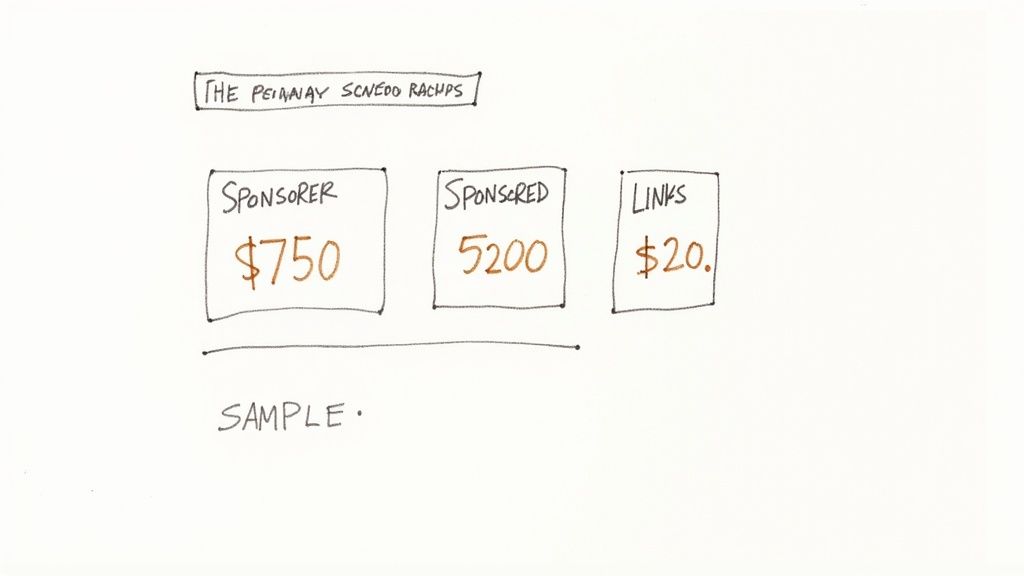
Having a defined ad inventory makes you look professional and just makes your life easier. If you don't have one, you're essentially just winging it, which usually means you'll either undervalue your newsletter or confuse potential advertisers.
My advice? Start simple. You don't need a massive, complicated menu of ad options right out of the gate. Look at your newsletter's layout and find a couple of spots where an ad would fit naturally without disrupting the reader's experience.
Creating Your First Ad Menu
Most successful newsletters stick to just two or three core ad products. This approach is smart because it avoids overwhelming sponsors with too many choices and keeps your own management tasks from getting out of hand.
Here’s a basic, effective setup that works for almost everyone:
- Primary Sponsorship: This is your headliner, the main event. It usually sits right at the top of the newsletter, introduced with a simple "Brought to you by…" It typically includes a logo, a short blurb, and a bold call-to-action link. Because this spot gets the most eyeballs, it’s your most valuable piece of real estate.
- Sponsored Links or Classifieds: Think of these as a more subtle, budget-friendly option. They're often just text-based links grouped together in their own section, maybe near the bottom. This format is perfect for smaller advertisers, job listings, or cross-promoting other newsletters. It also lets you feature multiple sponsors in one issue.
This two-tier system creates a clear difference in value and price, making it a straightforward decision for sponsors to pick what works for their budget.
Setting Your Ad Rates
Pricing can feel like the scariest part, but it really doesn't have to be. Your rates should be grounded in real data you can pull straight from your Ghost analytics. The two most important metrics here are your total subscribers and your average open rate.
A great starting point is the Cost Per Mille (CPM) model, which is just a fancy way of saying "cost per 1,000 impressions." For newsletters, an "impression" is an open.
Let's walk through a quick example. Say your newsletter has 5,000 subscribers and a solid 50% open rate.
This means about 2,500 people open each email you send. If you set your CPM at $50 (a pretty standard rate for a focused audience), the math is simple: 2.5 (for 2,500 opens) x $50 = $125 for your primary sponsorship slot.
But that's just a baseline. The value of your audience is a huge factor. If you're writing a highly specialized B2B newsletter for industry executives, you could easily charge a CPM of $75 to $100, maybe even more. If you can prove your audience is super engaged with high click-through rates, that’s added value you should absolutely charge for.
If you want a more data-driven starting point, a tool like this newsletter ad pricing calculator can give you a solid estimate.
Ultimately, you need to land on a price you feel confident about and be ready to justify the value. Your Ghost analytics are your best friend here. They provide the hard numbers sponsors need to see that they're making a smart investment.
Using Ghost Analytics to Sell and Place Ads
If you really want to level up your newsletter ad game, you have to stop guessing and start using data. Your Ghost dashboard is more than just a bunch of numbers; it's a treasure map pointing directly to your most valuable advertising real estate.
Sponsors need to see proof that their money will be well-spent, and your analytics are that proof. Instead of just saying, "My readers are really engaged," you can hit them with hard data: "This content category consistently pulls a 55% open rate." Suddenly, your pitch is not just a hopeful ask. It's a solid business case.
Finding Your Premium Ad Real Estate
The first thing I always do is dive into the post analytics. You're looking for patterns. Is there a certain post, or maybe a recurring series, that always crushes it? That's your premium spot. A post that drives a ton of clicks or, even better, converts free readers to paid members is pure gold to a sponsor.
Think about it like this. If a specific format, say, a deep-dive tutorial or a weekly roundup, always gets the most traction, that's exactly where you should place your highest-priced ad slot. Advertisers are more than willing to pay a premium to get their name next to your best, most-read content.
Pro Tip: Don't get fixated only on the highest open rates. A post with a slightly lower open rate but a much higher click-through rate can actually be more valuable. It shows your audience is not just passively reading; they're actively taking action.
Ghost's built-in analytics are surprisingly powerful for spotting these high-conversion opportunities. For example, if you send a newsletter to 5,000 free subscribers and it leads to 500 paid upgrades, that’s a massive 10% conversion rate. That’s a powerful stat you can use to justify higher ad prices for similar content. You can learn more about how Ghost's tools make these calculations simple by exploring their analytics resources.
Using Key Metrics to Justify Your Pricing
When you're talking to potential sponsors, you must speak their language. That means talking about open rates and click-through rates (CTR). These are the bread and butter of email marketing KPIs.
Your open rate is the first hurdle. It proves your emails actually land in the inbox and that your audience trusts you enough to open them. If you want a deeper dive into what a "good" open rate looks like and how to improve yours, check out our guide on boosting your email open rate.
Here's a simple way to frame your data for a sponsor:
- Start with your overall averages: "On average, my newsletter gets a 48% open rate and a 6% click rate."
- Highlight your best-performing segments: This is where you can really impress them. "But for our popular 'Case Study' series, the click rate jumps to 9%."
- Offer highly targeted placements: Use Ghost's member filters to create exclusive opportunities. "I can also place your ad in a newsletter going only to my 750 paid subscribers, who are by far my most engaged readers."
This kind of detail shows sponsors you're not just selling space. You're a strategic partner who understands their audience. It's also how you can start charging significantly more for those premium, targeted placements. This turns your Ghost analytics from a simple reporting tool into a core part of your sales machine.
Want to keep sponsors coming back? It all comes down to the experience you provide. A clunky, confusing process is the quickest way to make sure a sponsor never books with you again. Building trust and long-term advertising partnerships means creating a smooth, professional workflow from the moment they first reach out.
This predictability is what turns a one-time advertiser into a reliable stream of recurring revenue. The goal is simple. Make it incredibly easy for sponsors to say "yes" and even easier to work with you. A well-oiled process shows you respect their time and are serious about delivering results. This system should be ready to go before that first inquiry lands in your inbox.
Managing the Sponsor Relationship
Think of your entire sponsor workflow as a product you're offering. It needs clear steps, minimal effort from your client, and a consistent, high-quality result every single time. This means having your communication templates, asset collection forms, and contracts ready to deploy.
Here’s a simple, effective sequence that works wonders:
- The First Reply: Have an email template ready to go. It should thank them for their interest, provide a link to your media kit, and clearly explain what happens next. An immediate, professional reply sets a fantastic tone right from the start.
- Collecting the Creative: Ditch the messy email chains. Use a simple form from a tool like Tally or Typeform to get everything you need in one go: headline, body copy, call-to-action text, URL, and any images or logos.
- Confirming the Details: As soon as you have their assets, send a quick confirmation email locking in the publication date. This one small step removes all the guesswork for the sponsor and shows you're on top of things.
This kind of structured approach cuts out the endless back-and-forth that drives advertisers crazy. As you start juggling more partners, a dedicated newsletter sponsor CRM can be a total game-changer for keeping everything organized.
Placing Ad Content in Ghost
Once the creative assets are in your hands, the last piece of the puzzle is getting the ad into your newsletter. Thankfully, Ghost's editor makes this a breeze. The best way to do it is by using an HTML card.
Why an HTML card? Because it gives you total control over how the ad looks, making sure it’s clean and fits naturally within your content. It also neatly separates the ad's code from your main article text, which prevents any weird formatting bugs. This is also the perfect place to add any tracking parameters to the sponsor's link for your performance reports.
By standardizing the entire process, from that initial email to the final ad placement, you create a seamless and reliable experience. This level of professionalism is what impresses sponsors and, more importantly, makes them want to book with you again and again.
As your advertising revenue grows, you'll want to formalize these relationships. For a deeper look into that, check out a modern contract management guide to help you handle agreements properly.
Automating Your Ad Booking and Invoicing
Once your newsletter starts to take off, you'll quickly find that managing sponsors is a job in itself. The back-and-forth emails, chasing down ad creative, and sending invoices can eat up your entire week. What works for one or two sponsors becomes a total nightmare when you're juggling several at once.
This is the exact moment where a little automation can make a huge difference.
Instead of manually handling every single booking, you can set up a system that does the heavy lifting for you. The idea is to connect the tools you’re likely already using, like your booking form and payment processor, into a smooth, hands-off workflow. This not only saves you a ton of time but also makes you look incredibly professional to your sponsors.
Building Your Automated Workflow
The magic here lies in a simple "trigger and action" setup. When a sponsor completes a specific action (like filling out your booking form), it kicks off a series of automated events. The perfect tool for this is Zapier, which acts as the glue between all your different apps.
Let's walk through a practical example. Say you use a Tally form for bookings, manage your work in Trello, and handle payments with Stripe.
Here’s how you could connect them all:
- The Trigger: A sponsor fills out and submits your ad booking form on Tally. This is the starting gun for the whole process.
- Action #1: Zapier immediately creates a new card on your Trello board under a "New Bookings" list. It automatically populates the card with all the sponsor's details from the form. This includes the company name, contact info, the ad package they picked, everything.
- Action #2: At the same time, Zapier tells Stripe to create and send an invoice directly to the sponsor's email. The invoice amount is pulled straight from the ad package they selected on the form.
Just like that, a simple two-step "Zap" handles the tedious stuff. No more manually creating Trello cards or fumbling with invoices. The system takes care of it, freeing you up to focus on scheduling the ad and nurturing that sponsor relationship.
This diagram shows how a streamlined workflow looks, from the first inquiry all the way to the final performance report.
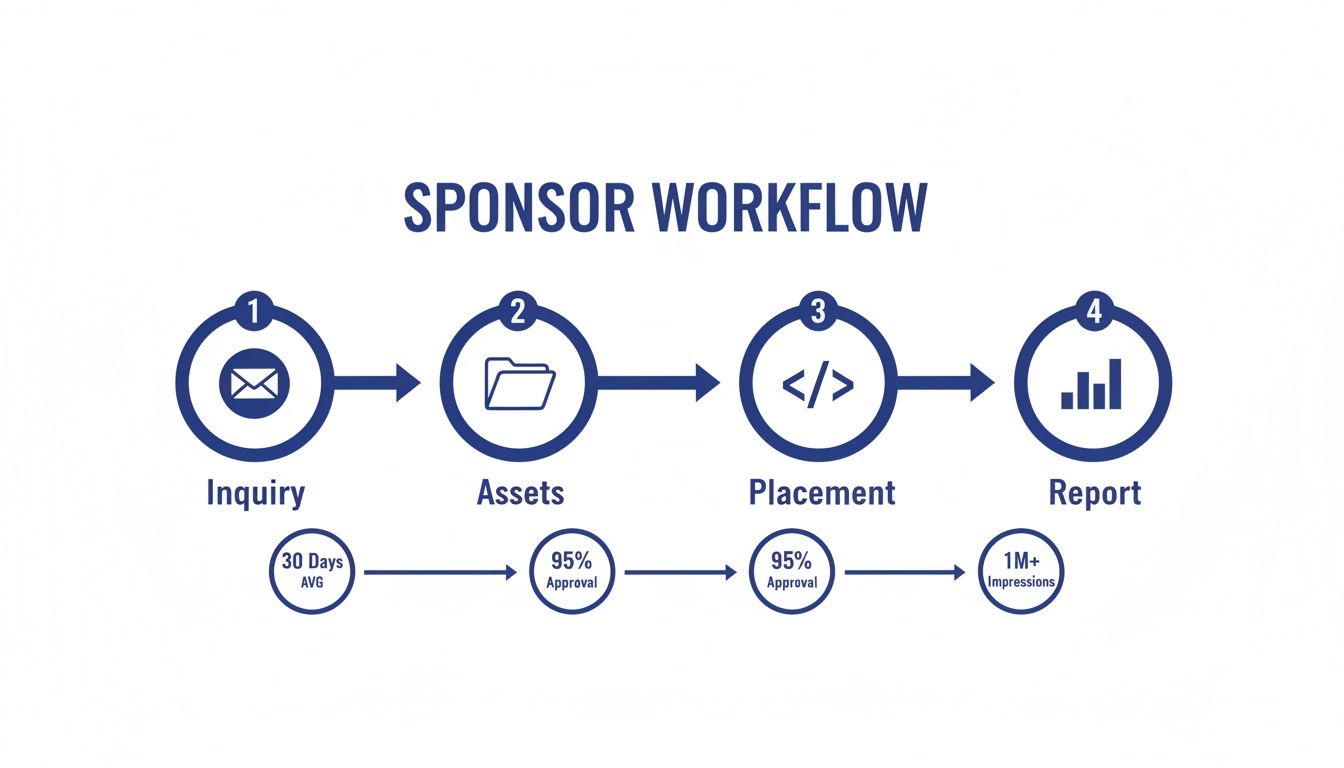
By automating the initial inquiry and asset collection, you can spend your time where it really counts: ensuring great ad placement and analyzing the results.
Why This Automation Is a Game-Changer
Putting a system like this in place does a lot more than just save you a few hours. It builds a scalable foundation for your entire newsletter business. You can start bringing on more sponsors with confidence, knowing you won't drop the ball on a missed invoice or a lost email.
Automating the repetitive parts of newsletter ad management for Ghost blogs creates a reliable system that’s less prone to human error. Sponsors get their invoices right away, and you get an organized pipeline of upcoming ads without any extra effort after the initial setup.
This efficiency is what allows you to maintain your momentum and grow your revenue. When you’re not buried in admin work, you have the mental space to focus on what actually moves the needle: creating great content for your readers and delivering fantastic results for your sponsors.
Common Questions About Ghost Newsletter Ads
When you first start thinking about newsletter advertising, a million questions pop into your head. How do I even find someone to pay me? What can I actually do inside Ghost itself? It’s completely normal to feel a bit lost at the beginning.
Let's cut through the noise. Here are some straightforward answers to the questions I hear most often from creators trying to build a real business around their content.
How Do I Find My First Advertisers?
Getting those first few sponsors is often less about cold outreach and more about looking in your own backyard. The best partnerships feel natural because they are. Start by thinking about the products, tools, or companies your audience already loves.
Here's a simple game plan:
- Scan your own articles. Who do you mention all the time? What tools do you recommend? Those companies are your warmest leads, period.
- Whip up a one-pager. This does not need to be fancy. Just pull your key stats from Ghost analytics. Subscriber count, average open rate, and click rates. Put them on a single, clean page.
- Send a personal note. Reach out and tell them why your audience is their audience. A short, genuine email explaining the fit will always beat a generic template.
Pro tip: Offer a small "first-timer" discount to your initial sponsors. In exchange, ask for a testimonial. That social proof is gold and will make landing bigger deals much, much easier down the line.
What Ad Formats Work Best in a Newsletter?
Forget flashy banners. The ads that actually perform well are the ones that blend in and respect the reader’s experience. You want it to feel like a genuine recommendation, not a disruptive commercial.
In a Ghost newsletter, two formats are proven winners:
- The Primary Sponsorship: This is your premium spot, usually right at the top. A simple intro like, "This issue is brought to you by [Sponsor]" works perfectly. It typically includes a quick paragraph, a single call-to-action, and one link.
- Sponsored Links or Classifieds: Think of this as a small, text-only section near the bottom of your email. It’s a great, low-cost option for smaller brands, job postings, or even cross-promotions with other creators.
My advice? Avoid large banner images whenever you can. They can seriously hurt your email deliverability and just feel out of place, which erodes the trust you have worked so hard to build with your audience.
Can I Manage Ads Entirely Within Ghost?
For the actual work of getting the ad into your newsletter and seeing how it performs? Yes, absolutely. You don't need any other software to get started.
The HTML card in the Ghost editor is your go-to tool. It lets you paste the sponsor's copy, images, and links right where you want them. You can even see how many clicks their specific link got by checking the post's analytics inside Ghost. While other tools can help with the booking and billing side of things, the core fulfillment happens right inside the editor you already use.
Ready to stop juggling spreadsheets and start scaling your newsletter's revenue? Ad Slots automates your entire sponsor workflow, from booking and invoicing to fulfillment scheduling. Get your time back and focus on what you do best: writing great content. Check out how AdSlots can streamline your operations at https://adslots.co.