
If you’re still wrangling newsletter sponsorships in a spreadsheet, you’re leaving money on the table. It's a classic case of what works for a handful of sponsors quickly becoming a liability. That cluttered grid is a breeding ground for double-booked slots, missed follow-ups, and hours of soul-crushing admin work. It is not just inefficient; it is a hard ceiling on your growth.
Why Your Ad Spreadsheet Is Leaking Revenue

Look, we've all been there. When you're just starting out, a spreadsheet feels like a perfectly logical way to track advertisers and their run dates. It's simple and free. But as your audience grows and more sponsors come knocking, that manual system starts to buckle under the pressure, creating hidden costs that silently sabotage your bottom line.
The most glaring issue is simple human error. One wrong date entry or a copy-paste mistake can lead to the dreaded double-booking of a premium ad slot. Now you're stuck having an incredibly awkward conversation with a sponsor. At best this damages your reputation and at worst costs you revenue through make-goods or refunds.
The True Cost of Manual Management
Beyond the obvious mistakes, the sheer operational drag of a spreadsheet is a killer. Just think about the time you burn manually updating your availability calendar, then cross-checking that against your payment records, then chasing down ad creatives via email. Every hour you spend on that kind of busywork is an hour you are not spending on what actually matters, creating great content and selling more ads. This inefficiency is a direct bottleneck on your ability to scale.
If any of these sound painfully familiar, your spreadsheet is failing you:
- No Real-Time Visibility: You cannot instantly see which ad slots are open next month without painstakingly scanning rows and columns, hoping you don't miss something.
- Inaccurate Revenue Forecasting: Trying to predict future ad income is a complete shot in the dark, making it impossible to plan for your business's growth with any confidence.
- Chaotic Sponsor Communication: Sponsor details are in one tab, the ad calendar in another, and the email history is somewhere in your inbox. To get this organized, check out our guide on using a newsletter sponsor CRM.
The newsletter world is booming. The beehiiv platform alone saw a staggering 96.2% year-over-year increase in newsletters from 2023 to 2024. Creators on their platform are now generating over $25 million in revenue. This explosion of growth means the competition is getting fiercer, and professionalizing your ad operations is no longer optional if you want to claim your piece of the pie. You can dig into more of this data in beehiiv’s 2025 report.
The biggest risk of a spreadsheet-based system is not just the mistakes you make; it is the opportunities you miss. When a potential sponsor asks about your Q4 availability, they need a fast, confident answer, not radio silence while you decipher a messy file.
At the end of the day, leaning on a spreadsheet forces you into a reactive mode. You're constantly putting out fires instead of building a predictable revenue engine. The move to a dedicated system for newsletter ad inventory management is the first real step toward treating your newsletter like the serious business it is.
Building Your Ad Inventory System from the Ground Up
Moving away from a chaotic spreadsheet is all about gaining control over your ad revenue. The first real step toward a professional setup is to stop selling vague "sponsorships" and start thinking like a product manager. You need to define exactly what you’re selling.
This means creating a proper ad product catalog. It is a menu of clear, distinct offerings that sponsors can easily understand and purchase. Each ad unit needs a name, a description of where it goes, and what the creative requirements are.
Define Your Ad Products and Pricing Tiers
Think of these ad units as the building blocks of your entire inventory. You don't need dozens of options, just a few well-defined ones that cater to different advertiser needs and budgets.
A simple, effective catalog might look something like this:
- Main Sponsor: This is your premium spot, usually right at the top. It is exclusive and often includes a logo, a decent chunk of text, and a bold call-to-action button. For instance, the popular Morning Brew newsletter places their main sponsor right after the opening story.
- Secondary Feature: A solid mid-content placement that gets great visibility without being the main headline. It might be a bit smaller or have slightly different creative specs than the main sponsor slot.
- Classifieds: A simple, text-only section at the bottom. It is the perfect entry point for smaller advertisers or those testing the waters. A newsletter like Dense Discovery uses this format effectively for indie makers and small brands.
With your products defined, it's time to put a price on them. A flat rate is simple and predictable for everyone. A CPM (cost per thousand opens) model ties the price directly to performance, which some advertisers love. I've seen many successful newsletters use a hybrid approach, offering flat rates for the premium slots and CPM for others to provide flexibility.
Do not make the classic mistake of undervaluing your inventory, especially early on. Do your homework. Look at what other newsletters in your niche with similar engagement are charging. If a comparable publication charges a $50 CPM for their main sponsorship and you average 10,000 opens, a starting price of $500 per send is a perfectly reasonable benchmark.
Create a Dynamic Availability Calendar
Once you know what you’re selling, you need a way to track what’s available and when. This is where a dynamic availability calendar comes in. It becomes your single source of truth. No more double-booking. No more frantic spreadsheet searches.
This calendar is more than just a schedule; it is a powerful sales tool. Imagine a sponsor asks about Q4 availability. Instead of saying "let me check," you can instantly pull up clear options. For many creators, a shared Google Calendar works just fine at the beginning. But as you grow, you'll quickly find that dedicated newsletter ad scheduling software is a lifesaver for automating bookings and preventing costly mistakes.
And if you’re managing ads across more than just your newsletter (like a podcast or website), it’s smart to follow cross-platform ad integration best practices to keep everything running smoothly.
A Practical Inventory Schema Template
To really tie this all together, you need a structured way to hold all this information. This is what I mean when I say "move beyond a spreadsheet." You need a schema. Think of it as a blueprint for organizing your data. This foundation is what makes your newsletter ad inventory management process scalable and lets you make decisions based on data, not guesswork.
Here’s a simple schema you can adapt. Whether you're using a tool like Airtable or something more advanced, this structure will serve you well.
Sample Newsletter Ad Inventory Schema
This template provides a clear, organized way to view your ad inventory at a glance.
| Ad Slot ID | Ad Unit Name | Placement (e.g., Header, Mid-Content) | Pricing Model (CPM, Flat Rate) | Rate | Availability Status | Booked by (Advertiser) | Scheduled Date |
|---|---|---|---|---|---|---|---|
| N24-MS-01 | Main Sponsor | Header | Flat Rate | $750 | Booked | Company A | 2024-10-15 |
| N24-SF-01 | Secondary Feature | Mid-Content | CPM | $40 | Available | – | 2024-10-15 |
| N24-CL-01 | Classified | Footer | Flat Rate | $100 | Booked | Company B | 2024-10-15 |
With a system like this, you get a real-time view of what's sold, what's open, and what revenue is on the books. This is the framework you need to turn your newsletter's ad space into a predictable and profitable business.
Automating Your Ad Sales Workflow
https://www.youtube.com/embed/rwsOc7TnWAo
Let's be honest: manual tasks are the biggest bottleneck for a growing newsletter. Once you've defined your ad inventory system, the next logical step is to automate the entire sales cycle. This starts from the moment a sponsor books a slot to the final performance report. This is the leap that takes you from a side hustle to a scalable media business.
The real goal here is to build a hands-off system where technology does the heavy lifting. This frees you up to focus on what actually moves the needle: building relationships with advertisers and creating great content. Instead of getting buried in spreadsheets, you can build a workflow that practically runs itself.
Connecting Your Booking and Availability
The core of any solid automation is the link between your booking process and your availability calendar. When a sponsor buys an ad slot, your calendar needs to update in real time to prevent the dreaded double-booking. This is where a few simple integration tools can work wonders.
For instance, you could set up a booking form using a tool like Typeform or Jotform. When an advertiser fills it out and completes the payment, it triggers a chain reaction. Using a platform like Zapier, you can create a "zap" that automatically handles several tasks:
- It creates a new event in your Google Calendar, instantly marking that ad slot as "Booked."
- It adds a new record to your ad inventory database in Airtable, populating it with the advertiser's details and the scheduled date.
- It sends a confirmation email to the advertiser with the next steps for submitting their ad creative.
This simple setup keeps your availability accurate and kicks off the fulfillment process the second a sale is made. No more manual data entry.
The diagram below shows how these core components fit together.
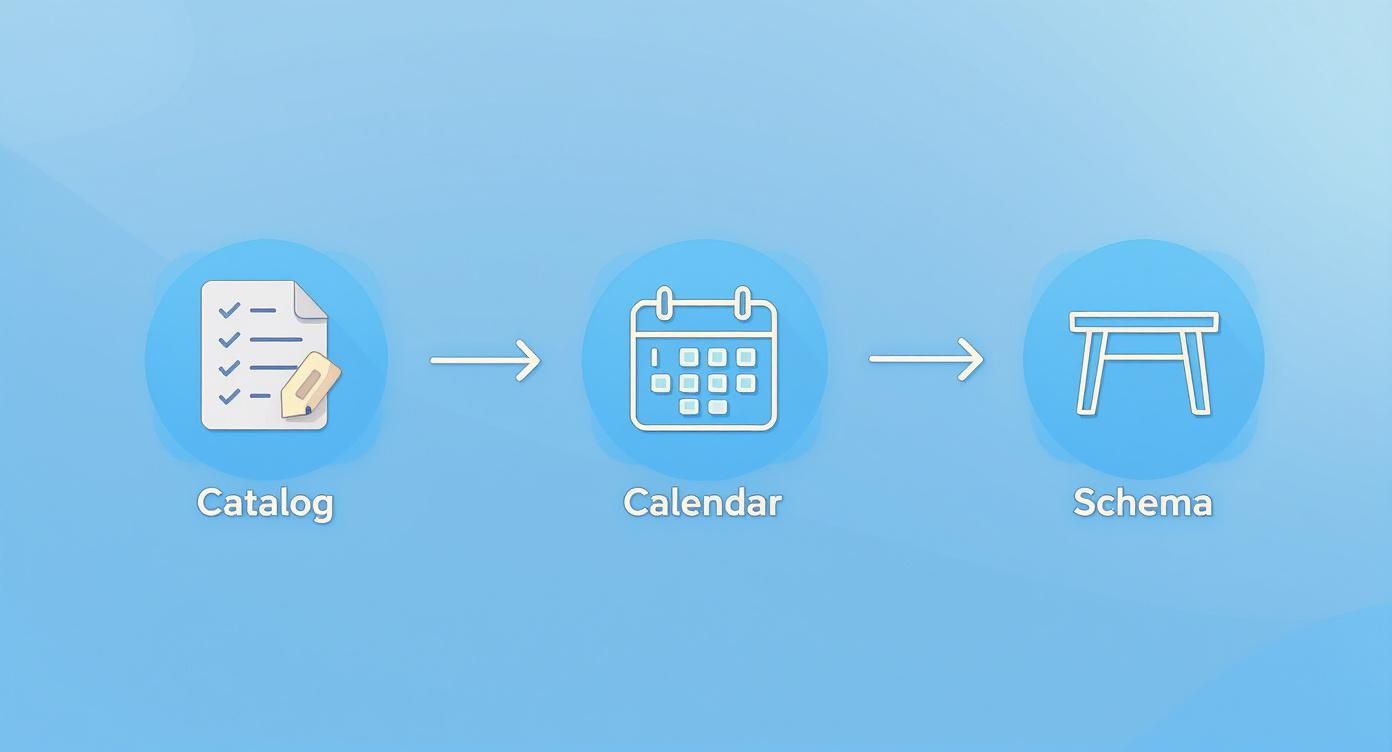
This flow illustrates how a standardized ad catalog, a live calendar, and a structured data schema are the three pillars of a reliable, automated system.
Creating a Hands-Off Fulfillment Workflow
Automation doesn't stop once a slot is booked. The fulfillment process is packed with manual touchpoints just waiting to be automated. This includes chasing down ad assets, getting them into the newsletter, and making sure they run on time. A smart workflow ensures nothing falls through the cracks.
Here’s what a typical fulfillment sequence could look like:
- Creative Asset Reminder: An automated email goes out to the advertiser 7 days before their run date, reminding them to send over their ad copy and images.
- Placement Scheduling: Once you have the creative, tools for automated newsletter ad insertion can place it directly into your email service provider, whether you're on Beehiiv or Substack.
- Performance Reporting: After the send, another workflow can pull the key performance data (opens, clicks) and email a clean, simple report to the advertiser 24-48 hours later.
A well-automated workflow makes you look incredibly professional. Sponsors appreciate a seamless, organized process, which builds trust and makes them far more likely to book with you again.
This kind of efficiency is non-negotiable when you consider the scale of email. With a projected 4.6 billion email users worldwide in 2025 and over 392 billion emails expected to be sent daily by 2026, the potential audience is staggering.
To really see the value, it's worth learning how to automate ad operations tasks and calculate their ROI. This helps you put a real number on the time and money you're saving, making the case for automation a no-brainer.
Measuring Ad Performance to Boost Revenue
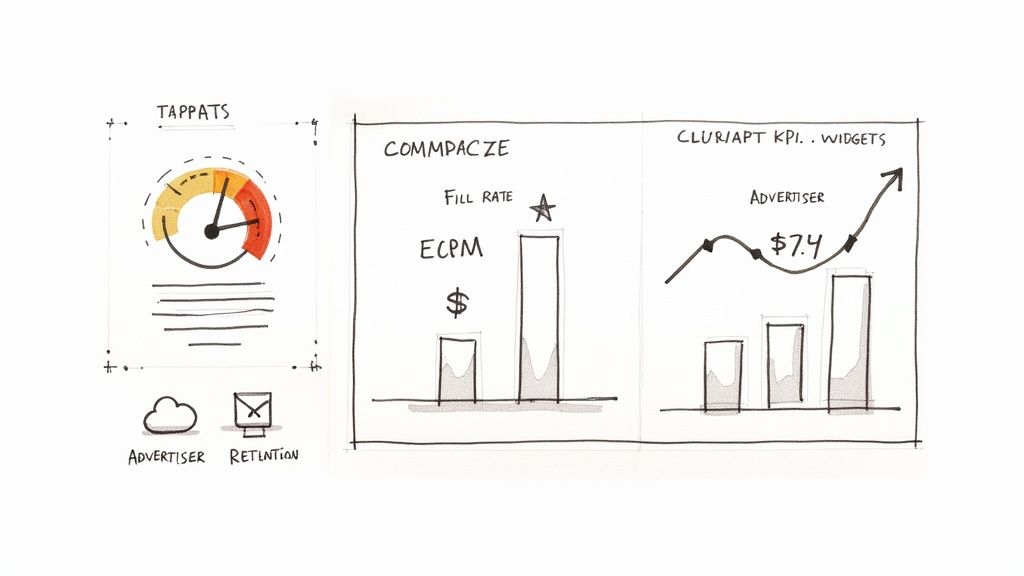
If you're not tracking your ad performance, you're flying blind. To really get a handle on your newsletter ad inventory management, you have to look past vanity metrics like open rates and dig into the numbers that actually move the needle on revenue. This is how you prove your value, confidently set your prices, and keep sponsors coming back for more.
The whole point is to understand what happens after someone sees an ad. It is about shifting from a simple transaction to a strategic partnership, where you can show advertisers the real-world return on their investment.
Core Metrics That Drive Smarter Decisions
To get a clear picture of how your ad operation is really doing, you only need to focus on a handful of key performance indicators (KPIs). These numbers give you the clarity you need to make smart calls about your inventory and pricing.
Start with these essentials:
- Fill Rate: This is the percentage of your total ad inventory that you actually sold. A low fill rate is a red flag. It might mean your prices are too high or your sales efforts are missing the mark.
- Sell-Through Rate (STR): This is a more focused metric. It tracks the percentage of a specific ad slot (like your "Main Sponsor" spot) that was sold over a certain period. For example, if you offer 4 "Main Sponsor" slots per month and sell 3, your STR is 75%.
- Effective Cost Per Mille (eCPM): This metric calculates your revenue per thousand opens. It is a great equalizer, letting you compare the true profitability of different ad placements and pricing models side-by-side.
Keeping an eye on these numbers gives you a real-time diagnostic for your business. For instance, if your Main Sponsor slot has a 95% sell-through rate but your Classifieds section is stuck at 40%, you know exactly where to direct your energy.
Your performance data is your best sales tool. When you can show a potential advertiser that a similar campaign hit an eCPM of $75, you’re not just selling space; you’re selling a predictable outcome.
Analyzing Performance to Maximize Profit
Once you have this data, you can start making strategic moves. Take a hard look at which ad placements consistently deliver the highest eCPM. Those are your premium slots, and their pricing should absolutely reflect that. A good dashboard helps you draw a straight line from performance to pricing.
It's also incredibly valuable to know which advertisers see the best results. If a particular brand is getting a fantastic click-through rate, their audience is a perfect match for yours. That's a huge signal to go find similar advertisers for future campaigns. You can even point potential sponsors to our free newsletter ad ROI calculator to help them map out what they could achieve.
But here’s a word of caution: measuring engagement is getting trickier. We're seeing a big uptick in non-human activity, which can seriously inflate click metrics and give sponsors a false sense of success. One study found that by early 2025, a staggering 71% of all clicks on newsletters could be from bots, not actual readers. To dive deeper into this, you can explore the latest trends in newsletter engagement. This makes it more crucial than ever to use reliable tracking and focus on metrics that are harder to fake, like real conversions and sign-ups.
Common Mistakes to Avoid When You Scale Ad Operations
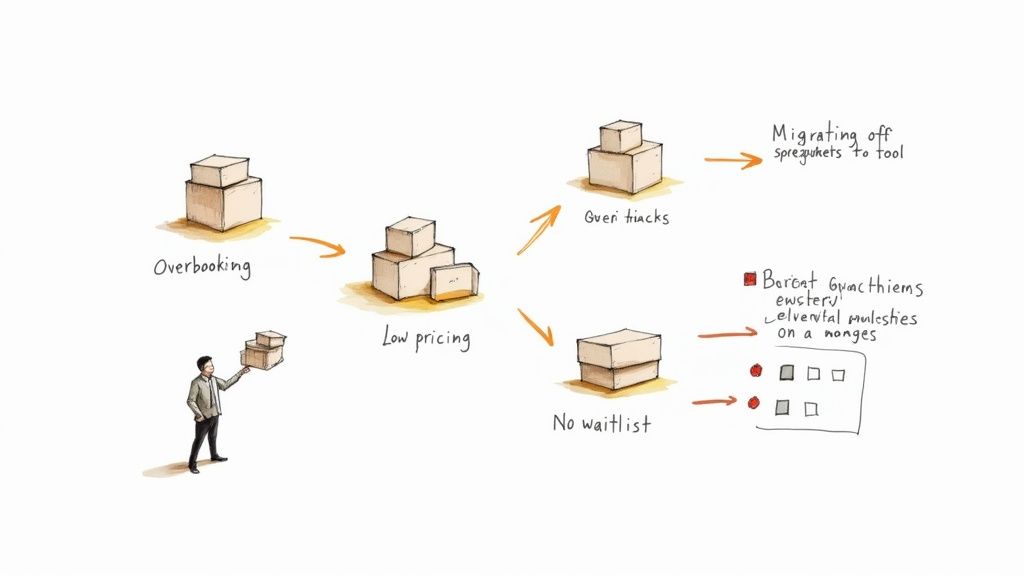
As your newsletter takes off, the scrappy, manual methods you used in the beginning will start to show their cracks. Scaling up brings a whole new set of headaches, and sidestepping a few common traps can mean the difference between steady growth and total chaos. If you keep doing things the old way, you're just leaving money on the table.
One of the biggest blunders I see is underpricing sponsorships. When you're new, any ad revenue feels like a win. But that initial rate you set probably doesn't reflect the value you provide as your audience grows. If you're not bumping up your prices as your open rates and clicks climb, you are losing out on serious revenue with every single email.
Another classic mistake? Not building a waitlist. Demand for ad slots can spike during busy seasons like Black Friday. Without a waitlist, you'll find yourself scrambling to fill last-minute spots or, even worse, turning away great advertisers. A solid waitlist not only fills gaps but also proves you have strong demand. This makes it much easier to justify raising your rates later.
Forgetting About Long-Term Partnerships
Too many creators get stuck in a transactional mindset, treating every ad sale like a one-and-done deal. That's a huge mistake. The real gold is in building long-term relationships with sponsors who are a perfect match for your readers. Repeat advertisers bring in predictable income and drastically cut down on the time you spend selling.
Make it your mission to deliver incredible results and share clear performance reports. When a sponsor sees a real return on their investment, they are way more likely to book a multi-month package. This shifts your ad inventory from just another line item to a vital marketing channel for your partners.
Moving from a spreadsheet to a dedicated tool feels like a huge leap, but it is an essential step for serious growth. The transition forces you to professionalize your entire ad sales process, from creating a media kit to standardizing your ad products.
Your Migration Checklist
Alright, let's talk about making the jump from a spreadsheet to a real platform for newsletter ad inventory management. A little prep work here goes a long way and will save you from losing data or sales momentum.
Here’s how to make the move without pulling your hair out:
- Audit and Standardize Your Inventory: Before you import a single thing, clean up your data. Give your ad products clear names and specs (e.g., "Primary Sponsorship," "Classified Link") and lock in a consistent pricing structure.
- Document All Your Bookings: Create one master list of every confirmed sponsorship. Include the advertiser's details, the run dates, and payment status. This becomes your source of truth for the migration.
- Create a Professional Media Kit: If you do not have one, now is the time. Your media kit is your #1 sales tool and should feature audience demographics, performance stats, ad specs, and your rates.
- Give Your Advertisers a Heads-Up: Let your current partners know you're upgrading your systems to give them a better experience. It shows you're a pro and sets the right expectations.
Taking these steps will help you dodge the chaos of a messy transition and set you up to run a bigger, more profitable ad business without all the manual busywork.
Common Questions About Managing Your Ad Inventory
I get it. Moving from a spreadsheet you've cobbled together to a real, dedicated system for your newsletter ads can feel like a big leap. It definitely brings up a lot of questions. Let's walk through some of the most common ones I hear from creators just like you.
What's the Very First Thing I Should Do When Ditching My Spreadsheet?
Before you even think about importing data into a new tool, your first job is to audit what you actually have. Seriously, do not skip this.
You need to create a clean, standardized list of every single ad product you offer. What are the specs? What is the current pricing? What historical performance data can you pull together? This is not just about data entry; it is about getting a crystal-clear picture of what you're selling. More often than not, this process uncovers underperforming ad slots and even sparks ideas for new, more valuable inventory.
How Do I Figure Out the Right Price for My Ad Slots?
Pricing feels like a dark art, but it doesn't have to be. Start by doing a little market research. See what comparable newsletters in your niche are charging. This gives you a solid baseline. From there, you can choose a model that fits your goals. A flat rate is great for predictability, while a CPM (cost per thousand opens) model directly ties the price to performance.
A simple way to start is by using your average open count. For example, if you typically get 5,000 opens per issue, a $30-$60 CPM puts your rate somewhere in the $150-$300 range. The key is to be ready to test and adjust as you see how advertisers respond.
The single biggest pricing mistake I see is creators undervaluing their audience. If your ad slots are consistently sold out months in advance, that's a blinking red light telling you your rates are too low. Don't be afraid to raise them to match the demand.
Should I Give Discounts if Someone Buys Multiple Ads?
Absolutely. Offering discounts for bulk buys or multi-send commitments is one of the smartest things you can do. It locks in predictable revenue, which is gold for any creator, and it drastically cuts down on your sales admin time. It also helps you build much stronger relationships with your sponsors.
A pretty standard structure is offering something like 10% off for booking three ad slots at once, or maybe 15% off for a full quarterly sponsorship package. This is a common practice used by newsletters like The Hustle to secure larger, long-term deals.
How Do I Stop Accidentally Overbooking My Most Popular Slots?
This is a classic growing pain. The only real fix is a centralized availability calendar that updates in real-time. This needs to be your single source of truth for sales. You can start with something as simple as a shared Google Calendar, but a dedicated platform handles this automatically.
Another pro tip is to create a waitlist for your most in-demand dates. This not only prevents booking conflicts but also serves as powerful social proof. It shows potential advertisers just how valuable and sought-after your inventory really is.
Ready to stop juggling spreadsheets and start scaling your ad revenue? Ad Slots automates your entire ad sales workflow, from booking and invoicing to fulfillment. Get started with Ad Slots today and get back to what you do best: writing great content.