
Managing local newsletter advertising is about building a system. It’s the entire workflow from finding sponsors and booking their ads to sending invoices, making sure you get paid, and showing them how their campaigns performed. A solid process here is what turns a loyal readership into a predictable source of income.
The Smart Shift to Local Newsletter Ads
Local businesses are getting smarter with their marketing dollars. Instead of just throwing money at Google and Facebook, where it's easy to get lost in the noise, they're realizing the value of connecting directly with their community. Local newsletters are proving to be the perfect channel for that. This isn't just a small shift; it's a strategic move toward an audience that is already listening.
Think about it. An ad in a social media feed is just one more thing to scroll past. A newsletter, however, lands in a personal, curated space: the inbox. Your subscribers asked to be there, which means they're way more likely to engage with messages that feel relevant to their community.
Why This Hyper-Local Connection Works
For a local coffee shop, a real estate agent, or a festival organizer, reaching 1,000 engaged neighbors is infinitely more valuable than shouting at 100,000 strangers across the country. It is a targeted approach that just makes sense.
Here’s why it is so effective:
- Trust is Everything: Readers have a relationship with the person writing the newsletter. That trust naturally rubs off on the advertisers you feature, leading to better open and click-through rates than you would ever see from a generic digital ad.
- No Algorithms in the Way: Your sponsor's message gets delivered straight to the inbox. It does not have to fight an algorithm for visibility. It just shows up.
- Smarter Spending: Local newsletter ads are typically much more affordable than pay-per-click campaigns, giving small businesses a much better return on their limited marketing budgets.
The proof is in the numbers. Platforms like beehiiv saw a 96.2% year-over-year jump in newsletters in 2024, with its ad network alone pulling in over $3.7 million in revenue. This is not a small trend, it is an explosion and a huge opportunity for creators. You can read more about the state of newsletters to see just how creators are building these mini media empires.
A perfect real-world example is the LA Raver newsletter. They went all-in on the local rave scene in Southern California, grew to 16,000 subscribers, and pulled in $100,000 in revenue in their first year. It is a powerful reminder that a highly engaged, niche audience is an advertiser's dream.
The Financial Upside for Creators
This is where solid local newsletter advertising management pays off. When you can offer local businesses a direct line to their ideal customers, you're not just running a passion project anymore; you are running a sustainable business. That ad revenue gives you the stability to invest back into your work, create even better content, and kick off a growth cycle that benefits everyone: you, your readers, and your sponsors.
How to Find and Secure Your First Sponsors
Landing that first advertiser is a huge milestone. It is the moment your newsletter starts to feel like a real, sustainable business. This is not about blasting out hundreds of generic emails; it's about being thoughtful and strategic with who you approach and how you present your value.
Honestly, the best place to start looking is right in your own backyard. Think about the businesses your readers already know and love. Local event organizers, real estate agents, new restaurants, or even that cool boutique shop downtown are all perfect candidates. They want to reach the exact same people you do.
If you want to get more systematic, you can use techniques like web scraping for lead generation to build a solid list of local contacts.
Focusing on these local businesses just makes sense. The U.S. local ad market saw a 3.7% bump in core business advertising recently. The fastest-growing categories? Real estate at +10.4% and restaurants at +7.8%. That is a clear signal telling you exactly where to aim your efforts first.
Build a Media Kit That Sells
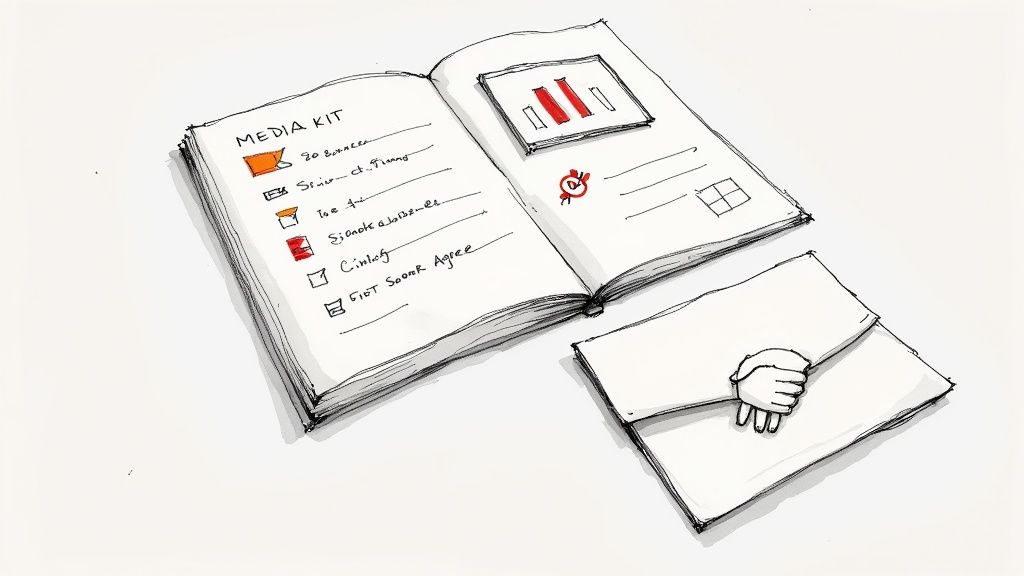
Before you send a single email, you need a media kit. Think of it as your newsletter's resume. It needs to look professional and make a great first impression. Do not go overboard. A clean, one or two-page PDF is all you need.
Make sure your media kit clearly lays out:
- Your Audience: Who are your readers? Think general age, location, and what they care about.
- Key Numbers: Be upfront with your total subscribers, average open rate, and click-through rate.
- Ad Options & Pricing: Clearly list what you offer (e.g., a main feature, a classified spot) and how much it costs.
- Reader Feedback: If you have a great quote from a reader, include it! A little social proof goes a long way.
This simple document does a ton of the selling for you. It immediately shows you're serious and makes your value crystal clear.
Crafting the Perfect Outreach Email
Your first email is all about starting a conversation. Keep it short, make it personal, and focus entirely on how you can help them. A giant wall of text is a one-way ticket to the trash folder.
A simple, proven structure works every time:
- A Personal Touch: Start by mentioning something specific you like about their business.
- A Quick Intro: Briefly say what your newsletter is and who reads it.
- The "Why": Connect the dots for them. "I think my audience would love your [product/service] because…"
- A Simple Ask: End with an easy question, like asking if they would be open to seeing your media kit.
A huge mistake people make is being way too aggressive with follow-ups. A gentle nudge after a week is perfectly fine, but anything more than that starts to feel desperate. Remember, you're trying to build a relationship, not just force a sale.
If you are staring at a blank page, do not worry. You can find some great starting points with these free newsletter sponsor outreach email templates to get the ball rolling.
Building Your Ad Management Workflow
Getting a "yes" from a sponsor is a great feeling, but that is when the real work kicks in. The difference between a professional newsletter operation and a frantic side project often comes down to what happens next. A repeatable, organized workflow is your secret weapon for delivering what you promised, keeping sponsors happy, and avoiding that last-minute scramble.
Your system does not have to be some complex, color-coded beast. It really just boils down to a simple sequence: get the sponsor set up, schedule their ad, get their creative assets, have them approve it, and then publish. The whole point is to make this journey predictable and professional for both you and your advertiser.
Onboarding New Sponsors
The second that contract is signed, your workflow should spring to life. Your first move is to officially welcome the new sponsor and start collecting everything you need to get their campaign live. This is about more than just grabbing ad copy; it's your first chance to set the tone and manage expectations.
A solid onboarding process usually involves:
- A Welcome Email: This email is key. It should confirm their purchase, clearly spell out the next steps, and give them firm deadlines for submitting their ad materials.
- Collecting Ad Assets: You will need their ad copy, any images or logos they want to use, and the exact URL for their call-to-action link.
- Confirming Dates: Double-check and lock in the exact publication date(s) for their ad. This small step prevents major headaches down the road.
Nailing this first step shows sponsors they made a smart decision. When the process is clear and organized, it builds their confidence right away and makes them far more likely to book with you again.
Scheduling and Managing Ad Creative
Once you have the sponsor's assets, it's time to get their ad on the calendar. This is where things can get messy for a lot of creators. Juggling multiple ads for different sponsors across several issues can quickly turn into a nightmare of endless email chains and confusing spreadsheets if you do not have a system.
The most common point of failure in local newsletter ad management is the lack of a central calendar. When you are trying to remember if the coffee shop ad runs this week and the real estate agent's ad runs next, a shared, visual calendar is not just nice to have. It is essential.
Simple tools can be a lifesaver here. A Trello board with columns like "Booked," "Creative Received," and "Scheduled" is a great start. Even a well-organized Google Sheet can work wonders when you are just getting off the ground.
Here’s an example of an interface designed to simplify this entire process:
A dashboard like this gives you a clean, at-a-glance view of your ad inventory, so you always know which slots are booked and which are still up for grabs.
As your newsletter grows, you will probably find that manual tools cannot quite keep up. That is when you might want to look into platforms offering dedicated newsletter ad scheduling software. These tools automate the process, syncing your bookings to a calendar and preventing dreaded double-bookings. They centralize all your sponsor info, from contracts to creative, creating a single source of truth that can save you hours of admin work.
Ultimately, the goal is to find a system that lets you focus on creating great content, not frantically searching your inbox for a link you know you saw somewhere.
To help you stay on track, here is a simple checklist you can follow for every ad campaign you manage.
Ad Management Workflow Checklist
This checklist breaks down the entire process from start to finish, ensuring no detail falls through the cracks.
| Phase | Key Task | Tool/Template to Use | Status |
|---|---|---|---|
| 1. Onboarding | Send welcome email & contract | Welcome Email Template, Contract | ☐ |
| Collect ad creative & links | Asset Collection Form | ☐ | |
| Confirm publication dates | Shared Calendar (e.g., Google) | ☐ | |
| 2. Scheduling | Add ad to the calendar | Ad Scheduling Software / Trello | ☐ |
| Send creative for approval | Email Template | ☐ | |
| Receive final approval | Email / Communication Tool | ☐ | |
| 3. Fulfillment | Place ad in newsletter draft | Email Service Provider (ESP) | ☐ |
| Send a test email to sponsor | ESP / Test Email Service | ☐ | |
| Publish the newsletter | ESP | ☐ | |
| 4. Post-Campaign | Send performance report | Reporting Template / Analytics Tool | ☐ |
| Send invoice | Invoicing Software / Template | ☐ | |
| Follow up for testimonial/renewal | Email Template | ☐ |
Having a checklist like this turns a potentially chaotic process into a series of simple, manageable steps.
Streamlining Invoices and Payments
Let's be honest: chasing late payments is the worst. It is an awkward, time-consuming task that pulls you away from what you actually enjoy, which is writing a great newsletter. Getting your invoicing and payment process dialed in is not just about avoiding a headache. It is a critical part of running a professional operation.
When a sponsor gets a prompt, clear invoice and can pay it easily, it reinforces their decision to work with you. It is a small touch that builds massive trust and makes them far more likely to book another ad.
This whole ad management process, from onboarding a new sponsor to sending them a final report, relies on that crucial step in the middle: getting paid.
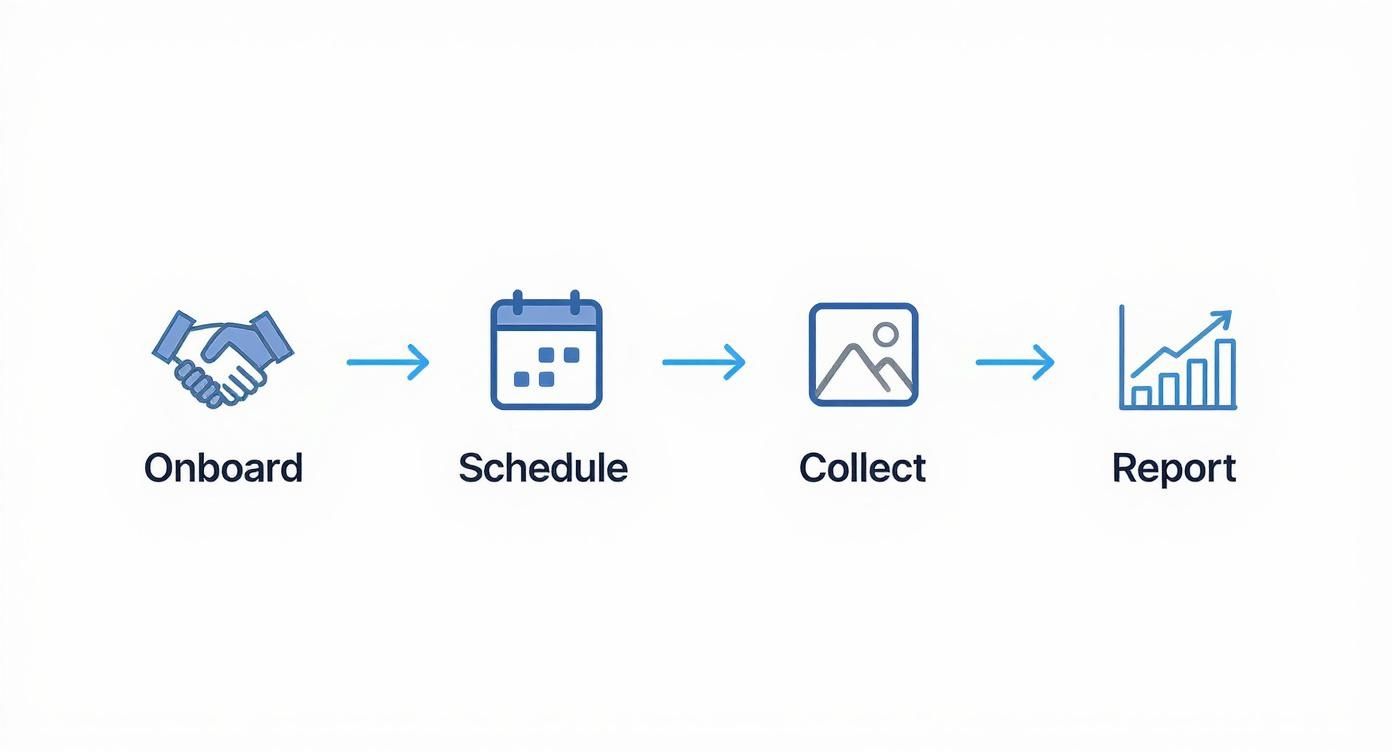
As you can see, collecting payment is the bridge between fulfilling the ad and proving its value. A sloppy payment process can make the whole experience feel unprofessional, no matter how great the ad's performance was.
Automating Your Billing Process
If you are still creating invoices manually in a Word doc and emailing them as PDFs, it is time for an upgrade. Manual billing is a surefire way to forget to send an invoice or spend your afternoons writing uncomfortable "just checking in" emails. The goal here is to put your billing on autopilot.
Thankfully, there are fantastic tools designed to do just that.
- Stripe Invoicing: This is a perfect starting point. You can create and fire off a professional-looking invoice right from your Stripe dashboard. Sponsors get a link where they can pay instantly with a credit card. It is simple and effective.
- QuickBooks or FreshBooks: If your newsletter is your full-time business, one of these accounting platforms is a smart move. They do more than just invoicing; they track your income, manage expenses, and can be set to send recurring invoices for those sponsors on a retainer.
- Purpose-Built Platforms: For a truly integrated system, specialized tools are the way to go. Some platforms offer automated newsletter invoice software that connects directly to your ad calendar. The moment a campaign wraps up, the invoice goes out automatically. No more forgetting.
The single most impactful feature to look for is automated payment reminders. Most modern invoicing tools will let you schedule a series of polite nudges for overdue invoices. This alone can slash your late payments and save you from ever having to play bill collector again.
Creating an Invoice That Gets Paid
A confusing invoice is an unpaid invoice. Your goal is to make it so clear and simple that your sponsor can approve and pay it in under a minute. It sounds obvious, but you would be surprised how often a missing detail can hold up a payment for weeks.
Make sure every invoice you send includes these key pieces of information:
- Your Business Info: Your newsletter's name, your address, and contact email.
- Sponsor's Info: The correct business name and the contact person you worked with.
- Invoice Number: A unique code for tracking (e.g., INV-001, INV-002). This is non-negotiable for bookkeeping.
- Key Dates: The date the invoice is issued and, crucially, the payment due date. Net 15 or Net 30 days are standard terms.
- Clear Description: Do not just say "Advertising." Be specific: "Main Sponsorship Feature in The Local Scoop – May 15, 2024 Issue."
- The Amount Due: The total, with any taxes or fees clearly broken out.
- Payment Instructions: A direct link to pay online is best. If you accept bank transfers, include all the necessary details. Do not make them ask for it.
Getting these details right every time signals to your sponsors that you are a professional who takes their business seriously. It makes the entire transaction feel buttoned-up and secure.
Delivering Reports That Prove Your Value
Keeping a sponsor is not about crossing your fingers and hoping they stick around. It is about proving your worth. Advertisers need to see that their money is actually working, and a simple, powerful performance report is your best tool for the job. Think of this report as more than just a recap of numbers. It's a sales document that validates their current spending and paves the way for renewals and even bigger ad packages down the road.
The good news? You do not need to be a data wizard to create a report that will impress your sponsors. To really show the impact of their investment, you just need to master email marketing reporting by focusing on the handful of metrics that actually matter to a local business owner.
Key Metrics to Include in Your Report
Forget dumping every possible data point into a spreadsheet. That is a surefire way to overwhelm a busy sponsor. Instead, keep your report clean and focused on three core metrics.
- Ad Impressions (Total Opens): This is simply the total number of times your newsletter was opened, giving their ad a chance to be seen. It's the foundational metric that establishes the overall reach of their message.
- Total Clicks: This is the raw count of people who actually clicked the sponsor’s link. It is the most direct measure of genuine interest and engagement you have.
- Click-Through Rate (CTR): This percentage (calculated as clicks divided by opens) is what puts the raw click number into context. A healthy CTR is proof that your audience found their offer compelling enough to act on.
These three numbers tell a clear story of reach and engagement. They are easy for anyone to understand and tie directly back to the sponsor's main goal: getting their business in front of local customers. If you want to dig deeper into what influences these numbers, check out how you can improve your https://adslots.co/email-open-rate/.
Presenting Data That Tells a Story
How you present the data is just as important as the data itself. A clean, visual format helps a busy business owner grasp the value you are providing in just a few seconds. You want them to think "professional summary," not "confusing spreadsheet."
The real power of a great report is its ability to build trust. When a sponsor sees clear, positive results, it removes any doubt about their investment and makes the conversation about renewing their ad slot a natural next step.
Do not forget to add a human touch. Alongside the hard numbers, I have found it incredibly effective to include a section with positive, anonymized reader feedback about the sponsor. A simple quote like, "I'm so glad you featured [Sponsor's Name], I have been looking for a great local option for that!" adds a layer of social proof that raw data just cannot capture.
This focus on proving value through monetization is a huge priority across the industry. A 2024 survey showed that right after audience growth (83%), advertising monetization was the top concern for local media professionals at 78%. With a strong 68% forecasting an increase in digital ad revenue for 2025, the confidence in channels like local newsletters is undeniable. By delivering professional reports, you align perfectly with this industry-wide focus, proving your value in a market that is only getting bigger.
Scaling Your Newsletter Advertising Revenue
https://www.youtube.com/embed/M2VP64Tc60w
Moving from your first handful of sponsors to a reliable revenue engine is all about working smarter, not just harder. Once you have a steady stream of interest from advertisers, it's time to stop the one-off sales hustle and start building a real system. This is where you level up your management game.
The most logical first step is to create tiered advertising packages. Let us be real, not every local business has the same marketing budget. Offering a few different options makes your newsletter an attractive choice for a much wider range of potential sponsors, from the small flower shop to the established real estate agency.
Building Your Ad Packages
I have found that creating two or three distinct tiers works best. It keeps things simple for potential sponsors and makes the value of each package crystal clear. You are not just selling space; you are guiding them to the right solution for their goals.
A simple, proven tier system could look something like this:
- Classifieds Section: This is your low-cost, text-only option. It is a perfect entry point for small businesses, local event promoters, or anyone with a job posting. Think of it as the easiest "yes" for a new advertiser.
- Sponsored Link: A solid middle-ground choice. This gets them a dedicated link with a short description right inside your main content. It is a noticeable step up from a classified without a huge price jump.
- Main Sponsorship: Your premium placement. This is the top dog, the main ad that often includes a custom write-up, a big logo, and maybe even a shout-out on your social channels.
This approach transforms a simple ad sale into a strategic product lineup. You are meeting different needs and, in turn, maximizing the income you can generate from every single issue.
Knowing when to raise your rates is a huge part of scaling successfully. A good rule of thumb is to seriously consider a price bump every time you add another 1,000 engaged subscribers, or when your ad slots are consistently booked out more than a month ahead. Do not sell yourself short.
Driving Recurring Revenue
One-off sponsorships are great, but recurring partners are the foundation of a sustainable newsletter business. The secret? Make it an incredibly easy decision for them to stick around. A small discount for booking multiple issues at once is the simplest and most effective way to do this.
Try creating simple package deals:
- Book 3 issues, get a 10% discount.
- Book 6 issues, get a 15% discount.
This is not just about locking in revenue early. This strategy builds deeper relationships with your best advertisers and gives you a predictable income forecast, which is gold when you are trying to plan for the future. When sponsors see the value and you make it easy to commit, they stop being one-time buyers and start becoming long-term partners who rely on your newsletter.
Got Questions About Selling Ads in Your Local Newsletter?
If you are just starting to sell sponsorships, you have probably got a million questions. That's totally normal. Getting a handle on a few key areas will help you run your ad operations confidently and build great relationships with your sponsors. Let's tackle some of the most common ones I hear from creators.
How Much Should I Charge for an Ad?
This is the big one, is it not? The honest answer is that it depends. Pricing is part science, part gut feeling, but there's a simple formula to get you started.
Most in the industry use Cost Per Mille (CPM), which is just a fancy way of saying "cost per thousand subscribers." For a local or niche newsletter with a really engaged audience, you can usually charge a CPM somewhere between $25 and $100.
Let's say you have 2,000 subscribers and you want to test out a $40 CPM. The math looks like this:
2 (for your 2,000 subs) x $40 = $80 for one ad spot
But do not get too hung up on the formula. You also have to consider who your readers are. If your newsletter goes out to local real estate agents or dentists, that's a high-value audience. Businesses will pay more to reach them, so you should feel confident charging a premium. Pick a price that feels fair, and do not be afraid to raise it as you grow and prove your value.
What Happens If an Ad Doesn't Do Well?
Sooner or later, an ad will flop. It is inevitable. What really matters is how you handle it. My advice? Get out in front of it.
When you are putting together the performance report and see a really low click-through rate, do not just send it over and hope they do not notice. Address it head-on.
The best move is to offer a "make-good." That just means you offer to run their ad again in a future newsletter, completely free. It is a simple gesture that shows you're a true partner, not just a vendor. This can be the single thing that turns a one-time, unhappy customer into a loyal sponsor who sticks with you for the long haul.
It's all about building a partnership, not just making a sale. Offering a make-good proves you are invested in the advertiser's success, which builds incredible trust and makes them far more likely to come back.
How Far Out Should I Be Booking Sponsors?
It's a great feeling when your ad calendar starts filling up, but it definitely requires some forward-thinking.
As a general rule, I always suggest booking sponsors at least four to six weeks out. This gives both you and the advertiser plenty of breathing room. You can get the ad copy and images finalized without that panicked, last-minute rush.
This buffer also works in your favor psychologically. When a new advertiser reaches out and you tell them your next opening is over a month away, it immediately signals that your ad slots are valuable and in demand. It reinforces that your newsletter is something worth waiting for. This kind of advanced scheduling is a cornerstone of professional local newsletter advertising management.
Ready to stop wrestling with spreadsheets and run your ad sales like a well-oiled machine? Ad Slots handles everything from booking and invoicing to payments, so you can save hours every single week. Give your sponsors an experience they'll love. Find out more and get started with AdSlots today.