
Don't let a small subscriber count fool you into thinking you can't land newsletter sponsors. In fact, the opposite is often true. Your secret weapon is not the size of your list. It is the engagement of your audience.
A small, dedicated list offers advertisers a direct line to a passionate community that big-name brands struggle to reach. This is where you have a serious advantage.
Your Small List Is Your Secret Weapon
It's a common myth that you need tens of thousands of subscribers to monetize with ads. That's old-school thinking. Modern, savvy advertisers know the truth. A small, hyper-engaged list is often far more valuable than a massive, passive one.
The real power of your newsletter isn't just a number in a dashboard. It's the trust you have built with every single reader. That trust translates directly into higher open and click-through rates. These are the metrics that sponsors actually care about. An ad that no one sees is just a waste of money.
The Math Of Engagement
Let’s run the numbers to see how this plays out in the real world. Imagine you have 1,000 subscribers with a stellar 45% open rate. That’s 450 dedicated fans opening every issue you send. They trust you and are genuinely interested in what you have to say. For instance, the Dense Discovery newsletter, run by Kai Brach, maintains open rates between 45-50% with over 40,000 subscribers, showing that high engagement is achievable and highly valued.
Now, compare that to a generic newsletter with 10,000 subscribers and an industry-average 20% open rate. That larger list might reach 2,000 people, but the audience quality is worlds apart. Your 450 readers are a concentrated group of ideal customers for a brand targeting that specific niche. To them, your audience is a goldmine.
This isn't just a hypothetical. Data consistently shows that smaller lists can achieve open rates of 42% or higher, blowing the industry average out of the water.
Small List vs Large List Value Comparison
This table really drives home the point. It shows how the superior engagement of a small list can deliver more value to an advertiser than a much larger, less-engaged one.
| Metric | Small List (1,000 Subs) | Large List (10,000 Subs) |
|---|---|---|
| Open Rate | 45% | 20% |
| Unique Opens | 450 | 2,000 |
| Click-Through Rate | 10% | 2% |
| Total Clicks | 45 | 40 |
Even though the large list gets more opens, the highly engaged small list actually generates more clicks. For advertisers focused on conversions and ROI, your small list is the clear winner.
Quality Over Quantity Is The Key
Your high engagement isn't just a nice-to-have metric. It is your core selling point. Advertisers are paying for access to an audience that listens, and your small list proves that your subscribers are all ears. Before you even think about pitching, get a handle on how you can manage your email list to keep that engagement sky-high.
For an advertiser, reaching 500 of the right people is infinitely more valuable than reaching 5,000 of the wrong ones. Your niche focus isn't a limitation. It's a powerful filter that delivers exactly the audience a sponsor wants to connect with.
At the end of the day, your small list isn’t a hurdle to overcome. It is a finely tuned asset. You have cultivated a community that trusts you, and that’s a feat many large publishers can't replicate. That connection is precisely what you’re selling, and it’s something brands will gladly pay for.
How To Find Your First Advertisers
So, you know your small list is valuable. That’s the first step. The real trick is finding brands willing to pay for that value. This is not about blasting a hundred generic pitches into the void and hoping one sticks. It is a focused, surgical approach to finding brands that are a perfect fit for your audience.
The goal here is to prove there’s demand before you sink countless hours into outreach. You want to build a small pipeline of interested brands who already get what you're doing. This flips the dynamic entirely. You go from asking for a chance to choosing the right partners.
Start By Looking Inward At Your Audience
Before you think about which companies to pitch, look at who is already in your world. The best sponsorships feel like a natural part of your newsletter, not a jarring ad break. Your readers will give you all the clues you need.
Start paying close attention to the tools, products, and services they’re already using and talking about.
- Poll Your Readers: A quick, one-question poll can work wonders. Ask something simple like, "What's one product under $100 that has genuinely made your life easier this month?" Their answers are literally a shopping list of potential sponsors your audience already loves.
- Analyze Your Clicks: Dive into your newsletter analytics. Which links got the most clicks over the last few months? If you recommended a book, a piece of software, or a cool gadget that saw a ton of engagement, the company behind it is a fantastic prospect.
This isn't just research. It is about finding genuine alignment. When a brand is already known, liked, and trusted by your readers, an ad from them feels more like a hot tip from a friend.
Create A Simple Sponsorship Waitlist
One of the easiest ways to see if anyone’s interested in sponsoring you is to just ask. You don’t need a fancy system. Just add a simple, low-key line at the bottom of your newsletter.
Something like, "Want to sponsor this newsletter and reach [Number] dedicated [Your Niche] fans? Join the waitlist."
That link can lead to a basic Google Form or a simple landing page. This does two brilliant things at once. It confirms there’s commercial interest in your audience, and it starts building a list of warm leads for you to contact when you're ready.
Putting up a waitlist before you have a formal ad program is a classic move. It signals professionalism and creates a sense of demand, making your ad slots feel more exclusive and valuable right from the start.
The core ideas of how to get sponsors and secure partnerships are a perfect match for this approach. You're not just selling space. You're offering a genuine partnership to brands that want to connect with your community.
Build A Professional Media Kit
Think of a media kit as your newsletter's resume. It’s a clean, one or two-page document that tells a potential sponsor everything they need to know. It should explain what you offer, who you reach, and why they should work with you. It doesn’t have to be a design masterpiece, but it must look professional.
Make sure your media kit includes:
- A quick bio: Who are you and what’s your newsletter all about?
- Audience demographics: Paint a picture of your ideal reader. Include any data you have on their jobs, interests, or biggest challenges.
- Key stats: Don’t be shy. List your subscriber count, average open rate, and average click-through rate.
- Ad options and pricing: Lay out exactly what you sell (e.g., main sponsorship, classified ad) and what it costs.
- Contact info: Make it incredibly easy for them to get in touch.
Here’s an example of what a good media kit looks like. You can use templates to get started fast.
Using a template helps you organize your information cleanly and professionally, which goes a long way in building trust with potential advertisers.
Send A 'Feeler' Email
Once you have a shortlist of dream-fit brands, it’s time to test the waters. A "feeler" email is a short, low-pressure way to introduce yourself and see if there’s any interest without going into a full-blown sales pitch. It is more casual than a formal proposal.
This first email is just about starting a conversation. Check out these super helpful newsletter sponsor outreach email templates to get some ideas. Your only goal is to find out if there's a potential match before you invest more time in a detailed proposal.
Pricing and Packaging Your Ad Offers
Figuring out what to charge is where most creators get stuck. It’s so easy to undervalue your work when you see a small subscriber count. Your price should reflect the quality of your audience, not just the quantity. Brands that get it will happily pay for targeted access to a trusted community.
You’re not just selling space in an email. You're offering a warm introduction from a trusted friend. The key is to present clear, simple options that make it incredibly easy for a sponsor to say "yes."
Choosing Your Pricing Model
For a small, highly engaged newsletter, a flat-fee pricing model is almost always the best way to go. It's simple for you and the advertiser. You agree on a fixed price for a specific ad, and you get paid no matter how many clicks it gets.
This approach rightly puts the value on the exposure and trust you provide. These are the two things you actually control.
You might hear about other models, but they're usually a bad fit for smaller, niche publications.
- Cost Per Mille (CPM): This model charges per thousand opens. It's standard for massive newsletters but doesn't capture the value of a tight-knit, engaged audience.
- Cost Per Click (CPC): Here, you only get paid when someone clicks. This puts all the risk on you. You can't control the advertiser's ad copy or their landing page, so you shouldn't be on the hook for their conversion rates.
Stick with flat fees. It’s the fairest way to get compensated for your hard work and the audience you've built.
A solid starting point is to charge between $25 to $100 per 1,000 subscribers for a main sponsorship. If you have a list of 800 engaged readers, asking $75 for a sponsorship is completely reasonable.
Creating Tiered Ad Packages
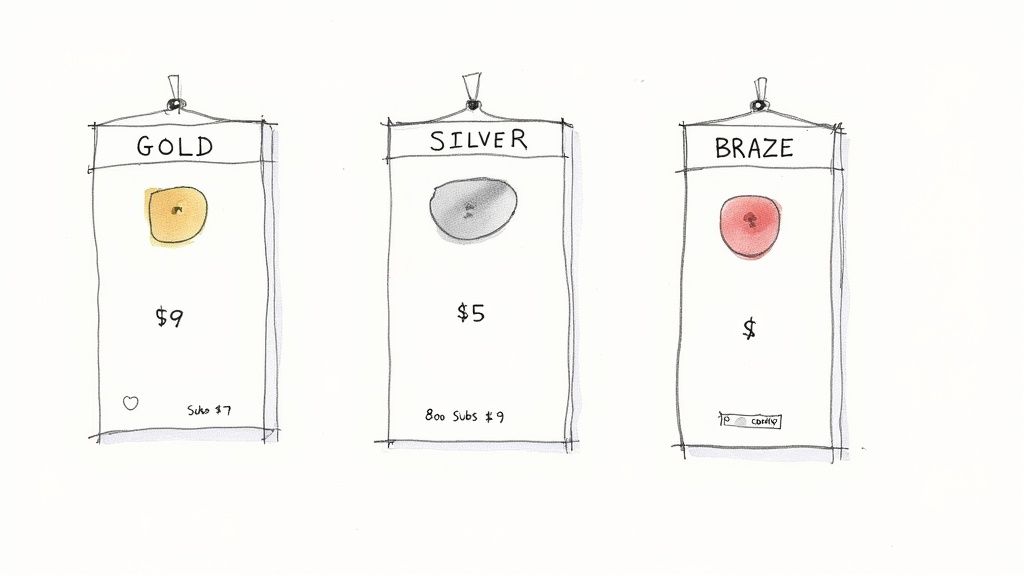
Offering a few distinct packages helps advertisers with different budgets find a good fit. Think of it like a restaurant menu. A few clear choices are much better than an overwhelming list of every possible ingredient. The classic "Gold, Silver, Bronze" structure works beautifully here.
This approach gives brands a choice and lets them test the waters with a smaller package. It's common for a sponsor to try a "Bronze" ad first and then upgrade to "Gold" once they see great results.
Here’s a simple way to structure your ad packages if you have around 1,500 subscribers.
Sample Ad Packages for a Small Newsletter
This table gives you a template for what you could offer. Remember to adjust the prices and features based on your specific audience and what feels right to you.
| Package Tier | Placement | Sample Price (for a 1,500 sub list) | Included Features |
|---|---|---|---|
| Gold | Title Sponsorship (Top of the newsletter) | $125 | Your brand is the main event. Includes a headline, 100-word description, logo, and a call-to-action link. |
| Silver | Featured Link (Middle of the newsletter) | $75 | A bolded headline, 50-word description, and one link placed in a dedicated section. |
| Bronze | Classified Ad (Bottom of the newsletter) | $40 | A text-only ad of up to 280 characters with one link, placed in a "classifieds" section. |
This kind of structure makes your offerings a breeze to understand and gives sponsors a clear path to working with you.
If you want a more data-backed estimate to feel confident in your rates, this newsletter ad pricing calculator is a fantastic resource.
Define Your Ad Formats Clearly
Besides pricing, you need to be crystal clear about what the advertiser actually gets. Spelling out the ad formats prevents any confusion down the road.
Here are a few common formats that work well:
- Title Sponsorship: This is your premium spot. The ad appears right at the top, maybe with a "Presented by" line. It gets the most eyeballs and commands the highest price.
- Dedicated Slot: This is a section within the main body of your newsletter, often written in your voice to feel more like a personal recommendation. It typically includes an image, a few paragraphs of text, and a clear call-to-action button.
- Classified Ad: A short, text-only ad, usually grouped with a few others at the bottom. This is a perfect low-cost option for brands with smaller budgets or for when you're just starting out.
Having a defined pricing model and clear ad packages instantly makes you look more professional. It shows advertisers you’re serious and makes the entire process of buying an ad from you feel smooth and straightforward.
Crafting Your Pitch and Closing the Deal
Alright, you’ve pinpointed the perfect brands and put together compelling ad packages. Now comes the make-or-break moment: the outreach. A great pitch is what separates you from the noise in a busy marketing manager’s inbox.
This is not about blasting out a generic template. It is about starting a genuine conversation and proving you actually get their brand and what they’re trying to achieve.
Your pitch email needs to be personal, sharp, and all about what’s in it for them. The biggest mistake I see people make is leading with their subscriber count. Instead, lead with why your audience is a fantastic fit for their product. This one shift completely changes the dynamic from a cold pitch to a warm partnership opportunity.
The Anatomy of a Winning Pitch Email
The best pitches are quick, scannable, and get right to the point. Marketing folks are drowning in emails, so you have to make it incredibly easy for them to see the value and say yes.
Here’s a simple structure I’ve used time and again. Notice how it leads with audience fit, not just raw numbers.
- A Hyper-Specific Subject Line: Ditch the generic "Sponsorship Inquiry." Go for something that feels personal and direct, like, "Partnership idea: [Your Newsletter Name] x [Their Brand Name]?" It immediately stands out.
- The Personalized Opener: Show them you have done your homework. A little effort goes a long way. Something like, "I've been a huge fan of [Their Product] since you launched the new [feature name]…" proves you’re not just spamming a list of contacts.
- The Audience Alignment Hook: This is your money-maker. Connect the dots for them so they don’t have to. For instance: "My readers at [Your Newsletter Name] are obsessed with [Topic Related to Their Brand]. In fact, last month I mentioned [A Competitor or Related Product], and it got one of the highest click-through rates I’ve ever seen."
- The Quick Intro: Now you can briefly introduce your newsletter. Something like, "[Your Newsletter Name] is a weekly newsletter for [Your Audience] that covers [Your Topics]. We have a small but mighty audience of 1,200 subscribers with an average open rate of 48%."
- The Clear Ask: Don’t be wishy-washy. Tell them exactly what you’re thinking. "I’d love to feature [Their Brand Name] as our main sponsor in an upcoming issue. I've attached my media kit with pricing and a few different ad options."
This structure works because it frames the entire conversation around their goals. You’re not just another creator asking for money. You are a partner with a solution to help them reach their ideal customers.
Follow-Up Without Being Annoying
Look, people are busy. Emails get buried. A polite follow-up is almost always necessary to get a response. The key is to be persistent without being a pest. My rule of thumb is to wait about five to seven business days before sending a gentle nudge.
Your follow-up email should be even shorter than your first one. Just reply directly to your original message and add a quick note.
Example Follow-Up:
"Hi [Name], just wanted to gently bump this in your inbox in case it got buried. Let me know if a partnership could be a good fit for [Their Brand Name] this quarter. Thanks!"
It’s respectful, low-pressure, and keeps the conversation alive. If you don't hear back after a second follow-up, it’s probably time to move on. Don’t take it personally. Priorities shift, budgets change. It happens.
Sealing the Deal with a Simple Agreement
Once a sponsor gives you the green light, it is tempting to just fire off an invoice and get started. Big mistake. You should always have a simple agreement in place, even if it's just a one-pager.
This is not about getting bogged down in legal jargon. It is about setting crystal-clear expectations to protect both you and the advertiser. A simple contract prevents so many headaches down the road.
Your agreement should clearly outline:
- Deliverables: What are they actually getting? Be specific about the ad format (e.g., Title Sponsorship), placement, and approximate word count.
- Timeline: When will the ad run? State the exact date of the newsletter issue.
- Payment Terms: How much do they owe, and when is it due? It's standard practice to require payment upfront. Also, specify how they can pay (e.g., Stripe, PayPal).
- Creative Guidelines: Who's writing the ad? I strongly recommend you write the copy yourself, in your own voice, based on their talking points. Understanding their campaign goals by creating a strong creative brief is a huge help here.
This simple document builds trust and shows you’re a professional. It creates a solid foundation for the partnership, ensuring everything runs smoothly from start to finish. With a great pitch and a clear agreement, you'll be on your way to closing deals like a pro.
Managing Ads and Reporting Your Results
Once a sponsor gives you the green light, the real work begins. Landing the deal is a great first step, but now you have to deliver a seamless experience that makes them want to come back for more. This all comes down to having a simple, repeatable process for everything that happens next. This includes getting the ad creative to reporting back on the results.
Nailing this backend process is what separates the pros from the amateurs. Advertisers absolutely love working with creators who are organized and make their lives easy. A smooth workflow doesn't just save you a ton of time. It builds a rock-solid reputation that will bring more sponsors knocking on your door.
This whole process, from that first conversation to launch day, is pretty straightforward.
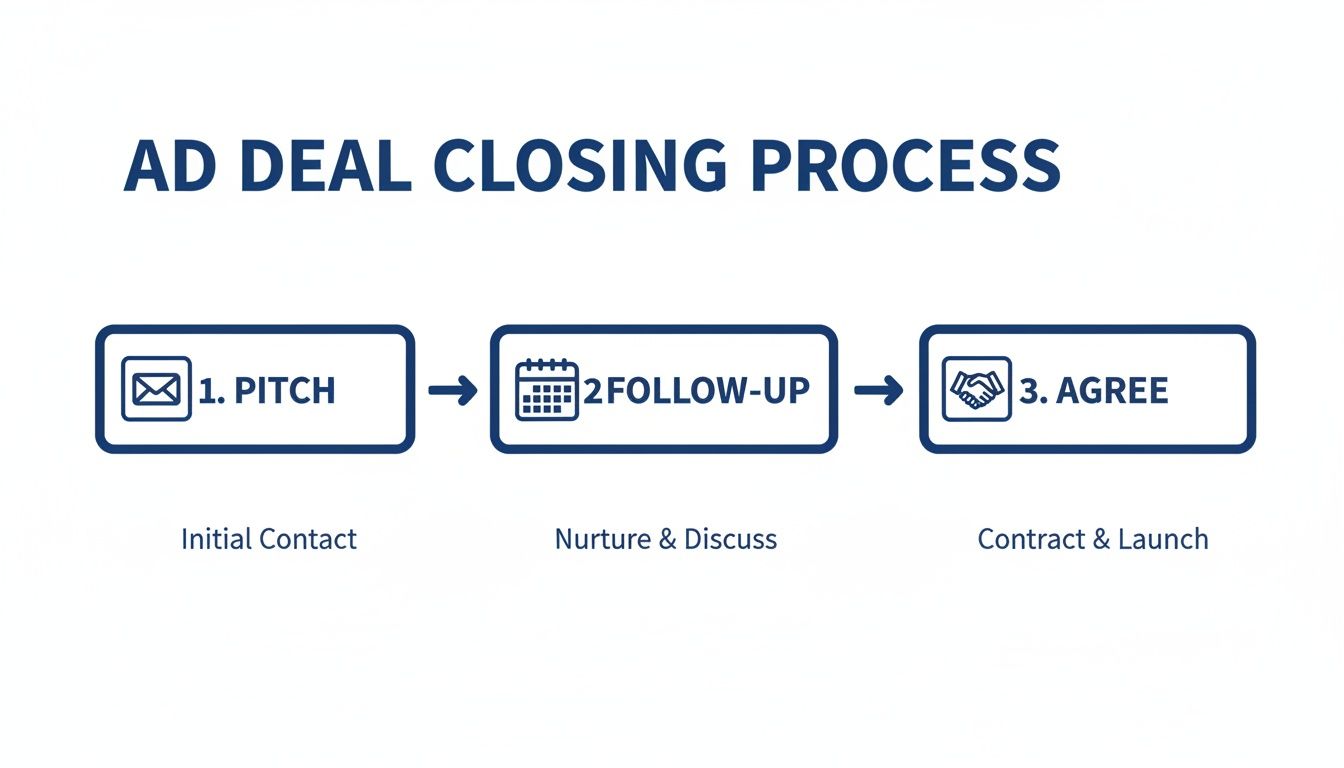
As you can see, getting the "yes" is just the midpoint. The real magic happens in the fulfillment and reporting phase.
Setting Up a Simple Ad Management Workflow
You don't need a complex, color-coded, 15-tab spreadsheet to manage your ads, especially when you're just starting out. The main goal is to keep things moving forward without letting any important details slip through the cracks. A basic checklist or a simple Trello board can work wonders here.
Your workflow should cover three key stages:
- Asset Collection: Create a simple form or a canned email to request everything you need from the sponsor. This typically includes the ad copy (or talking points), a specific call-to-action link, and any logos or images they want to use.
- Scheduling: The second a deal is confirmed, get that ad run on your calendar. It sounds obvious, but it’s shockingly easy to forget when you're juggling content creation, sponsor emails, and everything else.
- Review and Approval: Always send the final ad creative to the sponsor for a quick look before it goes live. This one simple step prevents any misunderstandings and ensures they're completely happy with what your readers will see.
I've learned this the hard way: the most successful newsletter operators are masters of process. They know that a reliable system for managing the business side frees them up to focus on what they do best, which is creating amazing content.
Proving Your Value with Clear Reporting
After your newsletter is sent, your job still isn't quite done. The final, critical step is to send a performance report to your sponsor. This is your moment to prove the value you delivered and hopefully turn a one-time advertiser into a long-term partner.
Your report should be clean, professional, and easy to digest. Don't drown them in a sea of metrics. Just focus on the numbers that actually matter for their campaign goals.
Here are the essential metrics every report should have:
- Total Subscribers Sent To: The size of the audience that received their ad.
- Newsletter Open Rate: The percentage of subscribers who opened that specific issue.
- Ad Clicks: The raw number of clicks the sponsor's link received.
- Ad Click-Through Rate (CTR): The percentage of openers who clicked the ad. For example, if 1,000 people opened the email and 50 clicked the ad, your ad CTR is 5%.
Package this data up in a simple email or a clean, one-page PDF. It shows you're a professional who takes their investment seriously. This level of follow-through is what separates the hobbyists from the pros.
Using Tools to Automate Your Workflow
As you start working with more sponsors, managing everything in a spreadsheet will quickly become a nightmare. This is where dedicated tools can be a total game-changer, automating the tedious admin work so you can get back to writing.
Tools built for creators, like AdSlots or Passionfroot, are designed to handle this entire process. They can manage everything from booking and invoicing to collecting creative and scheduling the ad placements. Think of them as your automated admin assistant. If you want to dive deeper, this guide on newsletter fulfillment tracking software is a great resource.
By putting a solid fulfillment process in place and providing clear, professional reporting, you build the foundation for a real business. You'll prove your value, save yourself hours of headaches, and create an experience that makes sponsors excited to work with you again and again.
Common Questions About Newsletter Ads
Diving into newsletter advertising for the first time? You probably have questions. It's totally normal to wonder if your list is big enough, how your readers will react, or what to do when an advertiser asks for something specific. Let's tackle some of the most common worries that pop up when creators start selling sponsorships.
The goal isn't to have a perfect answer for everything right away. It is about feeling confident enough to start, knowing you can handle these things as they arise.
How Many Subscribers Do I Need to Start Selling Ads?
Forget the idea that there's some magic number. The real metric to focus on isn't your subscriber count. It is your engagement. I have seen many creators successfully start selling sponsorships with just 500 to 1,000 dedicated subscribers.
If you consistently hit an open rate over 40% and you serve a well-defined niche, you are already sitting on a valuable asset. Brands targeting specific audiences would much rather reach the right people than just a massive, generic crowd.
Don't get hung up on hitting an arbitrary subscriber milestone. The best way to know you're ready is to test the waters. Put together a simple media kit, reach out to a handful of brands that would be a perfect fit, and see what they say. Their interest is your green light.
Will I Lose Subscribers if I Sell Ads?
This is probably the biggest fear for anyone starting out, but it's rarely a problem if you're smart about it. Your audience reads your stuff because they trust your voice and your recommendations. As long as you partner with brands that are genuinely helpful and relevant to them, an ad can feel less like a commercial and more like another great tip.
The key to keeping that trust comes down to two things: transparency and relevance.
- Always be upfront about sponsorships. A simple "Presented by our sponsor" or "Sponsored by" does the trick.
- Only work with brands you actually believe in. Your reputation is on the line, so be picky.
Think about it. A well-chosen, relevant ad is way less annoying than the pop-ups and banner ads plastered all over most websites. Sometimes, you might even introduce your readers to a tool or service they end up loving.
How Do I Handle Advertisers Who Want to Pay Per Click?
For a smaller newsletter, my advice is almost always the same. Stick to flat-fee pricing. Performance-based models like cost-per-click (CPC) sound appealing, but they put all the financial risk on your shoulders.
Your job is to deliver the advertiser’s message to your engaged audience. That's the value you provide. You can't control their ad copy, their landing page, or how compelling their offer is.
Politely explain that your rates are based on providing direct access to your dedicated community. You can and should provide click data in your follow-up report to show the value you delivered. Your fee for the placement itself needs to be guaranteed upfront.
As you grow, maybe you can explore hybrid models with long-term partners you trust. But when you're starting out, flat fees are the only way to ensure you get paid fairly for the work you put into building your audience.
What if an Advertiser Wants to Write the Ad Copy Themselves?
This happens all the time, but you should always, always have final say. The best-performing ads are the ones that don't feel like ads at all. They feel like part of your newsletter. That means they have to be in your voice. An ad that reads like it was written by a corporate marketing team will stick out like a sore thumb and probably won't get much engagement.
Here’s the best way to handle it. Ask the advertiser to send over their key talking points, links, any legal disclaimers, and brand assets. Then, you write the ad yourself, weaving their points into your natural style.
This approach works better for everyone. The ad resonates with your readers, which means better results for the advertiser. You can set this expectation from day one by including a line in your media kit like, "To ensure authenticity, all ad copy is written by us to match the newsletter's tone, using advertiser-provided materials."
Ready to stop juggling spreadsheets and start streamlining your ad sales? Ad Slots automates your entire workflow, from booking and invoicing to fulfillment, so you can focus on creating great content. Learn how AdSlots can save you hours every week.