
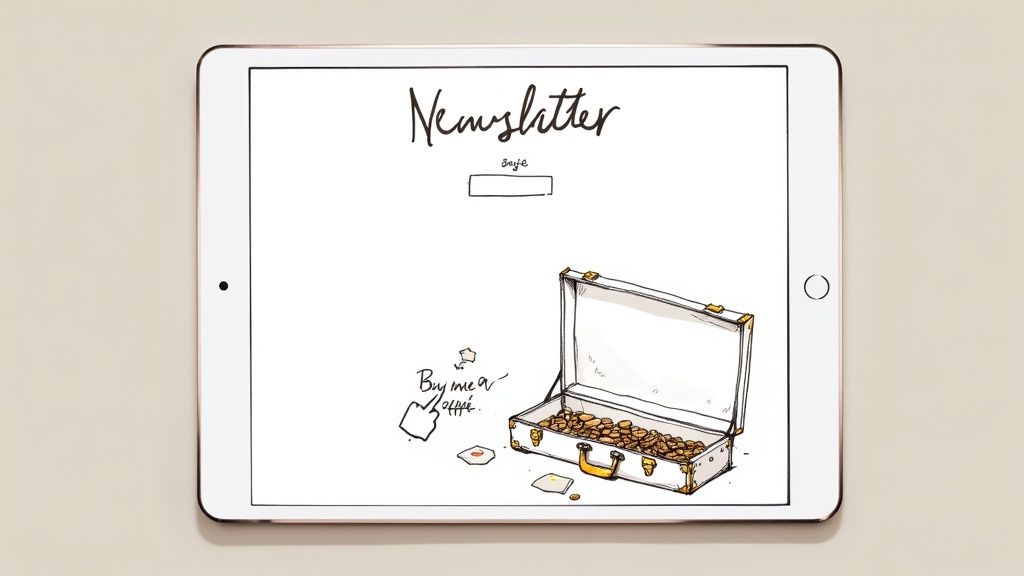
Think of a virtual tip jar as the digital equivalent of a musician's open guitar case on the street. It’s a simple, no-pressure way for your readers to toss you a few bucks as a thank you for the work you do. This is not a subscription or a paywall, just a voluntary show of support.
What a Virtual Tip Jar Really Means for Creators
A virtual tip jar is your entry point for accepting one-time payments from your audience. It's a fantastic first step into monetizing your newsletter, especially if you're not quite ready to jump into the deeper waters of paid tiers or sponsorships.
You simply give your readers a link where they can send you a small, one-off payment. The magic is in the framing. Phrases like "buy me a coffee" turn a transaction into a friendly gesture. This completely removes the friction and commitment of a subscription, making it easy for a happy reader to show their appreciation on a whim.
The Psychology Behind Digital Tipping
Digital tipping has really changed the game for creators. Look at Tip Top Jar, for example. It launched in 2022 and quickly grew to over 150,000 users by making tipping incredibly easy with QR codes and direct links.
They discovered something fascinating. When supporters could add personalized notes with their tips, the average tip amount jumped by 47%. That personal connection makes all the difference. You can find more insights about tipping behavior and how it's shaping the creator economy. It proves that this simple interaction forges a real bond between you and your audience.
How It Looks in Practice
Most creators gravitate toward platforms like Buy Me a Coffee or Ko-fi to get their tip jar set up. These services give you a clean, simple landing page where people can support you. The interface is designed to feel like a gift, not a purchase, which makes readers much more comfortable contributing.
The benefits for writers who are just starting to earn money from their work are crystal clear:
- Low Pressure for Readers: Supporters can give whatever they want, whenever they want. No recurring bills to worry about.
- Minimal Effort for You: You can keep all your content free without the pressure of having to produce exclusive, behind-the-paywall material.
- Builds Community Goodwill: A tip jar feels less like a transaction and more like a partnership. It invites readers to join you on your creative journey.
The real goal here is to make earning from your writing feel natural and approachable. It's less about trying to make a full-time income and more about validating that your work is valuable while covering some of your costs.
When you start thinking about making money from your newsletter, it feels like you're stuck with two choices: paid subscriptions or sponsorships. There is another way, a third path that's often a much better fit, especially early on. The virtual tip jar. The beauty of it is its simplicity, for both you and your readers.
With a tip jar, you dodge the immense pressure of having to create exclusive, "paid-only" content. That’s a huge weight off your shoulders when you're just trying to build momentum. You can keep your focus exactly where it should be: making your free newsletter as awesome as possible. That’s what got people to subscribe in the first place.
For your readers, it’s just as easy. A tip is a one-off "thank you," not another recurring charge hitting their credit card. This low-friction approach makes it way more likely for a happy reader to show their appreciation without the big commitment a full subscription requires.
The Problem With Subscriptions And Sponsorships
Paid subscriptions sound great in theory, but they instantly create a sense of obligation. All of a sudden, you're on the hook to deliver a steady stream of premium stuff to justify that recurring fee. This can quickly lead to burnout and even change the fun, creative project you started into a stressful job.
Sponsorships, on the other hand, usually require a big, engaged audience before they're even on the table. Brands want to see solid numbers before they'll open their wallets. This model can also bring outside influence into your writing, potentially watering down the authentic voice your readers trust. For a writer with a dedicated audience of just a few hundred, a tip jar often builds more trust and generates more immediate income than a paywall that could scare off a big chunk of that small but loyal base.
A virtual tip jar completely flips the usual monetization model. Instead of asking readers to pay for future value they might get, it lets them thank you for the value they've already received.
This is a really important distinction. It shifts the dynamic from a cold transaction to a warm relationship built on mutual appreciation.
A Direct Comparison Of Your Options
Choosing the right model really boils down to your goals and what your audience expects. Each path has a different level of commitment for both you and your readers. To help you see it clearly, let's put these monetization models side-by-side.
Comparing Newsletter Monetization Models
Here’s a simple breakdown to help you decide which model is the right fit for your newsletter right now.
| Monetization Model | Best For | Reader Commitment | Creator Effort |
|---|---|---|---|
| Virtual Tip Jar | Creators starting out or those who want to keep content 100% free. | Low: A one-time, voluntary contribution. | Low: No need for extra premium content. |
| Paid Subscription | Established creators with a proven track record of high-value content. | High: A recurring monthly or annual fee. | High: Constant need to create exclusive, premium content. |
| Sponsorships | Newsletters with a large, well-defined, and engaged audience. | Low: No direct cost to the reader, just exposure to ads. | Medium: Requires outreach, negotiation, and ad management. |
As you can see, the virtual tip jar is the most accessible entry point into making money from your work. The barrier to entry is practically zero, and you get to keep your creative freedom without the stress of deadlines tied to a subscription fee. If you are weighing alternatives, it's worth understanding the process of making a paid membership site with Notion and Gumroad just to see how a more structured subscription model works.
Ultimately, it comes down to what you're trying to build. A subscription builds a business with paying customers. A tip jar fosters a community of supporters. Both are perfectly valid paths, but the tip jar lets you grow your audience and revenue in a more organic, pressure-free way. To get a better sense of the overall landscape, you can explore various guides on newsletter monetization and see where tip jars fit into a bigger strategy.
Comparing the Best Virtual Tip Jar Platforms
Picking the right platform is a big decision. You want something that’s dead simple for your readers to use and doesn’t give you a headache to manage. The best options are easy to set up, play nice with newsletter tools, and don’t take a huge cut.
Let’s look at three of the most popular choices for writers: Buy Me a Coffee, Ko-fi, and a simple PayPal.me link.
Before we dive in, this visual shows you where tip jars fit in with other monetization methods like paid subscriptions and sponsorships.
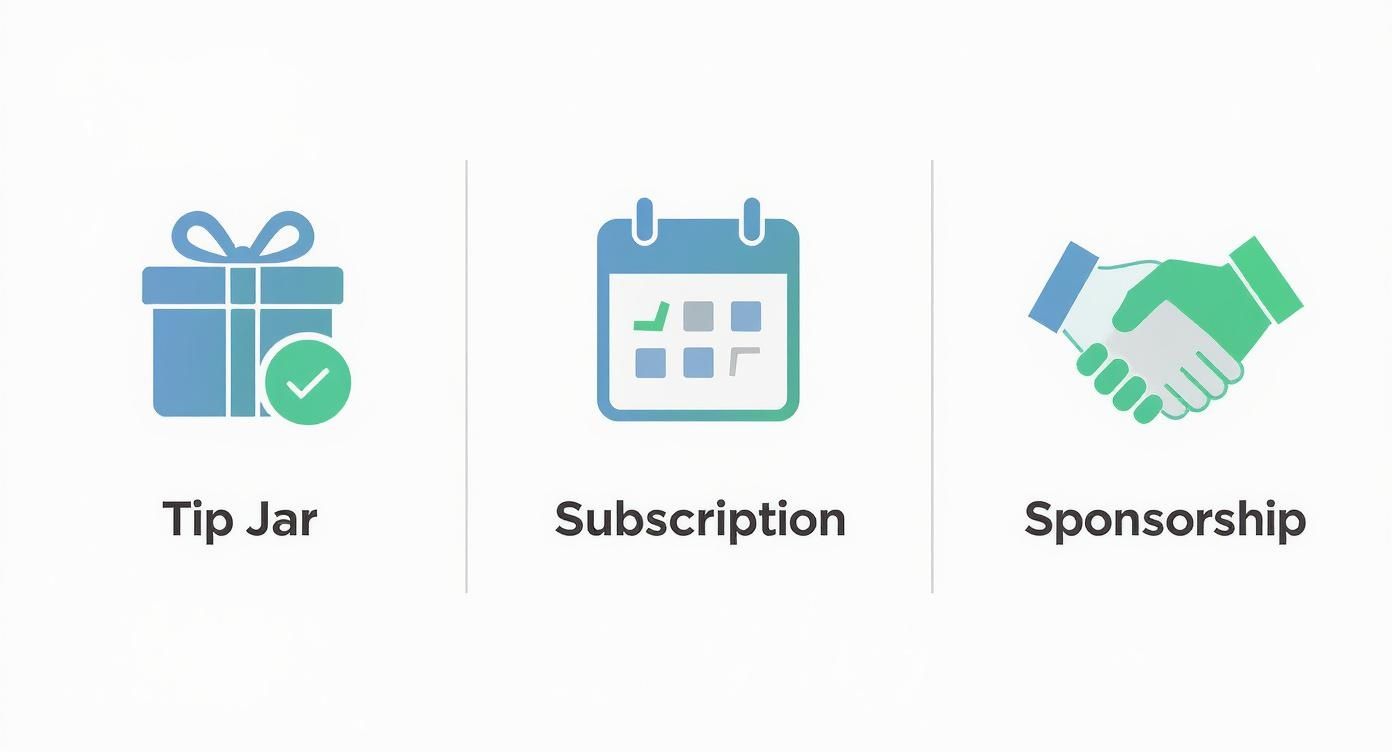
As you can see, tip jars are all about low commitment and high flexibility, which is perfect if you want to keep your content free for everyone.
Buy Me a Coffee: The Friendly Choice
Buy Me a Coffee just feels good. The whole brand is built around the idea of "buying a coffee," which turns a cold transaction into a warm, friendly thank you. That little psychological nudge can honestly make a big difference in getting readers to chip in.
Setting up a page takes just a few minutes. It is incredibly straightforward. Plus, they have simple options for memberships and commissions if you ever want to branch out later on.
The trade-off for that friendly vibe is a standard 5% platform transaction fee, which is on top of what the payment processor takes. It’s not a dealbreaker, but it's something to think about as your tip volume starts to climb.
Ko-fi: The 0% Fee Contender
Ko-fi’s main superpower is its 0% platform fee on donations. You only pay the standard Stripe or PayPal processing fees, which means more of every tip ends up in your pocket. For writers just getting their footing, this is a huge financial win.
It works a lot like Buy Me a Coffee, giving you a clean, simple page for one-off tips. If you find yourself wanting more powerful tools, you can upgrade to their "Gold" subscription. This unlocks memberships and direct commissions without them taking a percentage of your earnings.
The flexibility here is fantastic. You can start totally free and then scale up as your newsletter, and your income, grows. If you're exploring creator platforms, it's also worth checking out a Ko-fi vs. Patreon comparison to see how different support models stack up.
PayPal.me: The No-Frills Option
If you want to start accepting tips in the next five minutes, a PayPal.me link is your answer. You just create a custom link (like PayPal.me/YourNewsletter) and share it. Anyone with a PayPal account can send you cash instantly, and since it’s a globally trusted name, readers feel secure using it.
But let's be honest, it’s all transaction and no personality. There’s no branded page to share your story or a cute "buy me a coffee" message. It’s just a payment form, which can feel a little impersonal and might not inspire as many spontaneous tips.
The fees can also get a bit tricky. Payments sent as "Friends & Family" might be free, but "Goods & Services" transactions come with a fee. PayPal often defaults business-like payments to the "Goods & Services" category, so you have to keep an eye on how your tips are being classified.
A Head-to-Head Look at Your Options
So, what's most important to you? A friendly feel, the lowest possible fees, or just pure, unadulterated simplicity? This table breaks it all down to help you make the call.
| Feature | Buy Me a Coffee | Ko-fi | PayPal.me |
|---|---|---|---|
| Platform Fee | 5% on all transactions | 0% on donations (Gold for more features) | Varies (depends on transaction type) |
| Best For | Friendly branding and ease of use | Maximizing earnings with 0% fees | The simplest, fastest setup possible |
| Ease of Setup | Very Easy | Very Easy | Easiest |
| Customization | Good | Good | Minimal |
| Integration | Good with links and buttons | Good with links and buttons | Simple link sharing |
Key Takeaway: For most newsletter writers, Ko-fi hits the sweet spot. The 0% fee model lets you keep the most money from your supporters, while still giving you a professional-looking page that’s easy to link to from Substack, Beehiiv, or any other email tool you're using.
How to Set Up Your Virtual Tip Jar
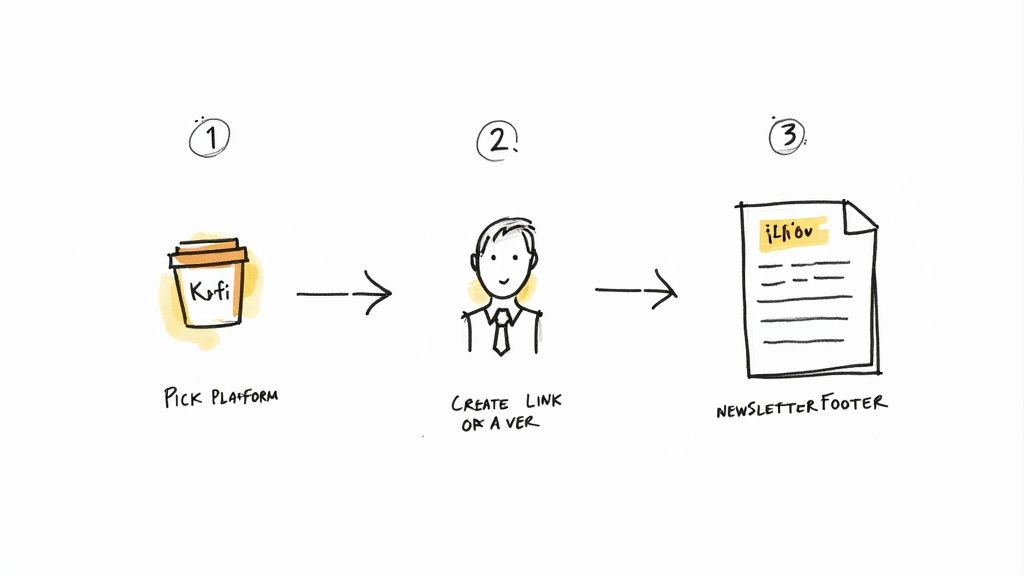
Getting started is genuinely straightforward. The whole process boils down to picking a platform, getting your unique link, and dropping it into your newsletter. That's it.
Let's walk through the exact steps to get this done, turning the idea into a reality for your publication.
Step 1: Choose Your Platform and Create an Account
First things first, you need to decide where your virtual tip jar will live. As we covered, Ko-fi is a fantastic starting point. A huge plus is their 0% platform fee on donations, which means you keep more of every tip.
Let's use Ko-fi for this walkthrough. Setting it up is quick and painless.
- Head over to the Ko-fi website and sign up for a free account.
- Pick a username that matches your newsletter's brand (something like
ko-fi.com/yournewslettername). - Connect a payment processor like Stripe or PayPal. This is how you'll actually get paid, and it's a standard, secure step for just about any online payment tool. If you want to understand more about how these systems work behind the scenes, our guide on Stripe integration for newsletters is a great resource.
- Personalize your page. Add a profile picture, a quick bio about your newsletter, and maybe even a small goal you're saving up for.
This page becomes your central hub for collecting tips. Once it’s good to go, Ko-fi gives you a simple link to share with your audience.
Step 2: Embed Your Tip Jar Link in Your Newsletter
Now you have your link, but where does it go? The trick is to place it where readers will see it without it feeling pushy or out of place. Whether you're on Substack, Beehiiv, or another platform, you've got a few smart options.
- In the Footer: This is the classic, low-key approach. Just add a permanent link at the bottom of every email. Something simple like, "Enjoying the content? You can support my work with a small tip!" works perfectly.
- In the Header or Welcome Note: For a more visible spot, you can include it near the top. It serves as a friendly, recurring reminder right where people are most engaged.
- As a Dedicated Call-to-Action Block: Most newsletter editors let you add special buttons or styled sections. Use one to create a visually appealing "Buy Me a Coffee" button that links straight to your Ko-fi page.
Make it easy for people to give. The fewer clicks it takes for a reader to go from your newsletter to your tip jar page, the more likely they are to follow through. The goal is a frictionless experience.
This move toward easy digital payments is everywhere. Some businesses saw their total tips jump by 17% in a single quarter after going digital. Why? Because it's just so easy. In fact, a 2023 survey found that 47% of people admitted to tipping in situations they normally wouldn't, simply because a screen prompted them. You can explore the full report on digital tipping habits to see just how powerful this effect is.
Step 3: Test Your Setup
Before you hit "publish" on your next issue, do yourself a favor and run a quick test.
Send a draft email to yourself and click on every link and button related to your tip jar. Does it lead to the right page? Is your Ko-fi profile loading correctly? A five-second check can save you from the embarrassing mistake of sending a broken link to your entire list.
Once you’ve confirmed everything works, you're officially ready to start accepting support from your community.
How to Ask for Tips Without Being Awkward
Let's be honest, this is the part that makes most of us sweat. Asking readers for money can feel a little weird, maybe even pushy. But it really doesn’t have to be.
The secret is to stop thinking of it as a demand for payment. Instead, frame your tip jar as a simple, no-pressure way for people to show their appreciation. People genuinely like to support creators they value. Your job is just to connect the dots between the content they love and the opportunity to say "thanks."
Finding the Right Words and Tone
Your request for a tip should sound like you. If your newsletter is funny and informal, don't suddenly switch to a stiff, corporate tone. If you’re known for being direct and data-driven, your ask can reflect that. The goal is authenticity, not a generic template.
Here are a few starting points you can tweak to fit your own voice:
- The Humble and Appreciative Ask: "If you got something out of this week's issue, you can buy me a coffee to help fuel the next one. Every little bit helps keep this newsletter free and running."
- The Direct and Value-Focused Ask: "This newsletter is free, but it takes over 10 hours a week to research and write. A small tip helps me carve out the time to keep delivering it to your inbox."
- The Community-Oriented Ask: "This publication is a community effort. If you’d like to support our work, you can leave a tip here. Thank you for being a part of this journey."
Notice how each one gives a reason why the tip matters. It supports future content, covers time, or builds the community. A great headline can also do a lot of heavy lifting before you even make the ask. It's always a good idea to brush up on powerful newsletter headline examples to see how to frame your message effectively.
Where to Place Your Call to Action
Wording is half the battle; the other half is placement. You want your tip jar link to be easy to find without screaming for attention.
A permanent link in the footer of every email is a fantastic, low-key starting point. It’s always there for readers who feel inspired to contribute on their own time.
For a more direct approach, try adding a dedicated call-to-action block in the middle or at the very end of your newsletter. Many creators have great luck placing it right after a particularly helpful or popular section. That’s when your value is fresh in the reader’s mind, and they're most likely to feel appreciative.
Don't be afraid to experiment. A simple text link in your intro might outperform a big, flashy button at the end. Test a few things, see what your audience responds to, and adjust.
Even with the perfect words and placement, timing matters. Virtual tip jars became a lifeline for creators during recent economic shifts. While some studies show that nearly 60% of Americans feel a bit of "tipping fatigue," the same data reveals that most people still tip when they're prompted.
In fact, a whopping 77% admit the rules for when to tip are getting blurry. This actually works in your favor. It means a polite, genuine request often gets a positive response. You can discover more insights about tipping statistics in America to get a better feel for this trend. Your well-placed ask fits right into this evolving behavior.
Practical Ways to Increase Your Tip Jar Earnings
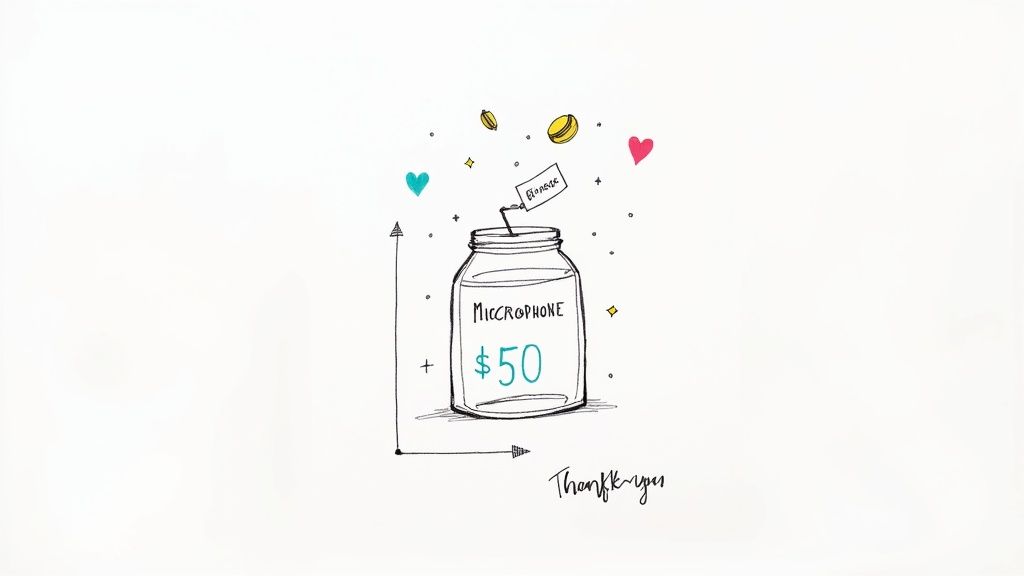
Just dropping a link to your virtual tip jar in the footer is a start, but with a little extra thought, you can genuinely increase the support you receive. The real magic happens when you move past that passive link and start connecting with your readers on a human level, showing them exactly how their contributions make a difference. It's about making tipping feel less like a transaction and more like a team effort.
One of the most powerful ways to do this is to set real, tangible goals and share them. People are far more willing to chip in when they know precisely where their money is going. It shifts the dynamic from a generic donation to a meaningful investment in the newsletter they love.
Make Your Goals Specific and Relatable
Instead of a generic "Support my work," try setting a specific, time-bound goal. This creates a clear sense of purpose and a little bit of urgency that encourages people to act.
Think about framing it like this:
- "Help me raise $50 this month for a new microphone to improve the audio on our podcast episodes."
- "My goal is to cover my $15 Substack Pro fee with tips this month. Your support helps me keep this newsletter 100% independent."
- "I'm saving up for a specific research book that costs $75. Tipping helps me get the resources I need to write more in-depth articles for you."
See the difference? It's a simple change, but it makes each tip feel like it's contributing directly to a concrete improvement. Your readers aren't just sending you five bucks; they're actively helping you buy that microphone or pay for that subscription. That creates a powerful connection to your creative process.
Acknowledge and Appreciate Your Supporters
The other side of this coin is gratitude. It’s absolutely essential. When someone takes the time and money to send you a tip, they’re sending a clear signal: your work matters to them. Acknowledging that gesture validates their decision and makes them feel great about supporting you.
A simple, heartfelt "thank you" can be your most powerful tool. It closes the loop and shows your supporters they are seen and valued, turning a one-time tipper into a long-term advocate for your work.
You don't have to overthink it. A quick, personal thank-you email can go a long way. If you prefer a more public approach, a general shout-out in your next issue works wonders. Something like, "A huge thank you to everyone who contributed this week! We're already halfway to our new microphone goal!"
Showing gratitude also builds social proof. When new readers see that others are tipping, it normalizes the behavior and makes them more likely to join in. For creators juggling different income streams, it's also smart to look into automated payment tracking for newsletters. It helps keep everything organized without the headache, so you can spend your time creating and connecting, not buried in spreadsheets.
A Few Lingering Questions About Tip Jars
Even after you've got everything set up, a few practical questions almost always come up. Let's tackle some of the most common ones that creators run into when they first start accepting tips.
Do I Have to Pay Taxes on Tip Jar Income?
The short answer is yes. In most places, any money you get from a virtual tip jar is considered taxable income. It’s no different than what you’d earn from a freelance project or any other side gig.
The best way to handle this is to treat it as business income. Keep a clear record of every tip that comes in. Tax rules can get tricky, so chatting with a tax professional is always the smartest move to make sure you're doing everything by the book.
How Often Should I Ask for Tips?
This is all about finding a comfortable balance. You don't want to sound like a broken record, but you also need to remind people the option is there. A two-part strategy often works best: one passive, one active.
- The Permanent Link: Stick a simple, no-pressure link in the footer of every newsletter. Something friendly like, "Enjoying the newsletter? You can buy me a coffee" works perfectly.
- The Occasional Ask: Every few months, maybe after a particularly in-depth or popular issue, make a more direct and personal appeal. This is when your readers are feeling the most value and are most likely to contribute.
This approach keeps the tip jar visible without making it the main event of every email.
What if Nobody Tips Me?
First off, take a deep breath. It is completely normal for a tip jar to be quiet at first. It takes time for your audience to warm up to the idea. Tipping is often an impulse, a small "thank you" for a piece of work that really connected with them.
If the tips aren't flowing, don't see it as a failure. See it as feedback. Double down on creating incredible, can't-miss content. The more value people get from your work, the more inclined they'll be to show their appreciation.
Think of it as a long-term play. Keep writing, keep connecting with your readers, and keep that link available. The support will come.
Running a newsletter is a marathon, and juggling sponsors on top of it can feel like a sprint. Instead of getting lost in spreadsheets, let Ad Slots handle your ad operations for you. We automate the invoicing, scheduling, and payment tracking, giving you more time to do what you do best: write. Learn how Ad Slots can save you hours every week.