
Getting paid on time is the lifeblood of any serious newsletter. It’s that simple. When you have a professional system for handling newsletter sponsor payment reminders, you’re doing more than just managing cash flow. You are signaling that you value your work and are building a reputable brand that sponsors can trust.
This isn't just administrative busywork; it's a core part of protecting the value you deliver with every single send.
Why Smart Payment Reminders Are Non-Negotiable
Let's be honest: chasing down invoices is a drag. It is one of the most frustrating parts of being a creator, pulling you away from what you actually love to do, which is writing great content. By setting up a clear, automated reminder process, you do more than just get your money faster; you establish professional expectations right from the start.
When sponsors see you have an organized system in place, their perception shifts. You're no longer just a creator they're trying out. You are a serious business partner. That shift is absolutely crucial for building those long-term, high-value relationships that allow you to command premium rates as you grow.
The Financial Engine of Your Newsletter
Sponsorships are the primary way most newsletters make money these days. In fact, research from the Reuters Institute for the Study of Journalism found that advertising, which includes sponsorships, is the top revenue stream for publishers. One industry survey showed that a massive 67% of newsletter monetization comes directly from ads and sponsorship deals, blowing past subscriptions and affiliate marketing. And it makes sense. Subscribers are 16 times more receptive to an ad in a newsletter they trust than a disruptive banner ad on a random website.
Sponsors know this, and they're willing to pay for direct access to your audience. This makes getting those payments on time the engine that keeps your whole operation running.
Think of it this way: a consistent payment reminder system is your first line of defense against cash flow gaps. It ensures the revenue you have earned actually hits your bank account, so you can reinvest in growth, better tools, and even better content.
Establishing Professional Standards
Having a well-defined reminder process shows you are organized and take your business seriously. It completely removes the awkwardness from following up and replaces it with a predictable, professional workflow.
This clarity is a win-win. Your sponsors know exactly what to expect and when, which helps them manage their own accounts payable process. For you, it means less stress and more predictability. If you want to make sure you get paid promptly, you first have to nail the invoice itself. This freelancer's guide to invoicing is a fantastic resource for crafting invoices that get paid faster.
Ultimately, a smart reminder system isn't about being pushy. It is about creating a reliable operational backbone that builds trust and mutual respect.
Designing Your Reminder Timeline
A good reminder system is not about hounding people for money. It is about building a predictable, professional workflow that communicates respect and keeps your cash flow healthy. Getting the timing and tone right is everything. It ensures you get paid on time without making your sponsor relationships feel awkward.
The process kicks off the moment their ad runs. From there, a series of automated touchpoints takes over, removing the emotion and guesswork from collections. This structure puts you in control and shows sponsors you run a tight ship.
This simple diagram shows how a professional system is the bedrock of a successful newsletter business. It builds trust, which in turn lets you deliver incredible value.
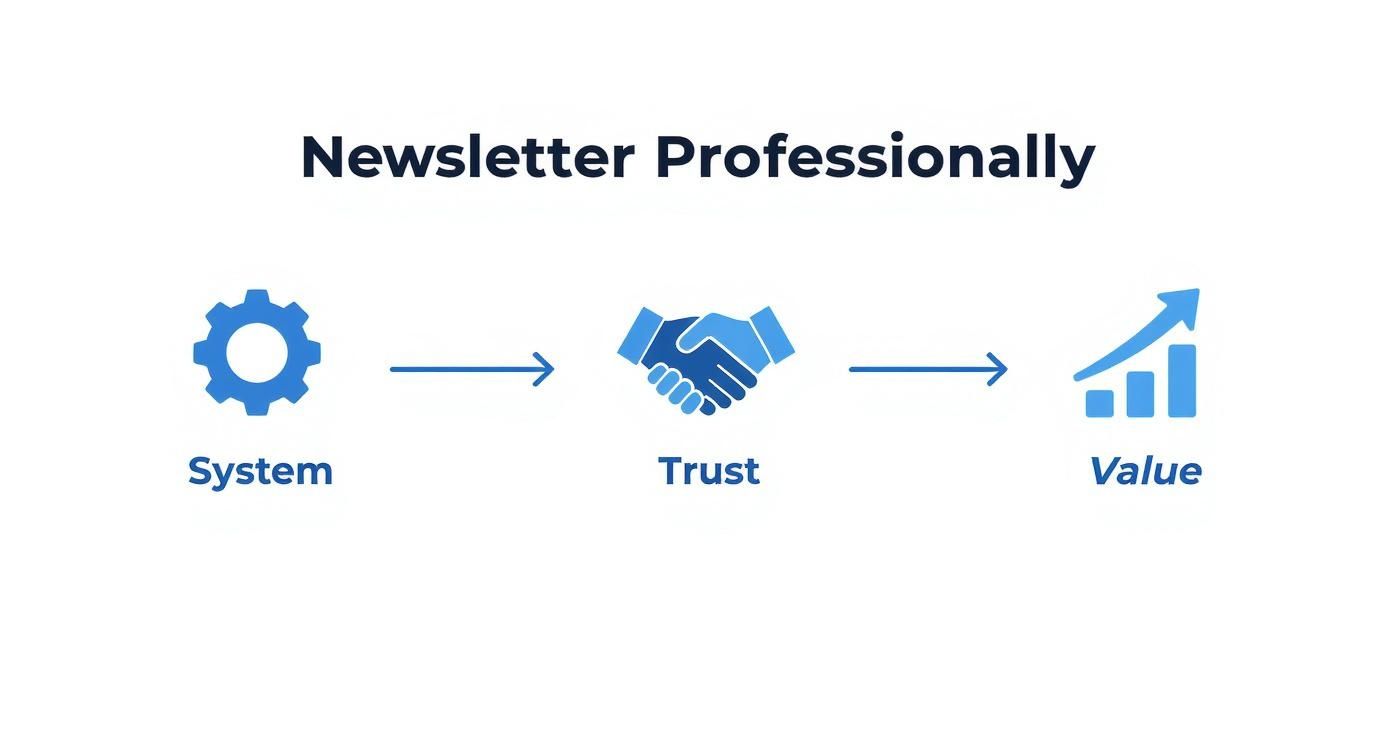
It all starts with a solid system. When sponsors see you are organized, they trust you. That trust is what allows you to prove your newsletter's worth, campaign after campaign.
Below is a proven schedule creators use to keep payments flowing smoothly. This timeline maps out the ideal timing and tone for each message, from the initial invoice to the final follow-up if a payment is late.
A Proven Sponsor Payment Reminder Schedule
| Timing | Message Focus | Recommended Tone |
|---|---|---|
| Day Ad Runs | Invoice Sent | Professional & Prompt |
| 3-5 Days Before Due Date | Gentle Nudge | Friendly & Helpful |
| Day 1 Past Due | First Overdue Notice | Polite & Direct |
| Day 7 Past Due | Second Follow-Up | Firm & Clear |
| Day 14 Past Due | Third Follow-Up | Urgent & Assertive |
| Day 30 Past Due | Final Notice | Serious & Final |
Following a consistent schedule like this one takes the emotion out of the process. You are not "chasing" anyone; you are simply following your standard operating procedure.
Setting the Stage: The Initial Invoice
The best time to send an invoice is right after you have delivered the goods. That means sending it the same day the newsletter with their ad goes live. This immediately connects the payment you are asking for with the value you just provided.
Make sure your invoice is crystal clear and includes:
- A unique invoice number for easy tracking.
- The total amount due with no ambiguity.
- A specific due date. Standard terms like "Net 15" or "Net 30" are common.
- A direct payment link to make it ridiculously easy for them to pay you.
This first step establishes a professional tone and gets the clock ticking on your payment terms. Do not wait a week. Send it while your awesome newsletter is still top of mind.
The Pre-Due Date Nudge
Let's be real: people are busy, and your invoice can easily get buried. A friendly reminder sent three to five days before the due date is a smart, proactive courtesy. It is not a demand; it is a helpful heads-up that can prevent a ton of late payments.
The tone here should be light and helpful. You are just giving them a gentle nudge about an upcoming deadline. This small act shows you are organized and helps your contact on the sponsor’s side look good. It is a key part of building a great working relationship.
Remember, the pre-due date reminder is all about prevention. It is a low-effort, high-impact touchpoint that frames you as a helpful partner, not just another vendor with their hand out.
When the Due Date Arrives
If the due date sails by with no payment, your first "past due" reminder should land in their inbox the very next day. This message is still polite, but the tone shifts from a helpful nudge to a clear, direct notification.
Your email on Day 1 past due should state that the invoice is now overdue and, once again, provide that easy payment link. Do not jump to conclusions. It could be a simple oversight or an issue with their accounting department.
As you map this process out, using a dedicated tool to manage everything becomes a lifesaver. You can see some great options in our guide to finding a newsletter sponsor CRM that works for you. Keeping everything in one place, from your first email to the final payment confirmation, is critical for staying organized and sane.
Writing Reminder Emails That Actually Get You Paid
The words you use in your payment reminders can mean the difference between getting paid on time and getting ghosted. A great reminder email is polite and professional, but it is also impossible to misunderstand. The trick is to be firm and clear without torching a good sponsor relationship.
Your reminders do not need to be long or complicated. In fact, they work best when they are direct. Just give your sponsor everything they need to pay you right away: the invoice number, the amount due, the original due date, and a direct link to pay.
Subject Lines That Get Opened
Let's be honest, your subject line is everything. It has to cut through a mountain of other emails and make its purpose known instantly. Vague subjects like "Following up" or "Checking in" are just begging to be ignored.
Get straight to the point and always include the invoice number. It makes it easy for them to look it up.
Here are a few practical examples that work well at different stages:
- Before it’s due:
Friendly Reminder: Invoice [Number] for [Your Newsletter Name] - The day it's late:
Invoice [Number] is Now Due - A week or more late:
ACTION: Invoice [Number] is Overdue - The final attempt:
FINAL NOTICE: Payment for Invoice [Number] is 30 Days Overdue
See how the tone gets a little more serious each time? A strong subject line is just as important as a killer newsletter headline. If you want more inspiration on writing copy that grabs attention, check out these newsletter headline examples.
Email Templates for Every Situation
Having a few templates ready to go will save you a ton of time and emotional energy. Here are some simple, copy-and-paste examples you can tweak for your own newsletter sponsor payment reminders.
Example 1: The Gentle Nudge (Before the Due Date)
Think of this as a courtesy, not a demand. It is a helpful heads-up that keeps your invoice from getting buried.
Subject: Friendly Reminder: Invoice [Number] Due on [Due Date]
Hi [Sponsor Contact Name],
Hope you're having a great week!
This is just a quick reminder that invoice #[Number] for $[Amount] is due on [Due Date]. You can view and pay the invoice right here:
[Link to Invoice/Payment Page]
Just let me know if you have any questions.
Best,
[Your Name]
Example 2: The First Overdue Notice (1 Day Late)
The tone here shifts from a friendly heads-up to a direct statement. You are not reminding them about a future deadline anymore; you are letting them know they have missed one.
Subject: Invoice [Number] is Now Due
Hi [Sponsor Contact Name],
Following up to let you know that invoice #[Number] for $[Amount], which was due yesterday, is now past due.
I have attached the invoice again for your convenience. You can pay it directly with this link:
[Link to Invoice/Payment Page]
If you have already sent the payment, please feel free to disregard this email.
Thanks,
[Your Name]
Example 3: The Firm Follow-Up (A Week or More Late)
Okay, now the message needs to be a bit firmer. You have to clearly communicate that this needs their attention now.
Subject: ACTION: Invoice [Number] is Overdue
Hi [Sponsor Contact Name],
I'm writing to follow up on invoice #[Number] for $[Amount], which is now one week overdue.
We need to get this payment sorted to close it out on our end. Please make the payment as soon as possible via the link below:
[Link to Invoice/Payment Page]
If there's an issue holding up the payment, please let me know immediately so we can figure it out.
Thank you,
[Your Name]
Using clear, professional templates like these helps you manage collections systematically without blowing up valuable partnerships. It is all about consistency and clarity.
Picking the Right Tools for the Job
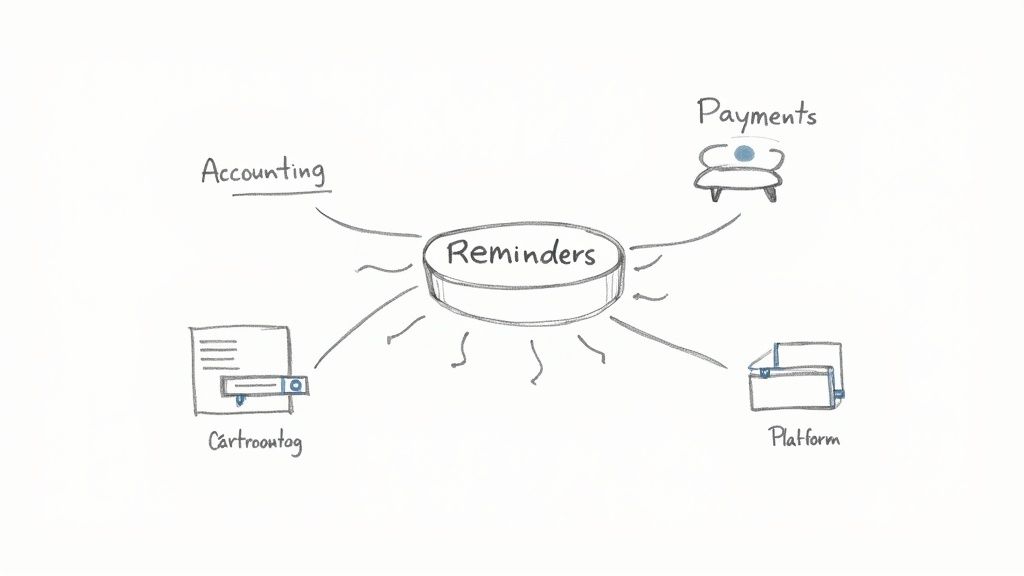
Let’s be honest: chasing down invoices is a huge time suck. It pulls you away from what you actually want to be doing, which is creating great content. The right toolkit for your newsletter sponsor payment reminders can give you back those hours. It builds a system that works quietly in the background so you get paid without the constant nagging.
There are a few different ways to tackle this. The best fit depends on your current workflow, budget, and how tech-savvy you feel.
Classic Accounting Software
Tools like QuickBooks or FreshBooks are the old guard for a reason. They are powerhouses when it comes to invoicing and have solid, built-in features for sending automated payment reminders.
You can easily set up a sequence to ping sponsors when an invoice is coming due or is already late. A common setup that works well is a three-part reminder: one email three days before the due date, another on the day it's due, and a final, firmer nudge seven days after. If you are already running your business finances through one of these platforms, this is the most logical place to start.
Standalone Payment Processors
If your main goal is just to get paid and handle the occasional follow-up, a dedicated processor like Stripe is a fantastic choice. Stripe Invoicing is built to automatically chase down unpaid invoices for you.
One of its best features is how it handles failed payments. For instance, if a sponsor’s card gets declined, Stripe automatically lets them know they need to update their info. This solves a common and awkward problem before you even know it exists.
The real magic of automation is its consistency. A machine never forgets to follow up and does not feel weird about asking for money. It just runs the plays you have designed, which shows sponsors you are professional and have your act together.
All-in-One Newsletter Platforms
For the most streamlined experience, many creators are now using newsletter platforms with sponsorship management baked right in. Tools like beehiiv or SparkLoop let you manage ad sales, invoicing, and payment reminders all from one dashboard.
These integrated systems are built from the ground up for newsletter operators. They get that managing sponsorships isn't just about sending an invoice. It is about the entire lifecycle, from booking the ad to proving its value. To get a complete picture of setting this up, it is worth learning more about automating invoice processing from A to Z.
Keeping your revenue on track is crucial, especially when you consider that audience churn can hit 20-30% annually. This means you are in a constant state of growth just to keep your numbers steady for sponsors. An automated payment system helps you look and feel more professional as you scale.
Ultimately, the best tool is the one that fits your business.
Dealing with Overdue Payments and Difficult Sponsors
https://www.youtube.com/embed/wuOgqUhYyto
Even with a perfect automation setup, late payments are going to happen. It is just a reality of doing business. Maybe the sponsor’s accounting contact is on vacation, their system had a hiccup, or they are simply swamped.
When your automated newsletter sponsor payment reminders fall on deaf ears, you need to shift gears. The goal is to get paid without torching the relationship. Having a clear, professional game plan for what to do next is everything.
Knowing When to Pick Up the Phone
If an invoice is more than two weeks late and your last couple of automated emails have gone unanswered, it is time to make a call. Emails are passive and incredibly easy to ignore, file away, or genuinely miss. A phone call is not so much. It adds a human touch and is much harder to brush aside.
This is not about being confrontational. You are just a person trying to understand what is going on.
- Start friendly. Introduce yourself and mention the specific invoice you are calling about.
- Keep it simple and polite. State that the invoice is overdue and you just wanted to check in.
- Ask if there is a problem on their end that is holding things up.
Most of the time, you will discover it was a simple oversight. The call cuts through the digital noise and gets you a straight answer, and usually, a commitment to pay.
Don't Be Afraid to Pause Future Campaigns
What if a sponsor is 30 days late but has more ads booked with you? You have to protect your business. It is completely fair and professional to put a hold on all upcoming work until the outstanding balance is cleared.
You will need to send an email that is polite but unmistakably firm.
Subject: Action Required: Your upcoming campaign is on hold (Invoice #[Number])
Hi [Sponsor Contact Name],
I am writing to let you know that we have had to pause your ad placement scheduled for [Date]. This is because invoice #[Number] is now more than 30 days past its due date.
We would be happy to get your campaign rescheduled for the next available spot as soon as the outstanding balance of $[Amount] is settled.
Please let me know if you have any questions.
Best,
[Your Name]
This simple action does two things: it protects you from doing more work without pay, and it clearly communicates that you have professional boundaries.
The Last Resort: Collections
When an invoice creeps into the 60 or 90-day overdue territory and you have gotten nothing but silence, the relationship is probably on shaky ground anyway. At this point, your primary focus has to shift from nurturing the partnership to collecting what you are owed.
Whether it is worth the fight often depends on the amount. Newsletter sponsorship payments can be anywhere from $50 for a small publication to over $3,000 for a mid-sized one, so a non-payment can be a serious financial hit. It helps to understand how these costs are calculated to see what is really at stake.
Before bringing in outside help, send one final notice via certified mail. This makes it official. The letter should detail the invoice, the total amount due (including any late fees you have specified in your contract), and a final payment deadline. This signals you are serious and prepared for the next step.
If that does not work, your final options are small claims court or a collection agency. Throughout this whole process, document everything. This includes every email, every call log, and every letter. That paper trail is your best friend if things escalate.
Common Questions About Sponsor Payments
Even the best automated reminder system will not solve every payment snag. As a creator, you are bound to run into a few tricky situations with sponsors. Let's walk through the most common questions, with some straightforward advice to help you manage your sponsorships like a pro.
What Should My Sponsorship Contract Include?
Think of your contract as your first and best line of defense against payment headaches. Before a single ad ever goes live, you need a signed agreement that spells everything out. This is not just a formality; it is a critical business tool that protects you and sets crystal-clear expectations.
Here is what it absolutely must have:
- Specific Payment Terms: Do not be vague. Instead of "payment is due," use industry-standard terms like "Net 15," "Net 30," or "Due on Receipt." This leaves no room for interpretation.
- A Late Fee Policy: A simple clause stating that a "1.5% monthly fee applies to all overdue balances" can work wonders. It is a gentle but firm nudge that encourages sponsors to pay on time.
- A Pause Clause: You need a bit of leverage. Include a line that lets you pause all future campaigns if an invoice is more than 30 days late. This lets you press the issue without immediately burning the bridge.
- Accepted Payment Methods: Clearly list how sponsors can pay you, whether it is through Stripe, bank transfer, or another platform. This preemptively answers a common question and avoids delays.
Getting these terms in writing and signed before you start gives you a solid foundation to stand on if you ever need to have a tough conversation.
Should I Ask for Payment Upfront?
One hundred percent, yes. For any new sponsor or for a one-off campaign, requiring 100% payment upfront is the smartest and safest way to go. It completely sidesteps the whole collections game and keeps your cash flow healthy. This is standard practice, so do not feel shy about it.
For your bigger, long-term partners, the ones you have a great relationship with, you can be more flexible. A 50% deposit to lock in their ad slots, with the rest due when the newsletter sends, is a great middle ground. Once you have built up a history of on-time payments, you can extend trust by offering Net 15 or Net 30 terms. Always start with payment upfront for new partners.
How Do I Handle a Good Sponsor Who Pays Late?
This one is tricky because you want to keep the relationship intact. It calls for a direct but friendly conversation. An email is too easy to ignore, so picking up the phone is often the best approach.
Start by saying how much you value the partnership, then explain that the consistent delays are starting to impact your business operations.
I have found that most of the time, the sponsor is not trying to be difficult. The person you are working with might not even know their accounting department is slow. The problem is usually a clunky internal process on their end.
Offer a simple fix. Suggest setting them up on a recurring auto-pay schedule with a credit card to make it easier for everyone. If the problem continues, you might have to politely explain that you will need to move them to a 100% upfront payment model going forward. It is all about finding a practical path forward that respects both your businesses.
Running a newsletter is a ton of work, and the last thing you need is to spend your days chasing down invoices. Ad Slots automates the entire sponsorship process, from booking and scheduling to invoicing and payment reminders. Stop wrestling with spreadsheets and get back to what you do best: creating great content. Find out how much time you could save.