
Forget about wrestling with complicated ad platforms or trying to outsmart social media algorithms. For local businesses, newsletter ads are a direct line to an engaged community. This is a simple, personal, and surprisingly affordable way to cut through all the digital noise.
An ad in your newsletter lands right in the inboxes of people who actually want to be there.
Why Your Newsletter Is a Lifeline for Local Businesses

Most local businesses are just trying to get noticed. They're often priced out of traditional advertising and feel like they’re shouting into the void on crowded social media feeds.
This is exactly where you come in.
You've built something incredibly valuable: a direct connection with a local audience that knows, likes, and trusts you. That relationship is the most powerful thing you can offer a neighborhood shop or restaurant.
A Big Shift in Local Advertising
The way local businesses spend their ad money is changing, and it's changing in your favor. Data from BIA Advisory Services shows U.S. local advertising revenue is projected to hit $175.6 billion.
Here is the important part: while overall spending has shifted, the digital piece of that pie is growing. Businesses are actively moving their budgets online, looking for channels just like yours that deliver real, measurable results.
What does this mean for you? Your newsletter isn't just a side project. It's a premium piece of advertising real estate that solves a real problem for local businesses.
For a local business, an ad in your newsletter feels less like a cold interruption and more like a warm recommendation from a trusted friend. That personal touch is something big ad platforms can never replicate.
What You're Really Selling Them
When you talk to a local business owner, you're not just selling them space in an email. You're offering a solution to some of their biggest marketing headaches.
Here’s why your newsletter is such an easy sell:
- A Hyper-Targeted Audience: You offer them direct access to people in their own backyard. These are potential customers who can actually walk through their door.
- Real Engagement: Let’s be real, newsletter open rates blow most social media engagement out of the water. An ad in an email gets seen, not lost in an endless scroll. A study by Mailchimp shows the average email open rate across industries is around 21%, which is significantly higher visibility than a typical social media post receives.
- It's Cost-Effective: Compared to a local radio spot or a print ad, sponsoring your newsletter is a much more affordable way for them to get started, with results they can actually track.
- Borrowed Trust: When a business shows up in your newsletter, they instantly benefit from the trust you’ve worked so hard to build with your readers.
And if you really want to stand out, get familiar with broader email marketing strategies for small businesses. When you can offer smart advice, you stop being just another person selling ads and become a true partner in their success.
Finding and Pitching the Right Local Partners
Alright, you know what you’re offering. Now comes the fun part: finding the right businesses to partner with and creating a pitch that actually gets a response. The key here isn't to shotgun-blast every local business with a generic email. Instead, you want to be a matchmaker, connecting businesses with the local customers who are already reading and trusting your newsletter.
Think about who reads your stuff. Where do they hang out? Where do they spend their money? If your newsletter is all about the best local hiking trails, a running store or a new outdoor gear shop is a natural fit. If you cover family-friendly weekend events, a local toy store or even a pediatric dentist makes perfect sense.
Identifying the Best Potential Sponsors
Before you write a single email, you need to do a little homework. The best potential sponsors are usually hiding in plain sight.
I always start by looking at who’s already in my orbit. Scroll through your social media followers and even your newsletter subscriber list. Do any local businesses pop up? These are your warmest leads by far because they already get what you do.
From there, you’re looking for businesses that just feel right. A good ad should feel like a genuine recommendation from a friend, not some random, jarring interruption in your content.
Here are a few goldmines for finding potential partners:
- Community Event Sponsors: Take a look at the sponsors for local festivals, farmers' markets, or that annual 5K run. These businesses have already bought into local marketing and are actively spending money to reach people in your town.
- Your Competitors' Advertisers: Who’s advertising in other local blogs, community magazines, or neighborhood podcasts? That list is a pre-qualified lead sheet of businesses already sold on the power of local media.
- Local Business Directories: Don't sleep on your local Chamber of Commerce site or other business associations. This is a great way to find newer businesses that are hungry to get their name out there.
Crafting a Pitch That Gets a Reply
Once you’ve got a solid list, it’s time to reach out. Your first email needs to be short, personal, and focused on their business, not yours. Local business owners are slammed. A wall of text is a one-way ticket to the trash folder.
Keep it brief. Introduce yourself, say something specific and genuine about their business, and draw a quick, clear line between your audience and their ideal customer.
The best pitch you can make doesn't sell ad space; it sells a solution. You’re offering them a direct line to local customers who are ready to buy. Show them you've thought about their goals before you even whisper a price.
Your subject line is everything. It’s your first impression, so make it count. Something like "Partnership idea for [Business Name]?" or "Connecting you with [Your City] locals" cuts through the noise way better than "Advertising Opportunity."
Getting this email right can feel a bit tricky. If you want a head start, you can check out some proven newsletter sponsor outreach email templates to see what works in different scenarios. Just promise me you'll personalize it. No one likes a copy-paste job.
Finally, don't be shy about following up. People get busy and emails get buried. A simple, polite "Just bumping this up in your inbox" a week later can make all the difference. Polite persistence shows you’re a professional, not just a spammer.
How to Package and Price Your Ad Slots
So, you've got a local business on the hook. Great! Now comes the moment of truth when they ask, "What can I get, and how much does it cost?"
Your answer here needs to be simple, clear, and confident. If your pricing is messy or your packages are confusing, you risk scaring away a great partner before you even get started.
Let's get your ad offerings dialed in.
Keep It Simple: Flat-Rate Pricing is Your Best Friend
First things first, forget about complex models like CPM (cost per thousand impressions). While it’s standard in the big leagues of digital media, it’s just confusing jargon to a local coffee shop owner. They think in terms of customers in the door, not abstract metrics.
Instead, stick with a flat-rate pricing model. It’s wonderfully straightforward.
You sell a specific ad spot for a fixed price per issue. That's it. The business knows exactly what they’re paying and what they’re getting. No mystery, no complicated math.
Structuring Your Ad Packages
You'll want to offer a few different ad types to give businesses some options. Think of it like a restaurant menu. A few well-chosen items are always better than a dozen mediocre ones.
Here are three popular ad formats that work incredibly well for local newsletters:
- Main Sponsorship: This is your prime real estate. Think of it as the "presenting sponsor." The business gets top billing, usually right at the beginning of your newsletter, with their logo, a quick blurb, and a clear call to action. It’s the most visible and valuable slot you have.
- Sponsored Content (or a Feature): This format is much more integrated into your content. You might write a short piece spotlighting the business, making it feel less like a traditional ad and more like a genuine recommendation. This approach builds a ton of trust with your readers. For example, a newsletter about local food could feature a new bakery, telling the story of the owner and their signature croissant.
- Classifieds Section: This is a fantastic entry-level option. At the bottom of your newsletter, you can sell small, text-based ads or listings. It's the perfect, low-risk choice for smaller businesses on a tight budget, like a local plumber or a new yoga instructor.
Building a good pitch isn't a one-and-done deal; it's a process.
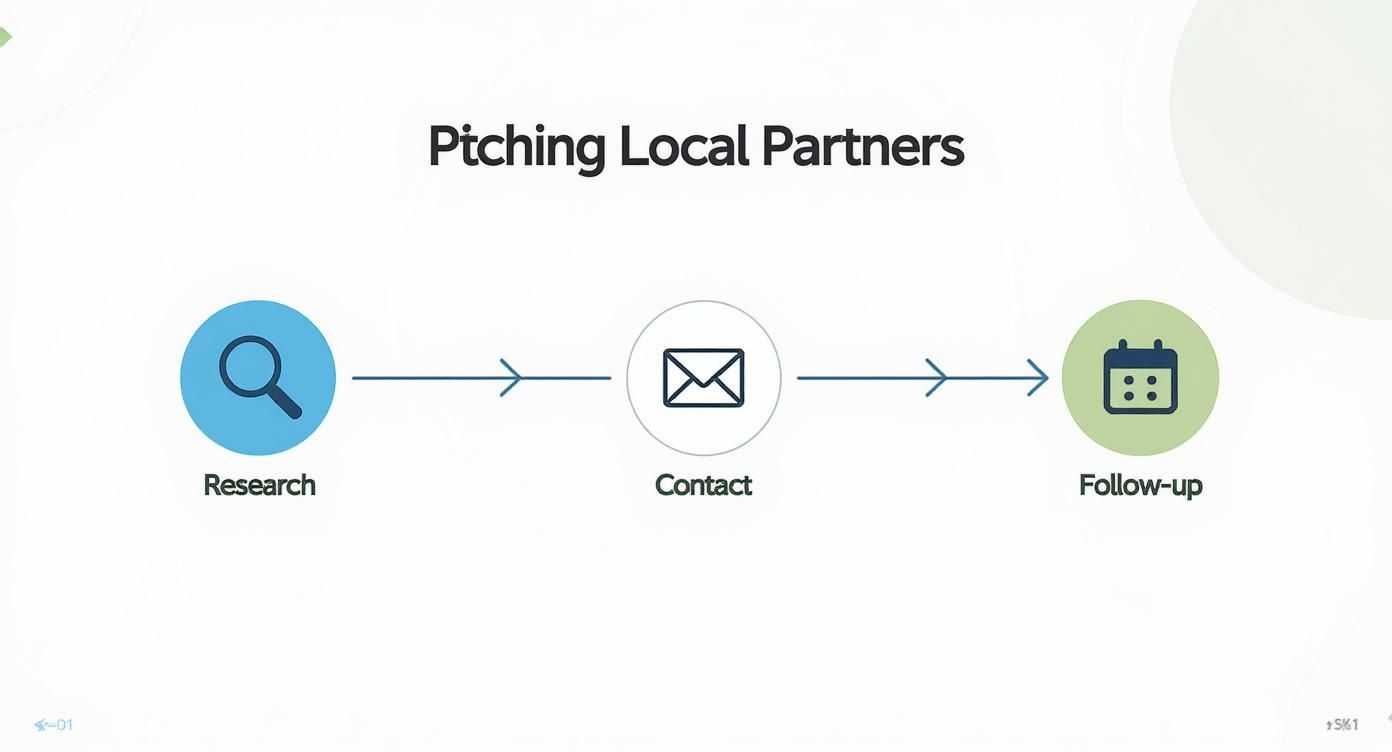
As you can see, a successful partnership starts with solid research and really depends on consistent, professional follow-up to get the deal across the finish line.
Setting Your Rates with Confidence
Pricing can feel like the trickiest part, but it doesn't have to be a guessing game. Start with a rate that feels fair for the value you're providing. And remember, you're offering direct access to a highly targeted local audience. That’s incredibly valuable.
A good way to find your baseline is to look at your subscriber count and engagement metrics. A newsletter with 1,000 super-engaged local subscribers is often more valuable and can charge more than one with 3,000 readers who barely open the emails.
Don't undervalue your work. Your price signals your worth. Setting rates that reflect the trust you’ve built with your audience makes you a more attractive partner for serious businesses.
To give you a starting point, here are some sample pricing tiers. These are just examples, of course, so you’ll want to adjust them based on your specific audience, engagement, and local market.
Sample Newsletter Ad Pricing Tiers
This table outlines potential pricing based on newsletter size and average open rates. Use it as a guide to help benchmark your own rates for different ad formats.
| Newsletter Size (Subscribers) | Avg. Open Rate | Main Sponsorship (Per Issue) | Classified Ad (Per Issue) | Dedicated Email (One-time Send) |
|---|---|---|---|---|
| 1,000 – 2,500 | 45% | $75 – $150 | $25 – $50 | $250 – $500 |
| 2,501 – 5,000 | 40% | $150 – $300 | $50 – $100 | $500 – $900 |
| 5,001 – 10,000 | 35% | $300 – $600 | $100 – $200 | $900 – $1,500 |
These numbers can help you frame your value. If you need a more tailored estimate, this free newsletter ad pricing calculator is a handy tool for getting a more precise number.
Finally, pull all of this information together into a simple, one-page media kit. It should briefly describe your newsletter, your audience, your ad options, and your pricing. A clean, professional media kit instantly shows potential partners that you mean business.
Creating a Smooth Onboarding and Ad Management Process
Getting a local business to say "yes" to an ad is a huge win. But honestly, that's where the real work begins. A clunky, disorganized process can quickly sour the relationship, turning an excited new sponsor into a one-time buyer. A smooth experience, on the other hand, builds serious trust and keeps them coming back.
Think of your onboarding as the welcome mat for your new advertiser. Your job is to make it incredibly easy for them to give you their ad materials and their money. A great process signals that you're a professional who has their act together, not just a hobbyist dabbling in ads.
If you want to keep sponsors for the long haul, it’s worth taking a look at ways to improve your client onboarding process. The main goal is to remove any friction and set crystal-clear expectations right from the start.
Your Step-by-Step Onboarding Checklist
The moment you get that verbal "yes," it's go-time. Having a consistent checklist ensures you never forget a crucial step and gives every advertiser the same professional, high-quality experience.
This isn't about creating more work for yourself. It’s about creating clarity and a system you can rely on. A simple, repeatable process is your best defense against chaos, especially as you start selling more newsletter ads to local businesses.
Here's a simple flow that works wonders:
- Send the Invoice Immediately. Don't delay. Get a professional-looking invoice over to them right away using a tool like Stripe or PayPal. This makes the deal feel official and gets the payment process rolling.
- Request Ad Materials (The "Creative"). In that same email, be super specific about what you need. List the exact image dimensions, character limits for text, and the destination URL. Give them a firm but friendly deadline to get it all back to you.
- Confirm and Schedule the Ad. As soon as payment comes through and you have their creative, send a quick confirmation email. Let them know the exact date(s) their ad is scheduled to run. This little step provides a ton of peace of mind for the advertiser.
- Send a Final Preview. Right before the newsletter goes live, send them a screenshot of their ad exactly as it will appear. This final check is great for catching last-minute typos and shows you’re committed to getting it right.
Tools to Keep Things Running Smoothly
When you're just starting, a simple spreadsheet might seem like enough to track one or two advertisers. But trust me, that system falls apart fast. Manual tracking is a recipe for missed deadlines, forgotten invoices, and a whole lot of stress you don't need.
A professional process is your most underrated sales tool. When a local business has a great experience working with you, they become your best source for referrals and repeat business.
This is where investing in the right tools can make a world of difference. As you grow, managing everything from a central hub becomes a necessity. Using a dedicated newsletter sponsor CRM can put so much of this on autopilot, from booking ad slots on a calendar to tracking payments and making sure creative is submitted on time.
Automating the admin work frees you up to focus on what actually moves the needle: creating great content and building real relationships with your local partners. It transforms your ad operations from a constant headache into a well-oiled machine.
Proving Your Value to Secure Repeat Business
It feels great to land a new advertiser, right? But the real win is turning them into a long-term partner. That's how you build a sustainable newsletter business.
The secret to getting that second sale is proving the first one worked. It all comes down to showing the advertiser in simple, clear terms that their investment paid off. You don't need a fancy analytics dashboard. Your job is to tell a clear success story with a few key numbers to back it up. This simple follow-up turns a one-off transaction into a real partnership.
Tracking the Metrics That Actually Matter
Local business owners are juggling a million things. They don't have time for vanity metrics like "impressions." They want to know one thing: did the ad bring in business? So, your report needs to focus on the numbers that connect directly to their bottom line.
Here are a few of the most effective ways to track performance for local ads:
- UTM Parameters: These are just little snippets of code you tack onto the end of a URL. They’re super easy to create with Google's Campaign URL Builder and let you see exactly how many people clicked the advertiser's link from your newsletter. No guesswork.
- Unique Discount Codes: This is my personal favorite because it’s so simple and powerful. Just create a special code for your readers, like "MAINSTR15" for the local pizza joint. The number of times that code gets used is hard, undeniable proof of your ad's impact.
- Dedicated Landing Pages: If you're running a bigger campaign, the advertiser might set up a special page on their website just for your readers. Tracking visits to that page gives you a crystal-clear picture of the traffic you sent their way.
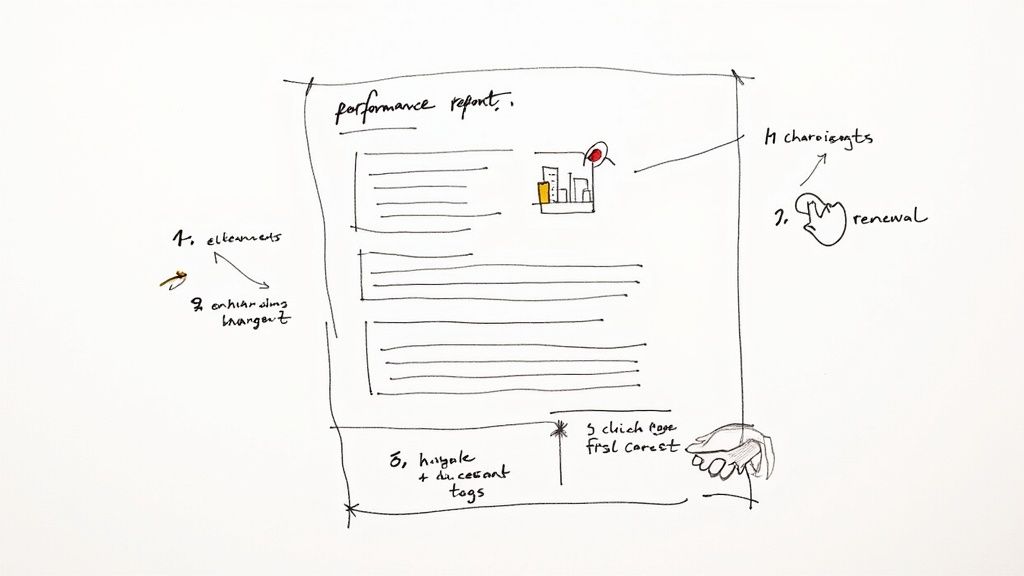
Creating a Simple, Powerful Performance Report
When you send your end-of-campaign report, remember your audience. A busy restaurant owner shouldn't need a marketing degree to understand it. Keep it clean, concise, and straight to the point.
Your report only needs a few key things:
- Ad Snapshot: A simple screenshot of the ad as it appeared in your newsletter.
- Key Metrics: Clearly list the total clicks and any conversions you tracked, like how many times the discount code was used.
- Audience Context: Remind them of the total subscribers the ad reached and that issue's open rate.
For instance, your summary could be as simple as: "Your ad was sent to 2,150 subscribers in an issue with a 48% open rate. It drove 92 clicks to your website, and your special discount code was used 14 times."
The goal of your report isn't just to dump data on them; it's to start a conversation. Use the positive results as a natural lead-in to ask, "This worked out great. Are you interested in booking another spot for next month?"
Sometimes, connecting the dots to the actual return on investment can be tricky. You can use our free newsletter ad ROI calculator to help advertisers visualize the tangible return they got from their ad spend.
This kind of transparent, results-focused approach builds an incredible amount of trust. It shows you're a true partner invested in their success, making their decision to run another ad an easy one.
Answering the Tough Questions About Selling Newsletter Ads
Once you start selling ad space in your newsletter, you're bound to run into a few tricky situations. It’s just part of the game. Let's walk through some of the most common questions and how to handle them like a pro.
Getting these scenarios straight in your head before they happen will give you the confidence to manage any advertiser relationship.
What If an Ad Doesn't Perform Well?
It’s not a matter of if, but when. Sooner or later, an ad just won't land the way you or the advertiser hoped. The real test is how you respond.
Don't hide from it. Get in front of the issue by reaching out with the performance report first. Be transparent about the numbers and then immediately pivot the conversation toward finding a solution together. Was the call to action weak? Maybe the offer wasn't quite right for your audience.
A great way to handle this is by offering to workshop a new ad with them for a future issue, maybe even at a slight discount. This simple gesture can turn a potential disappointment into a show of good faith. It proves you're a real partner invested in their success, not just another vendor.
How Do I Handle Ad Approvals?
A clear, buttoned-up approval process is your best friend. It saves you from those frantic, last-minute emails that can throw your entire publishing schedule into chaos.
Here's a simple, professional system: send a preview of the ad exactly as it will appear in the newsletter at least 24-48 hours before you plan to hit "send."
This gives the advertiser a defined window to spot a typo or ask for a quick link change. It also sets a firm but fair boundary. By making it clear that changes requested after that deadline might not make it in, you protect your own time and keep things running smoothly.
Your process defines your professionalism. A clear, consistent system for approvals, payments, and reporting tells advertisers you're serious about your business, which makes them more comfortable investing with you.
What’s the Best Way to Take Payments?
You need a payment process that is simple, professional, and friction-free. Chasing down checks or sorting through messy email chains is a massive time-waster.
Using a trusted online payment processor is really a must. The two most common options for newsletter creators are:
- Stripe: Fantastic for creating clean, professional invoices that advertisers can easily pay with a credit card.
- PayPal: It's a household name, so most small business owners already know and trust it, making it a safe bet.
As soon as an advertiser agrees to a placement, send the invoice. This formalizes the deal and gets the ball rolling. Requiring payment before the ad runs is standard practice, and it’s the best way to make sure you get paid for your work without any hassle.
Juggling all these moving parts from outreach and invoicing to scheduling and reporting can quickly feel overwhelming. With AdSlots, you can put the entire sales process on autopilot. Our platform is built to handle the administrative chaos, freeing you up to focus on what you do best: writing great content and building relationships with local businesses. Streamline your newsletter ads today.